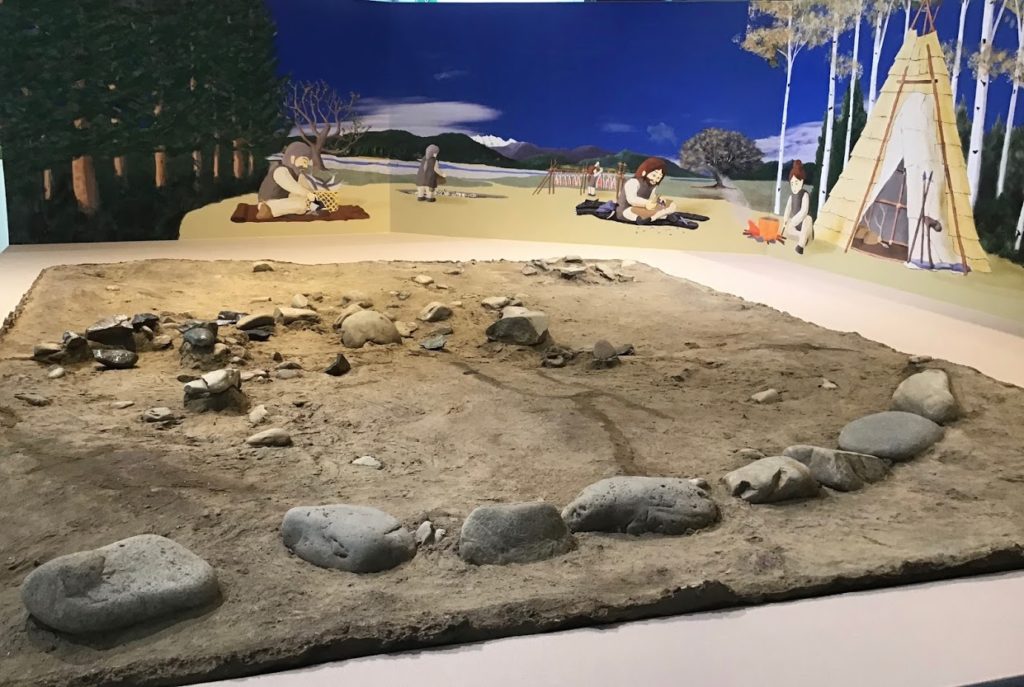
Field trip to the Tabata Stone Circle in Machida, Tokyo

A mid-Jomon stone circle dating to 3,500~2,800 years BP.

Some pottery finds were excavated on site(see photo above), as well as pit graves(see photo below).

Stone-lined graves

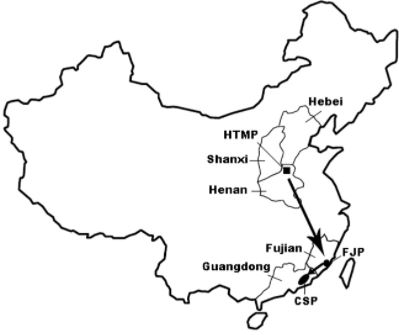
The tallest stones are smaller than the height of a man.  They resemble the stone circle in the Shaanxi area of China, rather than those of the Central Asian steppelands.

The sun can be seen setting over the peak of Mt. Hirugatake (1673 m.) on the Winter Solstice day, and which can be viewed from the line up of pillars in the stone circle. ‘Hiru’ means ‘daytime’, a cognate for which is ‘sun’.


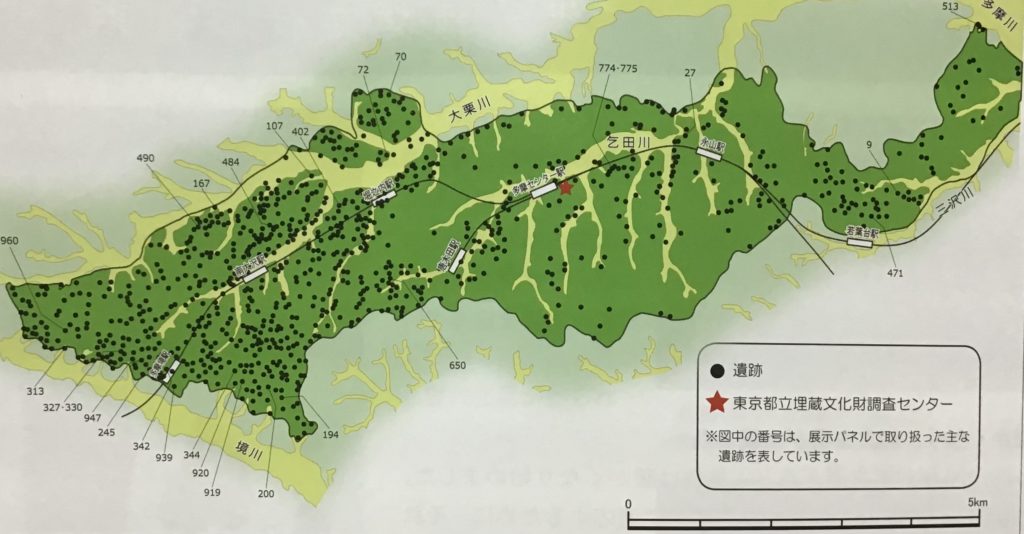
To visit the site, follow the access map and see address below:

Chibi 3112-2 Oyama-chou, Machida city, Tokyo 194-0212
【住所】東京都町田市小山町3112-2及び3113-2
【地図】 see Google Map location page [A 5 minute walk from Tamasakai eiki/station

***

More information and further reading from our website:

Secrets of the Stone Circles

Oshoro circle in the news

In addition to the above, a listing of stone circles around Japan can be found at the Megalithic.co.uk website’s page.

2011 study: Dogs were first domesticated in the southern part of East Asia (South of Yangtze River)

Below is an excerpt from the abstract of the latest genetics study “Origins of domestic dog in Southern East Asia is supported by analysis of Y-chromosome DNA“ suggesting that the possible place where the dog was domesticated was in the region south of the Yangtze River.

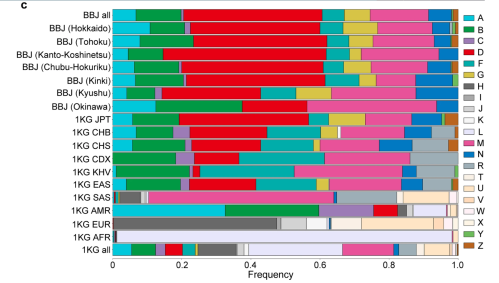
Figure 1  is particularly interesting as it suggests that the domestic dog in Japan is a mixture of two types, originating from the Middle East-through-Western Asian (Yunnan-Tibet) belt and also from the Southeast Asian regions, which would correspond closely to the dual structure theory of Japanese origins (and distribution of Jomon genes (haplogroups D and YAP+ (Y-DNA) and M7(mtDNA) vs. Yayoi or post-Yayoi-and-Kofun eras (haplogroups O2b/O3)

Map showing phylogenetic and geographical distribution of dog haplotypes (adapted from Table 1)

Origins of domestic dog in Southern East Asia is supported by analysis of Y-chromosome DNA

Z-L Ding et al., Heredity advance online publication 23 November 2011; doi: 10.1038/hdy.2011.114

Global mitochondrial DNA (mtDNA) data indicates that the dog originates from domestication of wolf in Asia South of Yangtze River (ASY), with minor genetic contributions from dog–wolf hybridisation elsewhere.

Two haplogroups were universally shared and included three haplotypes carried by 46% of all dogs, but two other haplogroups were primarily restricted to East Asia. Highest genetic diversity and virtually complete phylogenetic coverage was found within ASY. The 151 dogs were estimated to originate from 13–24 wolf founders, but there was no indication of post-domestication dog–wolf hybridisations. Thus, Y-chromosome and mtDNA data give strikingly similar pictures of dog phylogeography, most importantly that roughly 50% of the gene pools are shared universally but only ASY has nearly the full range of genetic diversity, such that the gene pools in all other regions may derive from ASY. This corroborates that ASY was the principal, and possibly sole region of wolf domestication, that a large number of wolves were domesticated, and that subsequent dog–wolf hybridisation contributed modestly to the dog gene pool.

NB: The abstract also notes that “there is yet no consensus concerning in which geographical region the domestication of wolf occurred. Studies of mitochondrial DNA (mtDNA) from dogs worldwide have strongly indicated the southern part of East Asia (dubbed Asia South of Yangtze River, ASY) (Savolainen et al., 2002Pang et al., 2009Klütsch and Savolainen, 2011). Archaeological data has instead indicated an origin from Europe or Southwest (SW) Asia or from multiple regions (Clutton-Brock, 1995), and a recent study of autosomal single nucleotide polymorphism (SNP) data suggested SW Asia as the major source of genetic diversity for dogs (Vonholdt et al., 2010). However, both the archaeological- and the autosomal-SNP datasets suffer from geographical bias, in that they almost totally lack data from ASY (Klütsch and Savolainen, 2011).”

***

See also earlier references and source readings:

Excerpts from a NY Times article highlighted the findings of research that concluded that dogs were first domesticated about 15,000 years ago  in the Middle East. This article’s findings contradicted initial conclusions of early research that found that dogs were first domesticated in the East Asia.

New Finding Puts Origins of Dogs in Middle East By Nicholas Wade (NY Times March 17, 2010)

“Borrowing methods developed to study the genetics of human disease, researchers have concluded that dogs were probably first domesticated from wolves somewhere in the Middle East, in contrast to an earlier survey suggesting dogs originated in East Asia.

A research team led by Bridgett M. vonHoldt and Robert K. Wayne of the University of California, Los Angeles, has analyzed a large collection of wolf and dog genomes from around the world. Scanning for similar runs of DNA, the researchers found that the Middle East was where wolf and dog genomes were most similar, although there was another area of overlap between East Asian wolves and dogs. Wolves were probably first domesticated in the Middle East, but after dogs had spread to East Asia there was a crossbreeding that injected more wolf genes into the dog genome, the researchers conclude in Thursday’s issue of the journal Nature.

The archaeological evidence supports this idea, since some of the earliest dog remains have been found in the Middle East, dating from 12,000 years ago. The only earlier doglike remains occur in Belgium, at a site 31,000 years old, and in western Russia from 15,000 years ago. Several thousand years later, in the first settled communities that began to appear in the Middle East 15,000 years ago, people began intervening in the breeding patterns of their camp followers, turning them into the first proto-dogs. One of the features they selected was small size, continuing the downsizing of the wolf body plan. “I think a long history such as that would explain how a large carnivore, which can eat you, eventually became stably incorporated in human society,” Dr. Wayne said.

Dr. Wayne was surprised to find that all the herding dogs grouped together, as did all the sight hounds and the scent hounds, making a perfect match between dogs’ various functions and the branches on the genetic tree. “I thought there would be many ways to build a herding dog and that they’d come from all over the tree, but there are not,” Dr. Wayne said.

An earlier survey of dog origins, based on a small genetic element known as mitochondrial DNA, concluded that dogs had been domesticated, probably just once, in East Asia. The author of the survey, Peter Savolainen of the Royal Institute of Technology in Stockholm, said he was not convinced by the new report for several reasons, including that it did not sample dogs in East Asia from south of the Yangtze, the region where the diversity of mitochondrial DNA is highest. Also archaeologists in China have been less interested in distinguishing dog and wolf remains, he said.

Two other experts on dog genetics, Carlos Driscoll and Stephen O’Brien, of the National Cancer Institute, said they believed that Dr. Wayne’s team had made a convincing case. “I think they have nailed the locale of dog domestication to the Middle East,” Dr. O’Brien said in an e-mail message from Siberia, where he is attending a tiger management workshop.

Dog domestication and human settlement occurred at the same time, some 15,000 years ago, raising the possibility that dogs may have had a complex impact on the structure of human society. Dogs could have been the sentries that let hunter gatherers settle without fear of surprise attack. They may also have been the first major item of inherited wealth, preceding cattle, and so could have laid the foundations for the gradations of wealth and social hierarchy that differentiated settled groups from the egalitarianism of their hunter-gatherer predecessors. Notions of inheritance and ownership, Dr. Driscoll said, may have been prompted by the first dogs to permeate human society, laying an unexpected track from wolf to wealth.”

***

Further reading and source links:

MtDNA data indicates a single origin for dogs south of Yangtze River, less than 16,300 years ago, from numerous wolves, Molecular Biology and Evolution, doi:10.1093/molbev/msp19

Dogs were probably domesticated in the Near East rather the East Asia (Dienekes’ Anthropology pub. date Mar 18, 2010 - retr. Feb 5, 2011)

Wolves were domesticated in southeast Asia (Past Horizon Blog)

Dogs First Tamed in China — To Be Food? (National Geographic News)

In the news: Remains of historic 6th century Iware Pond uncovered in Nara

Site excavated in Nara may be remains of pond mentioned in ancient history records (Mainichi Japan) December 16, 2011

The cross-section of a mound used as an embankment of a pond is pictured in Kashihara, Nara Prefecture, on Dec. 5, 2011. The white poles in the rear of the photo show where a large building used to be located. (Mainichi)

KASHIHARA, Nara — The remains of what is believed to be part of a pond described in ancient history and poetry books have been found here, city authorities have announced.

The Kashihara Municipal Board of Education announced Dec. 15 that the late 6th-century remains of what is likely an embankment of the ancient “Iware Pond” have been found in Kashihara, Nara Prefecture. The Iware Pond is mentioned in the history book “Nihon Shoki” (Chronicles of Japan), and the Nara-period poetry anthology “Manyoshu” (Collection of Myriad Leaves). The location of the pond had previously been unknown.

The remains of a large structure were also found on the embankment site, which some researchers believe to have been a facility for Emperor Yomei (died 587), the father of Prince Shotoku (574-622). The facility, called “Iware no ikenobe no namitsuki no miya,” is described in the Chronicles of Japan as having stood by the pond.

The embankment was apparently part of an artificial pond built by damming up a river, and is the oldest known pond of its kind in Japan, according to city officials.

Researchers found a ridge spanning some 300 meters from east to west and 20 to 55 meters wide at the site. An 81-meter-long stretch of the ridge’s eastern edge was found to have built up from a lower level. Researchers believe that the entire ridge served as a 3- to 4-meter-high embankment to dam the river. The pond’s area is estimated to have been some 87,500 square meters.

It is believed that the embankment, as well as the nearby building and earthenware excavated around the area, were all built and manufactured in the 6th century, making the Iware Pond older than the Sayama Pond in Osakasayama, Osaka Prefecture, which dates back to the early 7th century. The Sayama Pond was previously believed to be the oldest known pond of its kind.

At the western edge of the embankment site stands a monument, on which an ancient poem is inscribed, reading, “This is my last chance to see the ducks singing in the Iware Pond as I am destined to die today.” The poem is said to have been written in tears by Otsu-no-miko, the son of Emperor Tenmu, on the embankment before the former was executed for treason in 686.

20 stone tools dated to 120,000 years ago may write Japan’s Palaeolithic history

20 tool artifacts were reported by both The Asahi Shimbun, Yomiuri Shimbun and Japan Times (scroll down page to read the report) to have been unearthed at Sunabara in Izumo, Shimane Prefecture – are said to be Japan’s oldest stone tools used in Japan … dating back 120,000 years. If this news is verified to be true, it would re-write Japanese history for the Palaeolithic Period. Historians and experts are cautious right now … understandably so … recalling the huge archaeological hoaxes at the end of the 20th century surrounding supposed Palaeolithic Period finds dated back to 500,000 years ago.  Even if the finds are established to be authentic, they raise further questions … were the prehistoric people who wielded those tools merely passing through, or did they stay and start the first tribes to populate Japan?


***

TAKAHARU YAGI/The Asahi Shimbun

Some of the stone tools deemed to be the oldest yet uncovered in Japan (Photo: TAKAHARU YAGI/The Asahi Shimbun)

Stone tools may be the oldest found in Japan by Ichiro Nonaka

MATSUE–Archaeologists say 20 stone artifacts uncovered near here in a geological layer from 120,000 years ago are likely the oldest paleolithic tools to be found in Japan.

The discovery was announced Tuesday by Kazuto Matsufuji, a professor of paleolithic archaeology at Doshisha University in Kyoto, who led the team of researchers.

The site, called the Sunabara remains, is in Izumo, Shimane Prefecture. It dates from the Middle Paleolithic period (130,000 years to 35,000 years ago). Excavation work began Sept. 16.

The artifacts may have been crafted 30,000 years earlier than stone tools found at the Kanedori site in Tono, Iwate Prefecture, which previously were regarded as Japan’s oldest, from about 90,000 years ago.

Researchers said the latest discovery could shed valuable light on human settlement in prehistoric times.

The group started the survey after a topographer in Izumo found a stone with a sharpened edge in a cliff with exposed layers in August.

Researchers said the stone tools were found in a layer between a stratum of volcanic ash spewed out by Mount Sanbesan about 110,000 years ago and a sand gravel stratum dating back 128,000 years.

The artifacts range in length from 1.5 centimeters to 5 cm.

“The stone tools each show traces of people having worked on them,” Matsufuji said.

“Furthermore, rocks from the layer from which they were dug out are mostly andesitic, quite different from quartzite and rhyolite used for the tools.

“For this reason, we think the tools may have been brought in from somewhere else,” he said.

Other archaelogists had mixed reactions to the new finds.

Fumiaki Takehiro, an associate professor at Hiroshima University’s graduate school, agreed the stone tools were likely fashioned by humans and welcomed the discovery as helping to enlighten researchers on this period of history.

But Takashi Inada, a professor emeritus at Okayama University, said more research is needed before concluding the finds are indeed tools crafted by humans.

Research into Japan’s paleolithic era has been stalled since 2000, when Shinichi Fujimura, an amateur archaeologist deemed preeminent in the field, was exposed for having faked important discoveries.(IHT/Asahi: October 1,2009)

***

Tools may rewrite Paleolithic Japan Thursday, Oct. 1, 2009 Japan Times

MATSUE, Shimane Pref. (Kyodo) A team of archaeologists and researchers said Tuesday that they have likely unearthed the oldest stone tools used in Japan — 20 artifacts dating back some 120,000 years — at the Sunabara remains in Izumo, Shimane Prefecture.

The basic assumption among researchers has been that the first human ancestors landed in Japan about 40,000 years ago. The new findings might pave the way for a review of mankind’s history in Japan and give impetus to research on the Paleolithic Period.

The excavation team, led by Doshisha University professor Kazuto Matsufuji, discovered stone tools measuring between 1.5 cm and 5.2 cm long at a depth of about 2 meters. They were found in soil sandwiched between layers from around 127,000 years ago and 110,000 years ago.

One of the implements has a sharp edge, a characteristic that Matsufuji said would make it a likely candidate for a thrusting object.

In August, Toshiro Naruse, a professor emeritus at Hyogo University of Teacher Education, discovered the first of the 20 stone tools on a slope.

***

‘Nation’s oldest stone tools found’

The Yomiuri Shimbun

MATSUE–Twenty stone tools believed to be the oldest discovered in the nation have been excavated from a mid-Paleolithic period geological layer, dating back 120,000 years, at an archeological site in Izumo, Shimane Prefecture, researchers said Tuesday.

According to a team of experts, led by Prof. Kazuto Matsufuji of Doshisha University, that has researched the Sunabara remains, the tools are tens of thousands years older than any previously discovered.

The existence of stone tools dating back to the early and mid-Paleolithic period in this country was thrown into question in 2000, when a former deputy director of the disbanded Tohoku Paleolithic Institute buried stone tools and later recovered them, claiming they were unearthed from 700,000-year-old archeological remains in Kurihara, Miyagi Prefecture, and other sites.

Archeologists say the latest discovery could change the way the era is studied.

The tools are between 5.2 centimeters and 1.5 centimeters long and made of quartz or rhyolite. Their surfaces indicate that they were chipped into shape.

The excavation site is located on a slope in a hilly area.

In August, Toshiro Naruse, a professor emeritus of Hyogo University of Teacher Education and a physical geography expert, discovered a knife-shaped stone tool at the site. Naruse asked Matsufuji and other researchers to research the area, leading to 19 other stone tools being discovered there.

The age of the tools was determined by examining the volcanic ash layer just above the layer from which these tools were excavated.

(Sep. 30, 2009 Daily Yomiuri) 

Nobleman’s tomb of the Yamato dynasty uncovered in Nara

Fit for a nobleman: A red-colored chamber that forms the core part of the Sakurai Chausu-yama tomb in Sakurai, Nara Prefecture, was unveiled to the media Thursday. KYODO PHOTO

Fit for a nobleman: A red-colored chamber that forms the core part of the Sakurai Chausu-yama tomb in Sakurai, Nara Prefecture, was unveiled to the media Thursday. KYODO PHOTO

Source: Ancient tomb unveiled in Nara (Japan Times, Friday, Oct. 23, 2009)
KASHIHARA, Nara Pref. (Kyodo) Archaeologists showed to the media Thursday a stone chamber that was excavated at an ancient tomb near Nara and is believed to date back to the late third to early fourth centuries.

 
Fit for a nobleman: A red-colored chamber that forms the core part of the Sakurai Chausu-yama tomb in Sakurai, Nara Prefecture, was unveiled to the media Thursday. KYODO PHOTO

The red-colored chamber measures 6.75 meters long, 1.2 meters wide and 1.7 meters high, and forms the core part of the Sakurai Chausu-yama burial mound in Sakurai, Nara Prefecture.

The Nara Prefectural Kashihara Archaeological Institute restarted research on the chamber earlier this year to look into its structure.

The tomb is believed to be that of a nobleman in the early years of the Yamato dynasty, which ruled major parts of Japan from the third to seventh centuries.

The walls of the stone chamber, the core part of the tomb, are made of more than 1,000 processed stone plates, each measuring 30 to 40 cm wide. Precious cinnabar pigment has been used abundantly to color the stone chamber.

The tomb will be open to the public from Oct. 29 to 31

On display: Oldest hair found in Yoshinogari (Saga Prefecture) dates from Yayoi period

Oldest tuft of hair found in Japan from Yayoi Yoshinogari Saga Pref

Handle with care: This tuft of hair discovered in an ancient tomb in Yoshinogari, Saga Prefecture, is believed to be the oldest ever found in Japan and part of the "mizura" hairdo, shown in the illustration. KYODO PHOTO

Japan’s oldest hair find displayed

SAGA (Kyodo) What is believed to be the oldest hair ever discovered in Japan has been put on display in an exhibition in Saga Prefecture until Nov. 23.

The tuft, discovered in 1968 in an ancient tomb in Yoshinogari, Saga Prefecture, is believed to be that of a man who lived in the Yayoi Period around the late first century.

According to Chuhei Takashima, president of Saga Women’s Junior College, the hair is part of an ancient hairdo called “mizura,” a bunch of hair that is wrapped round and hangs beside the ears.

The hair is so fragile that it had never been put on display for public viewing.

“Yoshinogari is one of the candidate places that may have been the land of (the) Yamataikoku (kingdom). We hope many people will become interested,” Takashima said.

 
Thursday, Oct. 29, 2009 Source: Japan Times

Newly discovered remains of possible palace ruins advances theory that Makimuku structure may have been Queen Himiko’s palace and centre of Yamataikoku

Featured in today’s and yesterday’s news reports, is the new discovery of the ruins of a possible palace structure at Makimuku, Sakurai, Nara Prefecture. The finding bolsters the theory that the earlier discovered nearby Hashihaka keyhole-shaped tomb  may be Queen Himiko’s….see Mainichi report below for details. The Daily Yomiuri also carries the same news (3rd-century structure unearthed in Nara Pref. (Nov 12)) and has the additional information that “Earthenware items produced in various regions from Kanto to Kyushu have been unearthed there” as well as “Each pillar is about 32 centimeters in diameter. It is likely that the structure had an elevated floor.” Japan Times also covers the news - see  Japan Times: Dig in Nara, not Kyushu, yields palatial ruins possibly of Himiko.


Makimuku possible palace ruins

Recently excavated remains at the Makimuku ruins in Sakurai, Nara Prefecture, might once have been a palace.


***

Remains of large structure unearthed at Makimuku ruins in Nara
The Makimuku ruins, where the remains of the structure were discovered, are pictured in Sakurai, Nara Prefecture on Nov. 5 in this photo taken from a Mainichi helicopter. (Mainichi)

SAKURAI, Nara — The remains of a major structure from the third century — corresponding with the period in which the ancient Japanese queen Himiko lived — has been unearthed at the Makimuku ruins here, the Sakurai Municipal Board of Education has announced.

The Makimuku ruins are believed to be the most likely location of the Yamataikoku kingdom that is associated with Himiko. Education board officials said that holes for pillars, extended 19.2 meters from north to south and 6.2 meters from east to west in an organized fashion, making it one of the largest buildings from the period.

The newly discovered structure was designed to be symmetrical along a line running from east to west, lining up with three structures and a barrier line that were confirmed during past digs, and there is a possibility it was the palace of Himiko. The find is likely to advance the theory that Himiko’s realm was in the Yamato Province in the present-day Kinki region.

Hironobu Ishino, head of the Hyogo Prefectural Museum of Archeology, said the find was a strong basis for concluding that the Yamataikoku kingdom was located at the site of the Makimuku ruins.

“The building is of a size unparalleled for the same period. It is too big for a dwelling,” he said, adding that it probably corresponded to the “palace” of Himiko mentioned in ancient Chinese historical records.

In 1978 a barrier and remains of a building were found, and starting from the point of these discoveries, and expanded survey was launched in February this year. The remains of a large building were later found in an eastern part of the site.

The postholes at the newly discovered site were about 30 centimeters in diameter and were spaced at 4.8-meter intervals from north to south and were 3.1 meters apart from east to west. There were also small holes between the postholes running from east to west that were used to support floorboards.

It is believed that the structure had a total floor space of about 238 square meters, about 1.5 times bigger that the main shrine at the Yoshinogari archeological site in Saga Prefecture, thought to be one of the biggest moat-surrounded settlements during the Yayoi Period.

No earlier sites in which structures have been placed in a symmetrical east-west layout have been uncovered. The features of the structure are similar to those of palaces of the Asuka period (around the seventh century), and there is a high possibility that it was part of the center of a kingdom.

Queen Himiko is believed to have died around 248.

Click here for the original Japanese story

(Mainichi Japan) November 11, 2009

In the news: Ancient Nara – Heian period ornamental pond and garden site discovered in Tohoku region

Remains of artificial pond discovered around ancient capital of Tohoku region

The Konoike area, which appears to have been a pond. (Mainichi)

TAGAJO, Miyagi — Archaeologists have discovered what appears to be traces of an artificial pond 400 meters in circumference here, part of an ornamental garden dating back to the Nara or Heian periods.

The area, where the ruins of Taga Castle are located, was the former capital of the Tohoku region. The pond, measuring around 130 by 100 meters, appears to have been created by a wood and stone dike — the remains of which have been unearthed near the ancient government office’s south gate road.

The site dates back to between the late 8th and late 9th century, judging from geological samples and artifacts found.

The dike appears to have been constructed by shoring up a wooden picket fence with earth, with paving stones laid on top. Located in the swampy Konoike area, the new discovery raises the likelihood that the pond was artificial.

Click here for the original Japanese story

(Mainichi Japan) November 15, 2009

In the news: Discovery of a make-up kit in ancient Heian tomb in Nishiwaki, Hyogo

Rare find: Masahiro Ikeda, curator at the Hyogo Prefectural Museum of Archaeology, points Wednesday to a pot from an ancient makeup kit discovered in a tomb in Nishiwaki, Hyogo Prefecture. Above left is a rusty clod in which a pair of iron scissors and tweezers are embedded. Also in the picture is a Chinese bronze mirror. KYODO PHOTO

What did an ancient make-up kit comprise of? 

A make-up kit was discovered in ancient Heian period tomb in Nishiwaki, Hyogo Prefecture recently. See the Japan Times news report on the rare finding posted below…

Heian tomb yields tweezers
REIJI YOSHIDA

A makeup kit containing a pair of 17-cm iron scissors and iron tweezers 8.5 cm long has been discovered in the tomb of a woman who lived at the end of the Heian Period (794-1192), archaeologists said recently.

Also found inside the tomb, in Nishiwaki, Hyogo Prefecture, were a clay pot 6 cm in diameter and a 5.7-cm porcelain pot as well as a 9-cm bronze mirror made in China, according to officials of the Hyogo Prefectural Museum of Archaeology in Harimacho.

“It’s very, very rare to discover ancient makeup implements,” Shiro Yamashita, the museum’s head of public relations said Thursday by phone.

The discovery is particularly precious because “few (historical) materials that tell something about the life of women living outside ancient capitals remain,” Yamashita said.

The makeup kit was found inside the tomb together with other belongings of the woman, whose social status was presumably high.

The woman may have had a close relationship with an influential person who ruled the local area on behalf of a lord who lived in Kyoto, the capital at that time, Yamashita said.

Saturday, Nov. 21, 2009  Japan Times

Bronze mirror fragments from 81 ancient mirrors unearthed at Sakurai Chausuyama kofun suggest the tomb belonged to a powerful king of Wa

331 broken mirror fragments were unearthed from a stone chamber of the late 3rd – early 4th century Sakurai Chausuyama burial mound, according to a Yomiuri Shimbun report. The fragments are believed to belong to 81 ancient bronze mirrors but archaeologists think that the tomb which appears to have been robbed once contained more than 100 mirrors.

Through 3-D analysis, Kashihara Archaoelogical Institute in Nara Prefecture established that the pieces were part of 26 mirrors known as Sakakubuchi Shinjukyo and 19 mirrors known as Naiko Kamonkyo that were made in Japan and China. Sankakubuchi Shinjukyo mirrors are engraved with Seishi Gannen (in Japanese reading), a period name of Wei-dynasty China, meaning the first year of the Seishi era or 240. Although three mirrors bearing the year Seishi Gannen have been found in Japan before, this find is significant because it is the first time such a mirror has been found in Nara Prefecture and the finds are thought to directly link the Yamataikoku kingdom with the Yamato dynasty in the present-day Kinki region, that was later to become known as the Imperial Court. Read the full story below …

The Yomiuri Shimbun 9 Jan 2010

Right: A mirror marked with "Seishi Gannen" (first year of the Seishi era, or 240), reproduced based on data taken from a three-dimensional measurement. Left: A piece of the mirror on the right knwon as Sankakubuchi Shinjukyo, which also bears the same year. The kanji for "se" or "kore" can be seen on its surface. (Yomiuri Shimbun photos)

NARA–A total of 331 broken pieces belonging to 81 ancient bronze mirrors have been unearthed from a stone chamber of the Sakurai Chausuyama burial mound in Sakurai, Nara Prefecture, according to an archaeological institute.
The pieces, which belonged to 13 different kinds of mirrors, were the largest number to be excavated as burial items from an ancient tomb in the nation. The tomb dates to between the late third century and early fourth century.
Some of the pieces had been made in the same mold as Sankakubuchi Shinjukyo mirrors, which are engraved with Seishi Gannen (in the Japanese reading), a period name of Wei-dynasty China, meaning the first year of the Seishi era, or 240.
Himiko, a female ruler of the Yamatai-koku kingdom, is said to have received 100 mirrors from the Wei dynasty in that year.
The Kashihara Archeological Institute in Nara Prefecture believes the discovery may help directly link the Yamataikoku kingdom with the Yamato dynasty, in the present-day Kinki region, that was later to be known as the Imperial Court.
According to the institute, the largest piece discovered in the tomb is 11.1 centimeters long and 6.3 centimeters wide. With the new discovery, the institute’s research now covers 384 items, including those in private collections and others recovered from the tomb during an excavation 60 years ago.
Because the institute could not completely reconstruct any of the mirrors, they believe most of the mirrors originally buried in the tomb were either stolen or destroyed when the tomb was robbed in medieval times and later.
Through three-dimensional analysis, the institute confirmed the pieces are part of 26 mirrors known as Sankakubuchi Shinjukyo, and 19 mirrors known as Naiko Kamonkyo that were made in Japan and China.
The institute has not yet identified the mirror types for the remaining 180 broken pieces.
Forty mirrors from Hirabaru No. 1 tomb in Itoshima, Fukuoka Prefecture, dating back to the late second century, were the most excavated from a tomb until the recent discovery.
One of the recently unearthed pieces bore kanji with the Japanese reading of “ze” or “kore,” as had another mirror excavated from Kanizawa Tomb in Takasaki, Gunma Prefecture, leading the researchers to believe the piece came from a mirror made in the Gunma mirror mold that also bears the Seishi Gannen inscription. Three mirrors bearing the year Seishi Gannen have been found in the nation, but this is the first time a mirror assumed to have been engraved with a date from the period was found in Nara Prefecture.
Among the mirror fragments was a piece from a 40-centimeter Naiko Kamonkyo mirror, the largest known class of domestically made mirrors from that time.
“We could assume the tomb had more than 100 mirrors. It suggests the power held by the King of Wa [an ancient name for Japan],” said Taichiro Shiraishi, director of the Chikatsu Asuka Museum in Osaka Prefecture, specializing in archeology.
“Since burial items of kings and other high-ranking people have yet to be identified, this discovery is expected to greatly impact Kofun period research,” he said.
(Jan. 9, 2010)

In the news: Closest relation of Minatogawa Man I (ancestor of Jomon population) was Australia’s Keilor, not the Chinese Liujiang Man

Until recently, the academic consensus has been that the origin of Paleolithic settlers of Okinawa as typified by the human fossil Minatogawa Man I was likely to have been continental, since the human fossils of Minatogawa Man were considered to be most similar to those of the Liujiang Man. Recent research is veering in favour of more diverse origins for early settlers and in particular, a southern origin for the Okinawan human fossil –  dubbed the Minatogawa Man I.
NHK broadcast news reported this past weekend (Sat, Feb 19, 2010) that new genetic studies have concluded that the ancestors of Paleolithic settlers in Okinawa were likely to be most closely related to the Australian human fossil known as Keilor with the implication that the earliest settlers of Japan and Australia may have shared the same ancestors (the ancestor of Minatogawa Man probably did not originate from Australia but from a common ancestor who migrated into the region.
In an advanced publication of the June 2009 paper “Typicality probabilities of Late Pleistocene human fossils from East Asia, Southeast Asia, and Australia: implications for the Jomon population in Japan” which reported research analysis based on 13 cranial measurements of five Pleistocene fossils compared with a Late/Final Jomon sample from the Tohoku district, which revealed that the Australian human fossil “Keilor” from Australia was more likely to be a member of the Jomon population descended from Minatogawa I from Okinawa, than the “Liujiang Man” from southern China.
An earlier paper “The Ancestors of the Jomon People Were Not Like Minatogawa I But Like Keilor?” (by researchers Hisao Baba and Yuji)   had concluded that Australian specimens like Keilor and Lake Nitchie should also be taken into consideration as candidates for the Paleolithic ancestors of the Jomon people, (and the human fossils belonging to the Late/Final Jomon population) in addition to the Minatogawa and Liujiang materials. (The same researchers Hisao Baba and Yuji had earlier reported in another paper that their observational comparisons of morphological features of several Late Pleistocene/Early Holocene human skulls found in East and Southeast Asia, suggested that the Minatogawa skulls were closer to Wadjak and Jomon skulls, but farther from Upper Cave and Liujiang skulls.)
The new findings do not detract from the other findings the Paleolithic ancestors of the Jomon people also had a northern origin (southeastern Siberian). Another very recently published research paper Limbs and Twigs of the East Asian mtDNA Tree concluded that the presence of Y1 lineages among Ainu points to another migration route from the native Siberian populations to the northernmost populations of the Japanese islands in Hokkaido. The report also postulates that a founding migrating ancestor represented by the superhaplogroup trunk M had branched out into the rest of Eurasia, Southeast Asia, and Australia (all branches of M7 lineages).
Other recent studies based on craniofacial measurements have also suggest the northeastern Asian origin of the Jomon people.
For instance, the results of Hanihara and Ishida (2009)’s cranial studies comparing craniofacial data of Jomon samples and their contemporaries from various regions in the world, suggested that the Jomon ancestors of the northern part of Japan might have expanded southward to Honshu Island.
Earlier studies by Omoto and Saitou (1997), using gene frequency data of blood group, red cell enzyme, and serum protein systems from modern human populations, showed that Ainu and Ryukyuans, together with Hondo (main island) Japanese, are closer to Tibetans, Koreans, and Mongolians than to the other modern samples including southern Chinese and Southeast Asians, and asserted that the group represented by the Jomon people who gave rise to modern Ainu and probably also Ryukyuans has its origin in the Upper Paleolithic populations of Northeast Asia, not necessarily of Southeast Asia.
The findings of the paper “Y chromosome diversity in East Asia and Oceania” concluded that YAP lineages that are found in surviving M174 relic populations including Japan, Tibet and  Andamanese  (derived from M168 that also gave rise to M130 and M89 mutations)  are representative of the early colonizers into Asia who  likely  originated in Africa, migrating along the coast of Indian subcontinent and dispersing during the lower sea levels of Pleistocene times.  The paper postulates that the M168 lineages evolved into the M174 lineaged people who arrived in Japan with the Jomon people over 10,000 years ago. Over time however, the M174 lineage-populations in Japan (like those in the Andaman Islands and the Asian mainland became isolated geographically for a considerable time.
According to Asian Ancestry based on Studies of Y-DNA Variation: Part 1 Early origins’ roots from Africa and emergence in East Asia (2010),  Haplogroups C and D (which along with hap E contains the YAP polymorphism) represent the Great Coastal Migration along southern Asia from Arabia to Southeast Asia before dispersing northwards to East Asia, are found at high frequency only in the populations of Tibet, the Jarawa and Onge people of the Andaman Islands and the Japanese Ainu. This source says that these surviving populations are descended from tribes that had dispersed in very early times (possibly ~50,000-66,000 years ago) traces of which have been subsequently erased by the expansion of other cultures. There are thought to be two ancestral sources: hunter-gatherers (represented by Haplogroup C1/SNP M217 – that is found in present-day Ainu and Sakhalin and Kamchatka populations) who crossed over around 30,000 years ago from the mainland via the northern landbridge from Sakhalin Island to northern Japan who formed the Jomon culture that expanded around ~20,000 years ago.  Early founders from the Haplogroup C1 (SNP M8) lineages are thought to have entered Japan from the south around ~20,000 years ago because this haplogroup type is missing from Ainu in Hokkaido.  The other early founding population is represented by Haplogroup D2 is thought to have entered Japan between 20,000-37,000 years ago (Haplogroup D is found in abundance only in Japan, in Tibet and in the south of China).
Recently, Adachi et al. (2009), using the frequency data of mtDNA haplogroups from two prehistoric Jomon, one ancient Okhotsk and 13 modern East Asian and Siberian populations, showed that the Jomon and Okhotsk people in northern Hokkaido were closest to Udegey from southeastern Siberia and, then, to Hokkaido Ainu. From these findings, they suggest that the Hokkaido Jomon people share part of their ancestral gene pool with southeastern Siberian populations.  However, those findings only show the possibility of the Jomon being one of the ancestors of Udegey or Ainu, but do not necessarily indicate the Jomon people derived from a Paleolithic population in southeastern Siberia because it is unknown at present whether or not modern Siberians have the same DNA as that of Paleolithic Siberians.
::::::::::::::::::::::::
References and further readings:
Retrieved from JOI  JST.JSTAGE/ase/090330 ONLINE ISSN : 1348-8570
Limbs and Twigs of the East Asian mtDNA Tree Toomas Kivisild, et al. Molecular Biology and Evolution 19:1737-1751 (2002)
Y Chromosome Phylogeography in Asia: Inferring Haplogroup Origins and Polarity of Haplogroup Dispersion. Peter A. Underhill / In: Chap 19, Past Human Migrations in East Asia: Matching Archaeology, Linguistics and Genetics (Routledge Studies in the Early History If Asia). Alicia Sanchez-Mazas, Roger Blench et al.
Mitochondrial DNA analysis of Jomon skeletons from the Funadomari site, Hokkaido, and its implication for the origins of Native American. Adachi N., Shinoda K., Umetsu K., and Matsumura H. (2009)  American Journal of Physical Anthropology, 138: 255–265
Minatogawa-jin no ichi-zuke [The positioning of Minatogawa man]. Baba H. (2002)
In: Minatogawa Fissha Iseki: Juyo Iseki
Kakunin Chosa Hokoku, Okinawa-ken Gushikami-son Kyoikuiinkai, Okinawa, pp. 121–131 (in Japanese).
Genetic origins of the Japanese: a partial support for the dual structure hypothesis Omoto K. and Saitou N. (1997) American Journal of Physical Anthropology, 102: 437–446

In the news: Byodo-in temple’s colorful past shown in CG images

The Yomiuri Shimbun

A computer-graphic image shows a reproduction of the original coloful interior of the Hoo-do hall in the Byodo-in temple in Uji, Kyoto Prefecture. - Courtesy of Byodo-in

KYOTO–Byodo-in temple in Uji, Kyoto Prefecture, has used computer graphics to recreate the colorful interior of the Hoo-do (Phoenix Hall) as it was believed to look at the time of the temple’s founding in 1053.
The temple is part of a cluster of old temples and shrines in Kyoto and Shiga prefectures collectively designated a UNESCO World Heritage Site. An exterior view of the Hoo-do appears on Japan’s 10 yen coin.
The CG images, which show colorful patterns on pillars, beams and a shumidan altar for enshrining Buddhist statues, are on display at the Hoshokan museum on the temple grounds. The original colors of the hall interior have faded over the centuries.
“[The CG images] evoke a peaceful sea bottom,” said Monsho Kamii, 47, chief priest of the temple.
According to the temple, particles of lapis lazuli, a blue mineral that was precious when the temple was built, were discovered around the altar. Therefore, the altar platform is colored in vivid blue in the 3-D images. Its sides are decorated with elegant mother-of-pearl work in the reproduced images.
Experts determined the types of paints originally applied to the pillars and beams and reproduced color sketches of the interior.
The wall color was determined to be blue based on the color coordination of the interior, according to the temple.
Two CG images and selections from a group of 13 color sketches will be displayed alternately until Aug. 6.
(Apr. 20, 2010 Yomiuri Shimbun)

On Fujinoki Tumulus and its splendid tomb treasures

JUST ADDED!!

Fujinoki Tomb: Horse’s harness, splendid glass, stones and other tomb treasures hint of Korean connections

Red-painted skull unearthed in 5th-century Shiga tomb

OTSU (Kyodo)–A red-painted human skull has been found inside a stone coffin excavated from a fifth-century tomb in Otsu, a local conservation association said.

The box-shaped coffin, which was found almost perfectly preserved in a tomb from the early fifth century, was discovered during construction on a mountain overlooking Lake Biwa.

Judging from the location, researchers believe the tomb belonged to an influential figure involved in transportation on the lake, the Shiga Prefectural Association for Cultural Heritage said.

The cranium belonged to a man aged 20 to 40 estimated to be about 155 centimeters tall, slightly shorter than the average 160 centimeters at the time, according to the association.

The coffin measured 158 centimeters in length, 24 centimeters at the time, according to the association.

The skull and the interior of the coffin were painted with what is believed to be either vermilion or colcothar, both of which were used in rituals to ward off evil.

Source: Daily Yomiuri Jun 29, 2010

***

Red cranium found inside 5th century tomb in Shiga

29th June, 2010
OTSU —A cranium painted in red has been found inside a stone coffin excavated from a fifth century tomb in Otsu, Shiga Prefecture, a local conservation association said Monday. The box-shaped coffin, which was found in an almost perfect state in a tomb dating back to the first half of the fifth century, was accidentally discovered during construction work on a mountain overlooking Lake Biwa, Japan’s largest lake.    Judging from the location, researchers believe the tomb belonged to an influential figure involved in transportation around the lake, the Shiga Prefectural Association for Cultural Heritage said. The cranium with its lower jaw missing belonged to a man aged between 20 and 40. His height was estimated to be around 155 centimeters, slightly shorter than the average of 160 cm at the time, according to the association.    The man was likely buried with his body stretched inside the coffin, with the space inside measuring 158 cm in length, 24 to 36 cm in width and 30 cm in height.

Retr. source: Japan Today

See also recent Japan Times story: Lasers used to map giant burial mounds in 3D

Nara celebrates 1,300th anniversary of the founding of the Heijokyo capital

Light-headed: Scores of young women dressed as Nara period aristocrats and adorned in white, blue and pnk LEDs parade to the strains of court music at the site of the Heijokyu palace in Nara on Sunday night. About 80 people too part in the procession, which is part of a summer event celebrating the 1,300th anniversary of the founding of the Nara Heijyokyo capital. (The Yomiuri Shimbun, Aug 24, 2010)

1.5 mil. fete 1,300th Heijokyo anniversary

NARA–An 11-month festival to celebrate the 1,300th anniversary of the founding of Japan’s ancient capital of Nara has proved a major draw, with almost 1.5 million people–2.5 times more than expected–visiting the main venue in the 70 days since it opened in late April.

With Daigoku-den hall in the background, people flock to Heijo Palace Site in Nara last week (The Yomiuri Shimbun)

A nationwide fad for visits to historical sites and Buddha statues is thought to have fueled interest in the Nara Heijokyo Capital’s 1,300th Anniversary festival, which started in January. License contracts for products featuring official mascot Sento-kun have topped 3 billion yen.
The interest is not only limited to Japanese. Many foreigners have apparently felt the pull of a visit to “the birthplace of Japan.”
French exchange student Lucie Capelle, 24, came from Akita Prefecture, where she studies forestry, to see the main Heijo Palace Site.
“I got so excited just imagining what life was like 1,300 years ago in Japan,” she said.
The palace site is home to Daigoku-den, or the Main Hall of the Former Imperial Audience Hall, and a lifesize replica of a Japanese diplomatic ship used to carry envoys to China during the Tang dynasty (618-907), which is on display at the Heijokyo History Museum. About 1.48 million visitors have already taken in the palace, and organizers think the total number of visitors to the event through Nov. 7 could dwarf their target of 2.5 million.
“The festival has been a showcase for all that Nara Prefecture has to offer, including the reconstructed Daigoku-den,” a spokesman for the Association for Commemorative Events of the 1,300th Anniversary of Nara Heijo-kyo Capital said.
The association expects 48 million people will visit Nara Prefecture this year, 13 million more than an average year.
According to a report compiled by three leading tourist agencies, about 80,000 people stayed in hotels and inns in the prefecture between April and June, twice the number a year ago. The agencies said reservations for summer and afterward also have been pouring in.
Temples and shrines in the prefecture have seen an influx in visitors since the event started.
Kofukuji temple–whose National Treasure Museum displaying the popular standing Asura deity was recently renovated–had 6,000 visitors a day on weekends in March, three times more than a regular weekend. Kasugataisha shrine was swamped by double the usual number of visitors.
Sento-kun, the official mascot who resembles a young Buddha with the antlers of a deer, has won many hearts. He adorns about 1,500 items, including phone straps and postcards. Ezuya, a shop in Nara that sells about 500 Sento-kun items, estimates 70 percent of its sales come from Sento-kun goods. Sales in May jumped 30 percent to 50 percent from the same month last year, the shop owner said.
===
Feeling the heat, filling beds
The 100-hectare Heijo Palace only has a handful of buildings and trees that offer shade, and event organizers were worried the sweltering summer heat could deter some visitors. In June, the association set up 30 resting spots and tents and prepared 10 portable water misters before the summer heat sets in.
Many visitors could have trouble finding a place to stay.
Hotels and ryokan in Nara Prefecture had 9,436 rooms as of the end of March 2009, the fewest of any prefecture. Even in normal years, these lodgings are almost full in Nara Prefecture in spring and autumn.
In May, Hotel Nikko Nara registered a record-high occupancy rate of 99.1 percent.
“Travel agencies have booked most of our rooms, so it’s difficult for individuals to make reservations in September and October,” the hotel’s manager said.
The accommodation crunch could worsen when a series of big events are held in the second half of the year. From July 21, Nara National Museum will hold “Shiho no Butsuzo,” an exhibition of Buddha statues including Todaiji temple’s statue of Kongo Rikishi. Autumn will feature the Shoso-in exhibition and a commemoration ceremony to which Imperial family members have been invited.
Although the festival is in full swing, the Nara prefectural government has already started thinking ahead and is considering how to keep the festive mood bubbling in the years to come, officials say.
The prefectural government has put up signs in several languages–English, Chinese and Korean–at major temples, shrines and other cultural sites. “We mustn’t allow this buzz to fizzle out,” Nara Gov. Shogo Arai said. “We want to make Nara a tourist site loved all over the world.”
The year 2012 will mark the 1,300th anniversary of the completion of Kojiki (Records of Ancient Matters), the nation’s oldest extant chronicle. The prefectural government has already launched a project to ensure this event also becomes a tourist magnet.
(Jul. 7, 2010)

In the news: Rare octagonal tomb in Nara identified as Empress Saimei’s

Imperial dig: The octagonal stone paving in Asuka, Nara Prefecture, has been identified as part of the tomb of seventh century Empress Saimei. KYODO PHOTO

Nara tomb said that of seventh century empress

Japan Times Fri., Sept. 10, 2010

NARA (Kyodo) An ancient tomb in Asuka, Nara Prefecture, has been identified as that of a reigning empress and her daughter built in the seventh century, as an octagonal stone paving was newly discovered, researchers at the local education board said Thursday.

Octagonal structures are considered to be unique to Imperial tombs built between the middle of the seventh to early eighth century. Given that shape, the tomb was identified as that of then reigning Empress Saimei (594-661) and her daughter, Princess Hashihito, the researchers said.

The Imperial Household Agency has claimed another tomb in Takatori, Nara Prefecture, is that of Empress Saimei, although little academic evidence has been found to support that argument. The new discovery may prompt academic reviews of other tombs designated by the agency as those of Imperial family members, researchers said.

One side of the octagon measures 9 meters, and about 7,200 white stones are believed to have been used to build the three-layered stone paving.

At the center of the tomb was a stone chamber for two corpses.

About 550 tons of stones were used to build the whole tomb structure, the researchers said.


Origin of the koto (and kayagum) musical instrument

Haniwa figurine of a koto player. The koto-like instrument has five strings. 6th century (Tokyo National Museum)

The haniwa tomb figurine of the male koto-player depicted in the photo above is the earliest concrete representation of the ancient musical life of Japan. The figurine was among those found in a 6th century tomb of the Kofun period and the haniwa figurines served as funerary ritual substitutes for the custom of human sacrifices at the death of a leader, and as provisions for the afterlife (these practices were common all over Central Asia in those days).

The archaeological find of the Japanese haniwa zither is of special significance and is the focus here. It is thought to be earliest concrete representation of the wagon, or Yamato-goto, a six-stringed zither with movable bridges found in Japanese Shinto music. It is also possibly the earliest ancient prototype for the Japanese koto which was traditionally thought to have been introduced from China only from the Nara period (A.D. 710-794). With the haniwa koto as evidence, it is probable that the koto may have been introduced much earlier as an instrument for ritual use such as during funeral ceremonies or to summon the spirits in early Shinto-like rituals. There still exists a two-stringed zither called the yakumo-goto which is still played in ensembles in Shinto ceremonies (and a more recent adaptation called the Azuma nigenkin.

The earliest musical traditions of Japan

Primitive fiddles or koto-like instruments that resembled the tonkori instrument of the Ainu people are known to have existed during the Jomon period (along with whistles and drums). The musical heritage of the Ainu culture in Japan today has retained the mukkuri, a Jew’s harp (or jaw harp) and  tonkori zither with two to five strings.

Musical or ritual hand-bells are known from the Yayoi period.

Singing statues, Kofun period 6th century (Tokyo National Museum)

In the Kofun period, bronze bells (pellet or jingle bells) can be seen attached to costumes of haniwa clay figurines, and some of the statues seem to be of singers. One haniwa depicts a musician playing a barrel drum with a stick, while the above figure is seated with a five-stringed board zither across his lap.

Left: Male Haniwa with Drum, Kofun period, 6th century Center: Dancing Female Haniwa with Handheld Percussion Instrument, Kofun period, 6th century Right: Haniwa Figure with Drum, Kofun period, 6th century (Tokyo National Museum)

The Kaya Kingdom Connection

The haniwa tomb pottery of Kofun period is a technology that originates with the peoples of the ancient kingdom of Kaya. Both genetic and archaeological links between Kofun period Japan and the Kaya region have been established. The koto-like zither depicted on the 6th century haniwa is very similar to and may have its prototype in the Korean kayagum. According to Samguksagi, a history of the Three Kingdoms of Korea, the kayagum is supposed to have been developed around the 6th century in the Gaya confederacy by King Gasil (also known as Haji of Daegaya) after he observed an old Chinese instrument, a guzheng. He then ordered a musician named Ureuk to compose music that could be played on the instrument. The kayagum was then further improved by Wu Ruk during the reign of Jinheung in the Silla Dynasty. The ancient kayagum King Gashil was called by several names, including beopgeum, pungnyu. It closely resembles the Japanese koto. (To listen to music being played with this instrument, click on this Youtube link.

However, the Korean kayagum itself may have had its prototype roots in Central Asian (southern Siberian) jadagan (Khakassia) - chadagan (Tuva) - yatga (Mongolian) instruments OR in the Chinese guzheng instrument.

The Chinese guzheng can be traced way back to two other Chinese plucked zithers, the se. The guzheng is one of the most ancient Chinese musical instruments according to the documents written in the Qin dynasty (before 206 BC). The guzheng is considered as one of the main chamber as well as solo instruments of Chinese traditional music. Due to its long history, the zheng has been called guzheng or Gu-Zhengwhere “Gu” stands for “ancient” in Chinese. The earliest record of the guzheng in Shi Ji is attributed to the historian Sima Qian in 91 BC and known to have existed since the Warring States Period beginning around 475 BC gaining popularity the Qin dynasty (221 – 206 BC). Chinese legends of the origin of zither put the dates at 2,600 B.C.

Jadagan or Chatkhan zither of Khakassia

We also need to consider the role of the Silk Road in the proliferation of musical instruments, fiddles and zithers. The earliest koto and kayagum may have originated in an instrument played by the tribes of Central Asia (see traditional instrument of Khakassmusic of Khakassia, Tuva, Kazakhstan, Iran), having arrived via the Silk Road.  The opening up of regular trade routes with mainland Asia during the late Kofun period brought many new cultural influences and had an impact on artistic developments in Japan, including Buddhism. Despite that the other Chinese instruments that came to Japan originated in Central Asia, the koto is still widely believed to be one of the few musical instruments to be typically of Chinese origin.

One can also not rule out the possibility that the zither might go back even further to a prototype in the West to Greece 2,000 B.C. which might have made its way to Korea and Japan via the Silk Road (variants such as the psaltery were used by ancient Greek and Egyptian cultures since the instruments were highly portable, easily constructed and played). Conversely, the northern European zither family zithers are thought to have come from the psaltery family (plucked) with origins in Persia, or from the Asian zither family via Siberia.

From paintings in an A.D. 357 tomb near An-ag, then a colony of ancient China at that time, a horseback band of the Chinese Han dynasty style is seen with drums and a small bell hit with a hammer. One of the bandmembers appears to be playing the Chinese panpipes. Elsewhere deeper in the tomb, a zither, a lute, and a very long end-blown flute can be seen accompanying a dancer whose long nose and costume. The paintings suggest that Central Asian traditions traveled even as far as Korea by the 4th century.

Burmese zither of the Mon people (National Music Museum)

However, other experts say that the origins of the prominent Asian long zither family, e.g. the koto or the zheng, may be found in the Oceanic tube zither family in Austronesia, i.e. southern China, Island Southeast Asia or . The tube zithers are found from Madagascar (related to those in Borneo), India, to Burma, Thailand, Vietnam, Java and Bali, Sumatra and the Philippines.

Idiochord tube zither from Mindanao, Philippines

How the koto evolved

Originally, the Japanese word “koto” referred to all plucked instruments. Over time, the great diversity of stringed instruments that were being introduced required a change of names. The name “koto” came to be reserved for designating the table zither. During the 8th century Nara period, there existed two table zithers in Japan: the gaku-so, with 12 or 13 strings, and the wagon / yamagoto with 6 strings.

Musical developments in the Korean Silla dynasty(668–935) are closely related to those of the Chinese court of the Tang dynasty period so that both the Nara court and the Korea’s court-music traditions tended to reflect those of China. The koto is traditionally said to have been introduced to Japan around the sixth century during the Nara Period (553-794).

In the prototypes of China, there are two types of table zither: one with and one without bridges. The koto is derived from the former instrument.

The earliest koto (yamagoto / wagon) had only five strings and was about three feet long. A sixth string was added in the Nara period (710-794). The 13-stringed Koto modeled on the Chinese zheng, is approximately six feet long. It also dates from the 8th century and could be found in the court music ensembles. (The number of strings on the Chinese guzheng fluctuated with as few as 6 to as many as 23 strings during the Tang dynasty. ) The strings were originally made of silk (but are today of plastic).

Traditionally, the koto was played seated on the floor with the end of the koto either resting in the players lap or on a small stand in front of them. It is played with three ivory picks placed on the right thumb and the first two fingers.

The modern-day koto is made of Paulownia wood, is about six feet long and ten inches wide, and has thirteen strings of equal size and tension. A bridge is placed under each string. Moving the bridge up or down results in an infinite range of tunings. The strings are plucked with plectra worn on the thumb, index and middle fingers of the right hand.Various modifications of sound are made by pressing or pulling the strings with the left hand. In all, there are seventeen different playing techniques for the right hand and eight for the left hand.

The gaku-so was used in the Gagaku Court music. The instrument is played with picks, called tsume, on the thumb, the index and the middle finger. A 2-stringed version, the nigenkin, also exists, as well as a single stringed one, the ichigenkin.

The oldest known Japanese musical form gigaku is said to have been introduced in 612 by the ancient Korean kingdom of Kudara (or Paekche) by Mimashi who introduced it to young nobles in the Yamato court under the  sponsorship of Prince Shotoku Taishi (during the Asuka period) who admired all things Chinese.  Prince Shotoku, a devoted adherent of Buddhism and the founder of Shitenno-ji temple deemed this Gigaku dance to be an essential part of Buddhist ceremonies thus ordered some boys to learn the dance.

The important role of music in court ceremony can be seen from one of the imperial edicts of the Late Nara Period which was a reading before Empress Gensho and the Princess Imperial who later became Empress Koken (and which was recorded in the Shoku Nihongi (797) ):

“The Sovereign Sage [a reference to Emperor Temmu] whose name is to be spoken with awe, that ruled the Great Land of Many Islands in the Kiyomibara Palace of Asuka, in governing and ordering the Realm, even as a God deemed that to control and soften both high and low, keeping them tranquil and peaceful, it was necessary to have everywhere and always these two things: Ceremony and Music.”

The styles of early court music were influenced by Samhan-Korea, Manchuria and of course, by Tang China.  In later times Gigaku was absorbed into Bugaku, which the court dances to with the accompaniment of Gagaku.

The gaku-so was an instrument centrally important to the exclusive Gagaku“Elegant Music” performed by the Imperial court ensemble and the modern 13-string koto is descended from the so or gakuso of Japanese court music. The popularity of Gagaku court music peaked and flourished during the Heian period. The legacy of this music is to be found today at Shitennoh-ji Temple where the Gagaku music and Bugaku Dance are still performed.

A number of new schools of solo Koto developed in the late 15th century. A 17-stringed bass koto which was created at the beginning of the 20th century.

A 13-stringed koto instrument. The koto is the national instrument of Japan

Listen to the playing of the koto here.

By Aileen Kawagoe

References & Sources:

The Koto Societyhttp://www.kotosociety.org/aboutKoto.html According to the Koto Society, the koto is of Chinese origin and was originally used exclusively by the Imperial Court.

Japan Encyclopedia by Louis Frédéric

Source and stream: early music and living traditions in China, Early Music (1996) XXIV (3): 375-390.doi: 10.1093/earlyj/XXIV.3.375 - The earliest archaeological evidence of the Chinese guqin [a fretless instrument], found in the tomb of Marquis Yi of Zeng dating from 433 B.C.. It featured tuning pegs, a bridge and goose-like feet. The guqin is, however, not to be confused with the guzheng, which is a zither also without frets, but which has moveable bridges under each string.

Chinese and Korean influence – gigaku, gagaku, Japan Cultural Profile

Guzheng – Chinese zither, Chinese Music World website

Musica Asiatica, pp. 3-12

Shitennoh-ji-Temple Bugaku Dance

History of Japanese Traditional Music. In the early period, the masked drama called Gigaku entered Japan, but now only exists in the form of masks preserved in the Shosoin. The Nara period and Heian period are dominated by Gagaku imperial court dance and Shomyo Buddhist chanting. In addition, preserved within the current repertory of Gagaku there are other native forms of song like Saibara and Roei and there is also the popular song form called Imayo.
Gagaku consists primarily of music by wind and string instruments accompanied by percussion. Some of the instruments like koto and biwa and the drums are related to instruments used in other genres, but others, like the nasal hichiriki and the harmonica-like sho are only used in Gagaku and are a part of its distinctive sound. Many of the pieces include dance and when the dance is emphasized, it is called Bugaku, (“Bu” meaning, “dance”). The pieces of Gagaku are divided into two groups, To-gaku or pieces from Tang China and Rimpa-gaku or pieces from the region that is now the southern part of the Vietnam peninsula are called “pieces of the left”. And pieces from the three ancient countries of Korea and Pohai-gaku are called “pieces of the right”. The instrumentation and forms of these two groups of pieces are also different and originally they were performed by different groups of musicians that also enter the stage from different directions.

The musical tradition of Japan shares the same ideology and philosophy as that found in Central Asia:

The Musical Instrument is accorded the highest category of the universe in the musical myths and legends, which are a part and parcel of the traditional religious system. The Musical Instrument is considered to be the creator and the bearer of cosmic order, and the conductive medium of immaculate powers that harmoniously unify Cosmos, Nature and Man.”

As the koto-like instruments (along with drums and bells) were played by shamanic mikogura or shrine priestesses,  musical instruments were likely imbued with the same ancient sacral meaning, and with magical and supernatural power that was found in shamanic societies of Siberia and Altaic regions of Central Asia. During shamanic rites in many nomadic societies,  musical instruments were perceived to be vehicles that turned into fast horses on which the shaman rode on their journeys to whatever place of the Higher, Middle and Lower Worlds inhabited by people and spirits, both good and evil.

Musical Folk Art: The Zither, The Epoch Times

Musical instruments of the Nara Period

Zithers, Psalteries, Dulcimers, World Instrument Gallery

Mongolian music, dance, and oral narrative: Performing diverse identities by Carole Pegg

The musical instruments of the Scythians, The World of the Scythians by Renate Rolle p. 95

Music and musical instruments the Jomon people made

Nara court and ceremony: The flowering of the Tempyo Culture

Koto (musical instrument), Wikipedia

History of Japanese Traditional Music

Traditional Japanese Music and Musical Instruments by William P. Malm

Koto – The National Instrument of Japan

Traditional instruments – Khakass peopleThe Jadagan or Chatkhan is a wooden board zither of the Khakass people, usually with 6 or 7 strings stretched across movable bridges, The instrument was considered to be sacrosanct and used to accompany lyrical, historical and epic songs and heroic tales. The instrument was mainly used at court and in monasteries, since strings symbolised the twelve levels of the palace hierarchy. Related instruments include the Tuvan chadagan, the Mongolian yatga, the Japanese koto, the Chinese zheng and the Korean kayagum.

Tuva-online: Fundamental Research on Musical Culture of Tuva in the 20th century Ready for PublishingThe majority of Tuvan instruments are stringed instruments, i.e., chadagan, igil, byzaanchy, doshpuluur, and chanzy. but aerophones and idiophones are also prominent in this group of developed instruments existing in stable forms. For example, shoor (end-blown flute) limbi (side-blown flute), demir-xomus (metal jew’s harp) and kuluzun xomus (bamboo jew’s harp) belong to this group (the metal jew’s harp was also formerly used in the ritual practice of shamans). These instruments are considered by the Tuvans as natively Tuva, despite the etymology of their names, their construction, and the non-native materials from which some are made (e.g., byzaanchy, chanzy, limbi). These factors suggest that such musical instruments were brought to Tuva long ago, and are evidence of the Tuvans’ historical and ethnocultural connections to other peoples in Inner Asia. As far as instruments, instrumental music, and xöömei are concerned, Tuva itself represents a completely original epicenter of drone-overtone music, clearly distinguished from Central Asian types of sound culture.


***

In the news: Second scroll depicting ‘Wako’ pirates found in China

A part of China's scroll is pictured, with Wako pirates, left, and the Ming Dynasty navy, right, caught in battle. (Photo courtesy of the National Museum of China)

Second scroll depicting ‘Wako’ pirates found to be held by Beijing museum

(Mainichi Japan) October 31, 2010

A part of Japan's scroll is pictured, with Wako pirates, right, and the Ming Dynasty navy, left, caught in battle. (Photo courtesy of the Historiographical Institute of the University of Tokyo)

The National Museum of China in Beijing holds a picture scroll very similar to one in Japan that was until now thought to be the only pictorial record of the medieval “Wako” pirates, it has been learned.

“Wako” is a name meaning “Japanese invader,” used in the past by China and Korea to refer to pirates that plundered and engaged in smuggling along the Chinese and Korean coasts from the 13th to 16th centuries. Through the 15th century, the Wako were mostly Japanese, as the name implies, but in the 16th century most of the Wako are believed to have actually been Chinese.
Japan’s scroll and China’s scroll were both found to be inscribed with dates using a Japanese period name. The scrolls will be discussed at a joint research meeting between the two countries, planned to be held on Nov. 12 at the Historiographical Institute of the University of Tokyo, where Japan’s scroll is held. Expectations are high that the research meeting will shed new light on the little-understood Wako.
China’s scroll measures 32-centimeters tall and 522 centimeters long, almost the same size as the scroll held by Japan, which was was obtained before 1923 from a shop selling old texts. Like Japan’s scroll, the scroll in China depicts a battle between the Wako and the navy of China’s Ming Dynasty. The locations of the boats and other details differ between China’s scroll and Japan’s scroll, but overall the scene depicted is the same.
“Both were probably made at the same studio in China sometime around the 17th century,” said Toru Hoya, vice-director of the Historiographical Institute.
The possible existence of China’s scroll came to Japanese researchers’ attention in 2007, when a Chinese researcher visiting Japan remarked at a symposium that there was a scroll depicting the Wako in China as well. Japanese researchers at the Historiographical Institute planned a visit to the Beijing museum to see the scroll, and also decided to take a fresh look at the scroll held by Japan.
Re-examining the scroll in Japan with infrared photography, the researchers in June of this year discovered that on a ship’s flag in the picture, covered over with white paint was the date, “Year 4 of Koji.” “Koji” is a Japanese period name, and the fourth year of it corresponds to the year 1558 on the Gregorian calendar. The date coincides with when the Wako were at their height. The reason for the date being painted over is unknown.
On their visit to the National Museum of China in Sept. of this year, Hoya and others from the Historiographical Institute reached an agreement with Chinese researchers to conduct joint-research on the scrolls. They were able to use infrared photography on China’s scroll as well, which revealed the word “Japan” and the date “Year 3 of Koji,” or the year 1557, on the flag of a boat in that picture.
The scroll held in Japan is a well known historical artifact that even appears in Japanese school textbooks, but until now the location and date of the battle depicted were unknown. There were theories such as that the scene depicted the Ming Dynasty’s navy attacking Taiwan, but the recent research adds strong support that the image, in fact, depicts the Wako.
On Nov. 12 and Nov. 13, both Japan’s scroll, which is not normally open to viewing by the public, and a reproduction of China’s scroll will be exhibited at the Historiographical Institute

In the news: Ancient wooden tablet bearing times table sums found in Nara

Photos show the wooden tablet unearthed at the Heijo Palace site in Nara. (Photo courtesy of the Nara National Research Institute)

NARA — An ancient wooden tablet bearing multiplication sums has been found among a large number of unearthed tablets that are believed to date back to the late Nara Period (710-784).

The tablet, whose discovery was reported Dec. 3 in a publication of the Nara National Research Institute for Cultural Properties, was among those unearthed in 2008 in an administrative district at the site of the remains of the Heijo Palace in Nara. It is believed that the wooden tablet, or “mokkan,” was used by an official for times table practice.

“The characters are not that tidy, and it was probably used by a lower-ranked official to diligently study the multiplication table,” said institute official Akihiro Watanabe. “In the area there is a mixture of wooden tablets bearing the names of high-ranking officials in beautiful block script characters and tablets bearing poorly written characters, which is interesting.”

The tablet measures 16.3 centimeters long and 1.5 centimeters wide. On one side it bears part of the sum of “3×9=27,” together with the sums “2×9=18″ and “1×9=9.” On the reverse side are “5×8=40,” “4×8=32,” and part of the sum “3×8=24.”

A large number of wooden tablets were found in the area in a hole measuring about 6 meters in diameter that had been used to discard waste. Some of them bore the era name “Hoki,” corresponding to the years between 770 and 781, and it is believed that they were discarded toward the end of the Nara Period.

The rhythmic memorization method of the 9×9 times table is believed to have originated during China’s Spring and Autumn Period between 770 B.C. and 403 B.C. It appeared in Japan in a textbook for children titled “Kuchizusami,” written during the Heian Period in 970.

About 30 examples of such wooden tablets have been discovered across Japan, including early 9th century specimens unearthed at the Nyogamori archaeological site in Toyooka, Hyogo Prefecture.

(Mainichi Japan) December 6, 2010


Japan’s legacy of the celestial cultural complex of Eurasia


Gold-leaf marked star chart mural of Kitora tomb (Photo: Asuka Village Education Board)

Japan has many prehistoric stone circles, dolmens, rock alignments and tombs with painting murals with stars or star charts. These relics are a legacy from the vast pan-Eurasian cultural complex. Often identified with the Scythian nomadic culture, the cultural legacy encompasses a lot more than the oft-highlighted nomadic art and jewellery seen in museums, including a celestial cosmology-cosmogony and worldview, astronomical knowledge and calendrical techniques, and megalithic technology.

Big Dipper?-incised-pottery from Tomb no. 2, Donohara iseki, Tottori Prefecture (Late Yayoi Period)

Somewhere in Eurasia is the probable birthplace of astronomy and megalithic culture. Mesopotamia has long been regarded one of the four cradles of civilization and the birthplace of ancient astronomy. But there is no longer consensus today that Mesopotamia is either of those things. There are now, in fact, other contenders for the honour of both of those titles.

Above: Achiya stone circle site, Niigata Prefecture


Megalithic culture, religion and astronomical beliefs

It is highly probable that the many menhir or standing stones and stone circles found in various parts of Japan, the dolmens in Kyushu and tombs with mural paintings including stars and constellations (the most notable examples being that of the Kitora Kofun and the Takamatsu Kofun), and the ancient star observatory that existed in Asuka, Japan in 675 AD (which is said to be modeled on the Chomsongdae one in Kyongju, Korea) — are all a part of the entire pan-Eurasian megalithic complex of stone henges or circles and dolmens which can be found in Russia, the Altai-Caucasus-Mongolian steppes, Manchuria, Vietnam, Korea-Japan and island South East Asia.

LEFt: MAP OF MEGALITHS IN SOUTHERN JAPAN

RIGHT: KUBOIZUMI-MARUYAMA DOLMEN PARK

Dolmens were the manifestations of the ‘megalithic’ global culture closely connected to the Neolithic and Bronze Age cultures across the world during the 2nd and 1st millennia B.C. Between 3,000 and 2,000 B.C., funerary and ritual monuments constructed of large stones (the “Megalithic Culture”) emerged and became landmarks on a global scale.  They are to be found in western China (Tibet, Sichuan and Gansu) and the coastal areas of the Yellow Sea basin (Shandong peninsula, north-western Kyushu). They arrived in the Korean Peninsula with the Bronze Age.

The prehistoric cemeteries at Gochang, Hwasun and Ganghwa contain many hundreds of examples of dolmens – tombs from the 1st millennium BC with the Korean Hwansun dolmen site claiming the earliest dates of 2,500 B.C. Dolmens at Daeshin-ri, Hwasun were radiocarbon dated to 2,500 ±80B.C. The Chungnim-ri group in Gochang is considered to date from around the 7th century BC. The greatest density of the megaliths is concentrated in Korea and Korean dolmens are estimated to number between 40,000-80,000.  According to the World Heritage Hwasun Dolmen Park site in Korea, the Asian group of dolmens resemble most closely the dolmens of the Russian Caucasus which has 2,400 known dolmens and which are thought to have emerged around mid-3,000 B.C.

Dolmen at Chukrimri-Gochang, Jeolla-bukdo, South Korea (Photo: Wikimedia)

Korean astronomy

In the online book “Fifty Wonders of Korea, Vol. 2. Science and Technology“, we may learn the following: “The Babylonian boundary-stones of Mesopotamia, with engraved images of  dogs, snakes, scorpions, and other symbolic creatures, were generally believed to be mankind’s earliest depictions of the stars. Hence, the Mesopotamian region has been regarded as the birthplace of ancient astronomy, and one of the four cradles of human civilization. However, recent research has confirmed that images  of constellations found on dolmens near the Taedong River date from 3000 BC, preceding the Babylonian charts by some 1800 years. In his book  The Seven Wonders of Korea, Professor Lee Jong-ho claims “The dolmen constellations provide concrete evidence that the ancient Koreans were leaders in cultural development together with the four cradles of civilization, and that these constellations are a significant scientific heritage, on a scale comparable to the wonders of the world. The dolmens with engravings of astronomical charts  are found mostly in Pyongyang, and number around 200. … Close examination of the arrangement of holes, however, revealed they were a representation of the constellations around the North Star.  The most well-known of these constellation patterns is found on the surface of a dolmen from Woesae Mountain in the South Pyongan Province. The cover stone of the dolmen tomb bears 80 holes, with a central hole representing the North Pole, and the others making up 11 different constellations. The size of the holes also varies throughout according to luminosity (brighter stars are larger), and when the observations were dated, taking the precession of equinoxes into account, it was determined that they represented the night sky from 2800 BC1. Constellation patterns found on a dolmen stone from the Pyongwon district in the South Pyongan Province were estimated to have been inscribed around 2500 BC, whilst the dolmen constellation found in the Hamju district of the South Hamgyong Province is dated to 1500 BC. When we look at the latter chart from the Hamju district, we can see that it is more accurate than the maps from previous eras. For instance, the holes corresponding to Great Bear and the Little Bear are more accurately distanced with reference to the pole star than in the Pyongwon chart, and stars down to the 4th-magnitude have been included. In total, 40 constellations are displayed on the 200 dolmens in the valley of the Taedong River, including 28 from the regions around the pole star, skyline and equator. These include all the constellations visible at night from Pyongyang at 39 degrees north latitude, as well as the Milky Way and clusters of the Pleiades (the Seven Sisters). The charting of so many stars, before the invention of telescopes, is an unmatched feat in the history of astronomy.

The history of astronomy in Korea is rich and varied, with over 20,000 observations of astronomical phenomena accumulated  over the course of 2,000 years. These records are a valuable source for modern astronomers, firstly for their historical reach, and secondly for their reliability. Of the main nations of East Asia, for example, Korean records of solar eclipses show the highest rate of accuracy.

The history of classical Korean astronomy spans over two millennia. Evidence of this past can still be seen today, such as Chomsongdae, the world’s oldest surviving observatory, and the star maps from the megalithic and Three Kingdoms period. …

Koreans paid close attention to celestial phenomena, as they believed that events in the sky were a mirror and guide for earthly affairs. Chomsongdae, the world’s oldest observatory, was built during the Silla period, and is rich in astronomical symbolism as well as being carefully designed for its scientific purpose. Built in the palace grounds, it was tall enough to offer a wide and unobstructed view of the heavens.

Why did Koreans observe and document celestial phenomena so carefully?

As a society, they believed that man should live in harmony with Nature. In the official  History of Koryo (918~1392), there is a section entitled the  Book of Astronomy which provides 5,000 highly reliable astronomical records taken during the dynasty. The foreword to the book states the reason for its publication as follows:

With signs thus expressed, the Heavens show fortune and misfortune, /

And the wise will give heed to what they show.

The belief expressed here is that the Heavens are like a mirror reflecting the human world, and they reveal good and evil through events and transformations in the celestial world. Therefore, the wise always pay attention to the Heavens as the world’s reflection, and try to understand its meaning and humbly follow its will.” (End of excerpt – source: Fifty Wonders of Korea)

Cheomseongdae - the world's oldest surviving observatory

In the book “Ancient Solar Astronomy“, ancient Korea’s achievements in astronomy are noted thus:

“Perhaps the most noteworthy achievements of this period were the invention of  many  ingenious instruments for astronomy and horology,  as  described  in  The Hall  of Heavenly  Records,  compiled by Joseph Needham and other scholars (Cambridge University Press,  1986).

During his reign King Sejong also built a Royal observatory in the main palace  of  Seoul. He  arranged a series  of  astronomical and horological devices around the Kyonghoeru Pond in Kyongbok Palace. These included a simplified armillary sphere, a self-striking clock, a ”jade clock”, and a 40-foot high bronze gnomon to measure the exact altitude of the Sun. At least four kinds  of  sundials were invented under King Sejong’s reign. The most  distinguished is a sundial, shaped like a bowl. None  of the original sundials have survived. The peak of astronomical and calendarial advances made during this period was the compilation in 1442A.D.  of  a Korean version of the traditional calendar, called Ch’ilchongsan (on the calculations of the Luminaries). This work made it possible for scientists to calculate and accurately predict major heavenly phenomena, such  as  solar eclipses and other stellar movements.”

Chinese astronomy

A stone circle in Shaanxi, China (Photo: Wikimedia)

Close by to Korea, in what is now known as Shanxi Province China, stone circles, rarely to be seen, are found. More significantly, Chinese archaeologists have unearthed at the Taosi site the world’s earliest astronomical observatory and using 14C analysis dated it back to about 2,100 B.C.  The ancient observatory was a platform used not only to determine the seasons by watching the sunrise, but also for sacrificial rites.

The site belongs to the Longshan Culture (3000B.C.-2000 B.C.), the earliest cultivators of silk worms and also one of the earliest rice cultivating sites. The Chinese made the first record of the eclipse of the sun in 2136 B.C. And during the Han dynasty, (104 BCE – 220 CE) the astronomer Qi Meng is said to have promoted (or rejuvenated) a cosmic theory that had the planets, the Sun and stars floating freely in “infinite, empty space” and Chinese astronomers and astrologers depicted in their Horoscope the influences they saw coming from cyclical alignments (with base of 12 years maybe at early times and which is equal to the sunspot cycle, the sun `weather’ cycle and the sun’s magnetic field cycle) of the solar system’s planetary bodies. Like the Sumerians, the Chinese devised a Zodiac system and both the Chinese and Babylonians used the 19 year Sun-Moon cycle in their calculations – by the 6th Century B.C. Astronomical observation and the making of calendars are hallmarks of a civilization, so the Chinese or proto-Chinese Neolithic Culture may justifiably be considered one of the contenders for the birthplace of astronomy or of civilization.  The Longshan Culture may have influenced the development of both early Korean and Yayoi cultures of Japan given the cultural similarities in the grave goods of both cultures: the painted wooden coffins, jade, lacquer, copper bells and ritual black pottery.

Indian astronomy

India too, claims the honor of having had the most advanced astronomers and astronomical observers in ancient times. India’s first accounts of astronomy are found in the Rig Veda which dates to 2000 B.C. and ancient Indian astronomers were ahead of other skywatchers elsewhere in recognizing that stars are same as the Sun and that the Sun is center of a universe we know as the Solar System. Indian astronomers may also have been the first to support the theory that Earth is a sphere; to recognize the Sun as a star; to predict eclipses, to understand the Sun is the moon’s source of light and to propose a Heliocentric theory of gravitation was one of the earliest – all preceding Gallileo and Copernicus by a thousand years.

***

Shared cosmogonies of Japan and Eurasia’s Baltic, Siberian and Finno-Ugric-Uralic peoples.

One of the most fascinating things you will find in Japan is the wealth of cosmogonic myths and legends about the night skies – many of which are found throughout Eurasia to the Baltic Sea and Western and Central Europe. For example, cosmic ideas of the Milky Way as ‘the path of birds’, the moon with a water-carrier (the girl with pail seen on the moon) - these themes are similar to the Baltic-Finnish myth cycle found everywhere in the Eastern Baltic region (except for Slav-speaking populations).

The water-carrier / girl with the pail in the moon motif: there are two versions that are widely known. According to one, the Moon takes pity on an orphan girl, a poor step-daughter, or the like, who was sent to fetch water and so the Moon takes her up to herself. According to the second version, the Moon does this as punishment for a girl or young woman who was arrogant and boastful. Among the Karelians, the girl holds in her hands a milk-pail. In the Volga-Permian region, the version with an orphan girl is widely known, while the version with the woman who made fun of the Moon is absent. Bashkirs and Tatars have the story of the Moon who carried away the girl because he fell in love with her (Siberian Tatars have two versions). ‘The water-carrier on the Moon’  in its ‘poorstep-daughter’ version is known among the Kirgiz, the Khakas and Kazakhs.

Different groups of Buryats also seem to inherit the ‘water-carrier on the Moon’ from a pre-Mongolian sub-stratum. Among them this tale was recorded many times in a form which was near to the ‘poor step-daughter’: a girl’s stepmother or her own mother who married another man sends her to fetch water and expresses a wish that the Moon would take her.

In a tale of the Darkhats, who live in Mongolia near Khubsugul Lake and who are new converts to the Mongolian language, two boys went after water and ended up on the Moon. In other areas of Mongolia the motif is unknown, and it seems that it is connected only with Siberia, not with Central Asia. Among the Southern Selkup, it is a small girl who went to fetch water, or a young girl who teased the Moon and among the Khanty it is a small girl (alone or together with a boy) who teased the Moon and among the Mansi it is a girl with pail (but the story details are lost). The Altai region has an atypical motif that of the ogre Tilbegen who got to the Moon, and he went to fetch water and had a yoke and pails in his hands.

The motif is neither known among the Primorye and Sakhalin peoples nor among the  Northern Samoyeds nor the Northern Selkups who are also more recent arrivals to Siberia than the deeper Paleo-Siberian substratum populations.  The Nivkh version of the ‘poor step-daughter’ exists but it was recorded recently and the same image of a girl or a woman seen on the Moon and holding a pail is known to the Udihe.

Japanese Moon Maiden mythology has survived till the present day

According to the Ainu of Sakhalin and Hokkaido, they see on the Moon, a girl who went to fetch water and was taken by the Moon to become his wife or who was envious and insulted the Moon accusing her of being idle, or in another version, the Ainu see in the lunar disc a boy who insulted the Moon in the same way. The motif of a woman seen on the Moon with pails in her hands (no other details) is known in southern Japan, while myths recorded on the Ryukyu Islands (Miyako and Okinawa) explain how a man with a water-pail ended up on the Moon. The Ainu version is similar to Siberian text versions recorded among the Khakas, Tofa, Buryat, Ket, Selkup, Khanty, Yakut, Vakhan of Pamir, the Koryak and southeastern Evenki:  When the water-carrier was being taken up to the Moon, he or she tried to hold a bush and is now seen on the lunar disc holding both the pails and the bush. The same detail is present among the Vakhan of Pamir and the Koryak.

In Southern Siberia among the Teleut, Altai, and Khakas, instead of a water-carrier, there is an ogre who attempted to hold a bush to prevent being pulled up to the Moon.

Scholars have concluded that the central motif of a girl or young woman who went to fetch water and ended up on the Moon is widespread across Eurasia from the Eastern Baltic to the Sea of Okhotsk and also beyond to North America (where the ‘water carrier on the Moon’ is known to most peoples of the northwest coast and the story versions recorded are similar to the typical Eurasian variant of ‘woman insults the Moon’).

But like a game of Chinese whispers, on the fringes of these regions, there are variant versions such as the water to be fetched by a person is lost, or else the actors are a boy, a man, or two children instead of a girl. In Ireland, instead of the moon maiden, people saw on the Moon two boys who carried a stick with a pail of water on it, while in Northern Germany it was a man with a pitcher in his hands, a child with a pail, a thief who carried two stolen pails with water, or two men who held yokes with water-tubs. Among the Saami the Sun takes the girl to give her in marriage to his son and throws her onto the Moon where she is now seen with her yoke and pails. In Scandinavia, it was two children with a yoke and a pail or two old men who tried to drown the Moon with water.

The cosmonym for Milky Way as ‘the path of birds’ (‘path of cranes’, ‘birds’ path’, ‘trace of the route of birds’, etc.) is known mainly to peoples from three language families, i.e. Balts, Finno-Ugrians (but excluding Samoyeds) and Turks, the Letts and Lithuanians, Estonians, Finns, Saami,  Bashkir, Udmurt, Komi, Kazakh, Kirgiz, Karakalpak. The same cosmonym was known also to the Khanty and Mansi and to the Hungarians. The Russians call the Milky Way ‘path of geese’ in Vologda, Viatka, Perm, Tula, Smolensk, and Kaluga provinces and in Siberia. The ‘path of birds’ is also known to the Evenki of the Middle Amur area and in America to Algonkians who live to the north of the Great Lakes.  The absence of the ‘path of birds’ among peoples of the Sayan-Altai region as well as among Uzbeks (and most probably Uigurs) makes it doubtful that this cosmonym had a proto-Turkic origin. However, it is thought that this concept of the Milky Way as ‘path of birds’ that is so well known to the Finno-Ugrians must have appeared in Eurasia long before the split of Proto-Uralic into two major branches.

The cosmonym of the Milky Way as the “route of dead souls” is known among the native peoples of Alaska, North American Northwest Coast and some South American Indians, who do not know of the Milky Way as the ‘path of birds’. There is another bird cosmonym this time, for the Pleiades (not Milky Way) — that of ‘a duck’s nest’ or ‘a flock of ducks’ which is predominantly seen among northern Russians, among the Khakas, who speak a Turkic language,  and east of the Urals, where the Russians brought the ‘duck’s nest’ to Siberia. The myth cycle is a clear Uralic legacy of the pre-Slavic sub-stratum.

wATERFOWL OR DUCK HANIWA: lEFT – 5th CENTURY MOZU GROUP TUMULUS, sakai city (KOuRYU-MACHI EDUCATION BOARD);  middle: late 4TH cENTURY tsudoUshiROYAMA tumulus (PHOTO: FUJIDERA CITY EDUCATION BOARD); far right – 5th or 6th century gaya KINGDOM DUCK pottery (wIKIMEDIA)

This flying bird motif and by extension, the duck-swan-cranes cosmic motifs of Russia and the Urals are thought to be implied in many of the ritual and shamanic implements or bird totems excavated from Yayoi Period to the Kofun Period sites of Japan. The rituals may resemble those of Siberian shamans where the shamans are often transported away to the other world of the dead spirits on a bird (in lieu of the horse or deer).

Given the ritual or symbolism or funerary context of the Japanese bird totems, it is likely that Japanese bird imagery might be consonant with the variant interpretation of the Milky Way ‘path of birds’ as the heavenly ‘route of dead souls’. Though the two ideas are quite similar in meaning but the cosmonym ‘path of birds’ is still specific and distinctive enough differ from the image of the Milky Way (called the heavenly river or “ten-no-gawa” in Japanese) as a ‘route of dead souls’. (From the Nara period onwards, the literal watery “river of souls” becomes the more common imagery in local festivals.)

A variation of the bird cosmonym that is typically found in Western, Southern and Central Europe, the Balkans, Western Ukraines is however that of the ‘hen with its chickens’, ‘brood’, ‘chickens’, ‘pullets’ that is symbolic of The Pleiades. The cockerel which crows at dawn is said to be symbolic of the transition from night’s darkness to daylight and as a marker of time it is associated with birth, death and rebirth and thus is a symbol often seen on Greek and Italian tombstones. In several Celtic legends, the cock is a good luck charm that chases away ghosts and other night terrors by his crowing at dawn. The chicken played an important role among the Romans as sacrificial animals. Sometimes clay figurines were used as a substitute in their death rituals. Cocks were regarded as animals accompanying the god Mercury and votive offerings of clay were therefore often sacrificed in sanctuaries. As an intermediary between day and night, life and death or as a guard for the dead.

Outside Europe it is also found in North-East India, South-East Asia, West Africa and the Sudan. The chicken imagery is only absent across most of the territory of the former Yugoslavia, but the imagery is present among the Basques peoples of the Pyrenees. It is also thought that the Pleiades chicken cosmonym was also once known in the Near East and North Africa.

Replica of a early 2nd century AD cockerel terracotta originally deposited in the grave 2 of "Older Praunheimer burial ground" (Photo: Archaologisches Museum Frankfurt)

Chicken haniwa, 3rd century, Asadaiseki no. 3 Kofun tomb (Photo: Asahi Shimbun)

Curiously, this European cosmonym seems to be familiar to the Japanese – how it arrived at the opposite end of Eurasia and East Asia is not known (but probably via the Near East though the motif is rarely seen there) — it is seen in the  symbolism of the funerary earthenware ”chicken” haniwa seen in many of the Kofun tombs as well as at modern-day chicken and bird shrines of Japan as good luck symbols (niwatari jinja and otori jinja) and Rooster Day Market Tori-no-Ichi festival.

Procession of chicken and bird (among other animals) haniwa figurines, Hodota-hachimanzuka Kofun, Takasaki city, Gunma Prefecture (Photo: Kamitsukenosato Museum)

The symbolism interpretation of the cockerel leading the dead in their journey is further collaborated by the 4th century haniwa pottery incised depictions of a “boat of the dead with a bird perched on the prow”  found in the Higashi Tonozuka tomb from the Yamato Kofun group in Nara, as well by the late 6th century tomb mural with a similar motif found in the Mezurashiizuka Kofun (see below).

Drawings of the haniwa pottery incised pictures of the "boat of the dead" from the early 4th century Higashi Tonozuka Kofun, Nakayama-cho, Tenri city, Nara prefecture

"Boat of the dead with bird perched on prow" late 6th century tomb mural, Mezurashiizuka Kofun tumulus, Ukiwa city, Fukuoka

In the Eastern Baltic, the conception of Pleiades is not like a bird, rather it is viewed as a ‘a sieve’ and as an image of openings or holes in the sky firmament (or sieve) it is predominant only in Northern Eurasia, in the American Arctic and possibly in Borneo although the image of a particular star (usually Polaris) as an opening through which one can penetrate into the upper world is also known to many American Indians.  It should be noted that there are Siberian and Paleoasiatic variations of the Pleiades sieve motif — for the Saami the Pleiades are girls; among Chukchi and Koryak of the Asian North-East, the Pleiades cosmonyms Ke’tmet and Kä’tmäc have been translated them as ‘small sieve’, but among the Chukchi the basic image of the Pleiades was ‘group of women’.  In Yakut stories, the hero makes mittens of wolf skin to stop up holes in the sky from which the icy wind blows and these holes are the Pleiades.

Among the Orochi and the Uilta of Sakhalin the Pleiades, are also ‘seven openings’ but ‘seven women’ are more usual for the Lower Amur region. Japan appears to have inherited this Amur variation on the seven holes in the sky – the Pleiades for the Japanese are a star cluster with eta (η), Alcyone, as the principal star, situated on the shoulder of the Bull, also known as the Seven Sisters and Messier 45, or M45. Traditionally six of the stars are visible to the naked eye, another star is “lost” or “invisible” giving rise to stories and legends explaining the reason. In Japan they are called “Subaru” (source: “The Pleiades“).

Another name for the Milky Way which is widespread among Ob’ Ugrians is ‘ski trace’, connected to the myth about the hunt of the sky elk. It is either the only or the most dominant name among Samoyeds and the peoples of Eastern Siberia, Lower Amur and Alaska. Often a motif characteristic of Scythian art and jewelery, in the form of the White Doe or White Stag, the deer was often a messenger and guide from the Otherworlds. Following such an animal led the unsuspecting human into contact with supernatural beings. Celtic shamans may have copied the antlered headdress of Cernunnos as apparel in their rituals.

The deer-stag imagery is also known to ancient Japan, though in the form of rare pieces of Kofun haniwa and in the crown filigree motifs found in Kofun tombs which have a funerary context.

6th century stag haniwa, Hiradokoro Funkubo, Matsue city, Shimane Prefecture (Photo: Shimane Education Board)

Given that all three cosmic motifs (the Milky Way ‘the path of birds’; the motif of stars/Pleiades as sieve/sky-openings; and the ‘water-carrier on the Moon’) are typical for the Eastern Baltic and Middle Volga region and that all the motifs are also typical for some or for many of the northern Russian provinces and for most of Siberia, according to Yuri Berezkin in his paper “The Pleiades as openings, the Milky Way as the path of birds, and the girl on the moon: Cultural links across Northern Asia“, this makes his hypothesis of trans-Eurasian migration plausible. The ‘path of birds’ is known to all Finno-Ugrians and ‘the water-carrier on the Moon’ is known to most of them in some variation. Some of the motifs are not known to the peripheral regions such as for southern Russia or for the Ukraine or to some of the Altai-Sayan Turks or for later arrivals to Siberia (the Northern Samoyeds –  the Nenets, Enets and Nganasans – are not familiar with these three motifs) and the southernmost parts of Americas. In many instances, new images in Siberia and Eastern Europe did not displace earlier ones but were added to them. It is thus concluded that detailed ideas about the objects of the night sky had probably been forming in Northern and Central Eurasia since very early times during the Final Pleistocene – Early Holocene, and that small groups of migrants from the East were spreading the new cosmic ideas across most of Eurasia and to North America (The Algonkians to the north of the Great Lakes have ‘the path of birds’ and ‘the water-carrier on the Moon’, and also a possible parallel for the image of the Pleiades as an opening in the sky).

***

In “An Introduction to Simorghian culture and Mithraism in the East Asia“, Tojo Masato states that Asuka culture shows influences from the ancient Aryan religion formed on the basis of Simorghian culture that had flourished and dominated in Central Asia and that held not only Mithraism and worship (cult) of Anahita, Daevas and other gods but also a branch of Zoroastrianism (Ahura Mazda worship). There was a possibility that it was influenced by Manichaeism and Mahayana Buddhism. Tojo writes of the newly arrived religion in Asuka from Central Asia: “In the Central Asia (present Afghanistan and Pakistan) Iranian religions met primitive Buddhism and made a syncretic new religious movement. The first is Miroku Buddhism 弥勒仏教, the second is Pure Land Buddhism 浄土教, the third is Esoteric Buddhism 密教. These three syncretic religions brought Simorghian culture and Mithraism to Japan. There is a scripture which is a definite attestation of its coming. The title of the sutra is Sukuyôkyô 宿曜経. Suku 宿 means the lunar mansions (manzils), you 曜 means the seven planets and kyou 経 means scripture (sutra). Therefore Sukuyôkyô means the Scripture about the Lunar Mansions and the Seven Planets. It was dictation of what a Buddhist monk Amoghavajra 不空 said by his disciple. … In this scripture the name of the seven planetary gods are listed … It is written that these are the gods worshipped by the Persians living in the Central Asia.”

In Takamatsu Zuka Kofun: An Ancient View of the Sky from a Tomb in Asuka, Japan, Renshaw and Ihara explain that the symbolism and significance of the tomb mural paintings and sacred animal motifs showed the importance of the Chinese Four Cardinal Directions and the North Pole (which is identified with Emperor Tentei) and the 28 moon or lunar stations.

Scholars are still trying to trace the beginnings of the body of astronomical knowledge but there is yet no consensus as yet on where it all began.

Where then is the Birthplace of Astronomy and Civilization?

The next few links and readings list some of the foremost theories as to whether the birthplace of civilization and astronomy might be Mesopotamia, nearby Armenia (Shengavit) and Amenian Highlands or Turkey’s Gobekli Tepe (near both Mesopotamia and the Anatolian plateau). India, China, Korea and island South East Asia (drowned Sundaland)’s maritime or neolithic populations (see Stephen Oppenheimer’s Eden in the East) are all contenders for the titles as well.

The Oldest Lunar Calendar

The archaeological record’s earliest data that speaks to human awareness of the stars and ‘heavens’ dates to the Aurignacian Culture of Europe, c.32,000 B.C. Between 1964 and the early 1990s, Alexander Marshack published breakthrough research that documented the mathematical and astronomical knowledge in the Late Upper Paleolithic Cultures of Europe. Marshack deciphered sets of marks carved into animal bones, and occasionally on the walls of caves, as records of the lunar cycle.

The Oldest Lunar Calendars and Earliest Constellations have been identified in cave art found in France and Germany. The astronomer-priests of these late Upper Paleolithic Cultures understood mathematical sets, and the interplay between the moon annual cycle, ecliptic, solstice and seasonal changes on earth. [Note: The Aurignacian Culture is thought to have reached Anatolia from Europe during the Upper Paleolithic and so could have spread to Armenia or the Fertile Crescent from there.]

Alexander Marshack proposed that the human recording of lunar phases began no later than around 28,000 BC and that it likely served a rough calendrical purpose. See his 1972″The Roots of Civilization: the Cognitive Beginning of Man’s First Art, Symbol and Notation“and his “The Taï plaque and calendrical notation in the Upper Paleolithic” (Source: Cambridge Archaeological Journal 1:25-61). Marshack is renowned and remembered for his controversial theory that the notches and lines carved on certain Upper Paleolithic bone plaques were in fact notation systems, specifically lunar calendars notating the passage of time. Using microscopic analysis, Marshack showed that seemingly random or meaningless notches on bone were sometimes interpretable as structured series of numbers. For instance, Marshack hypothesized that notches on the bone plaque from the Grotte du Taï in southern France (which dates to approximately 12,000 BP) were structured in subsets of 29 notches, thus suggesting that they were used to mark the duration between two lunations.

According to Gary D. Thompson however, beyond lunar calendars and simple star or star groupings (asterisms) charts of the early cultures, “The appearance of elaborate constellation sets as reference systems covering most of the visible sky only originated with the development of complex societies. Complex constellation systems make their earliest appearances in the 2nd millennium BCE in the stable kingships of Mesopotamia, Egypt, and China. In these empires astronomy had become a state supported and state directed enterprise.. “

The Turkey-Gobekli-Tepe hypothesis:

Gobekli Tepe is situated on the highest hilltop point 35 miles north of Turkey’s border with Syria, in the vicinity of the Anatolian plateau, and north of the Mesopotamian plain, that stretches south hundreds of miles to Baghdad and beyond. The stone circles of Gobekli Tepe are just in front, hidden under the brow of the hill. The site itself is just outside the city of Sanliurfa (known as Edessa to the Crusaders — and which locals say is the Biblical city of Ur, birthplace of Abraham). The Euphrates flows eighty miles to the west, putting Gobelki Tepe smack in the middle of the Fertile Crescent. Gobekli Tepe is a puzzle that currently defies explanation because the megalithic techniques used are highly skilled, the dates for the technology earlier than pottery and far earlier than believed possible for a hunter-gatherer culture. Where are the cruder prototypes for the stoneworks?

Is Gobekli Tepe: The World’s First Temple?

Predating Stonehenge by 6,000 years, Turkey’s stunning 11,000 year old Gobekli Tepe upends the conventional view of the rise of civilization. The discovery of 20 T-shaped stone towers, carved with drawings of snakes, scorpions, lions, boars, foxes and other animals dating back to 9,500 BC, i.e. 5,500 years before the first cities of Mesopotamia and 6,000-7,000 years before the circle of Stonehenge.

Gobekli Tepe, Turkey - the world's earliest megalithic circle (Photo: Biblioteka Pleyades).

Gobekli Tepe in Turkey a 12000 year old Temple Complex (by Nicolas Birch, Eurasianet.org) :

“None of the circles excavated (four out of an estimated 20) are more than 30 meters across. What makes the discovery remarkable are the carvings of boars, foxes, lions, birds, snakes and scorpions, and their age. Dated at around 9,500 BC, these stones are 5,500 years older than the first cities of Mesopotamia, and 7,000 years older than Stonehenge …But the site is devoid of the fertility symbols that have been found at other Neolithic sites, and the T-shaped columns, while clearly semi-human, are sexless. “I think here we are face to face with the earliest representation of gods”, says Schmidt, patting one of the biggest stones. “They have no eyes, no mouths, no faces. But they have arms and they have hands. They are makers.” For the best collection of photos on Gobekli Tepe’s megaliths and ritual figurines, see Matilda’s Anthropology Blog page.

According to the article “Gobekli Tepe: Making us rethink our ancestors” mentions that “theories such as a link to astronomy and astrology given the circular arrangement of the stones are being heatedly discussed. Others are a talking about how carved reliefs and pictograms on the pillars at Göbekli Tepe support Babylonian and Sumerian oral creation myth that suggest hunter-gatherers started god worship and temple building before agriculture. For Professor Schmidt, Göbekli Tepe allows us an insight into the organization of hunter-gatherer groups .”

In Stone Age temple may be birthplace of civilization (Fox News, November 17, 2008), according to the German archaeologist in charge of excavations at the site, Gobekli Tepe might be the birthplace of agriculture, of organized religion — of civilization itself. ”This is the first human-built holy place,” said Klaus Schmidt of the German Archaeological Institute.

The Armenian hypothesis:

Mesopotamia’s civilization originated in [Shengavit] Armenia (PanArmenian.net July 2, 2010)

Unique discoveries revealed as a result of excavations at Shengavit (4,000-3,000 B.C.) confirm that Armenia is the motherland of metallurgy, jeweler’s art, wine-making and horse breeding. A group of archaeologists studying the ancient city concluded that 4,000-3,000 B.C. Armenia was a highly developed state with exclusive culture. The glass beads discovered at the territory of Shengavit were found to be of a higher quality than the Egypt samples. The article concluded that “all the discoveries prove that around 6,000 years ago the culture of Shengavit has spread over the ancient world”.

See also Maximillien de Lafayette’s “Civilization and Arts of Armenia From Pre-history to the Present Day” whose central theory is that 9,000 year old Armenia (Uraštu “Urashtu” in Akkadian, Armina in ancient Persian, and Arminia in Arabic) is the true cradle of civilization, and not Mesopotamia.

“The Sumerians referred to Armenia as Ararat or Arrata, the birth of civilization. The Early Sumerian scribes acknowledged that the Arratans (Armenians) living on the high plateau of Armenia were their ancestors. Thus, civilization did not start in Mesopotamia or in any other part of the world, but in Armenia. The ancient Greek historians told us that the first to have worked with metals, iron, coper and bronze (Metallurgy) were the Armenians, often called Khaldi. The Anunnaki Ulema told us that the two oldest civilizations on Earth are Phoenicia and Armenia. By all means, Armenia is the cradle of our civilization, and one of the greatest empires of the ancient world.”

The Eurasian homeland-Scythian-Indo-European hypotheses:

In “In and Outside the Square: The Sky and the Power of Belief in Ancient China and the World, c. 4500 BC – AD 200Volume I: The Ancient Eurasian World and the Celestial Pivot“, John Didier argues that the beginnings of observing and remembering simpler celestial events, particularly the heliacal rising of certain bright stars, to establish,  for food-gathering and migratory purposes, seasonal and annual time, began long before that (i.e. 28,000 BC). Didier hypothesizes that astronomical observation and the mapping of the sky activities (including Shang China’s religious beliefs about highest and celestial polar power), and ancient Chinese and contemporaneous Eurasian  body of astronomical knowledge) that had resulted in the development of the calendar were just a part of the technological and cultural diffusion that was taking place across Eurasia during the Neolithic and Bronze periods — and a part of the  interacting “labyrinth of movements and influences that truly interconnected — at some level, either distantly or intimately, directly or indirectly — virtually all developing civilizations of Eurasia, from the Atlantic to the Pacific, and from Siberia to northern India, during the  period of approximately 9000–500 BC”.

Didier believed that the  influences that were seen were part and parcel of the vast cultural complex which he terms the “Skytho-Saka-Siberian complex” that spanned Eurasia from east of the Carpathians  through the steppe, the Caucasus, Anatolia, Syria, the Levant, Mesopotamia, and western Persia – as well as the Pontic-Caspian steppe, Central Asia, and eastern Persia. (Many aspects of this cultural complex can be seen in Japan, from Jomon times through Asuka and Nara times, but the starry-constellation motif is most arresting characteristic of the Kofun and Asuka tomb cultures).

On the Americas-Paleolithic Japan migratory connection – see Maria-Catira Bortolini et al 2003, Y-Chromosome Evidence for Differing Ancient Demographic Histories - Haplogroup Q has been found in approximately 94% of indigenous peoples of South America and Q-M120 is also found at low frequencies in China and Japan (as well as among Koreans and Tibetans). A Central Asian origin is postulated for the haplogroup Q. See Zegura SL, Karafet TM, Zhivotovsky LA, Hammer MF (January 2004). “High-resolution SNPs and microsatellite haplotypes point to a single, recent entry of Native American Y chromosomes into the Americas”Mol. Biol. Evol.21 (1): 164–75.doi:10.1093/molbev/msh009PMID14595095. The Central and South American native populations and Japan also share many of haplogroups A, C, D that are found in Siberian Asia, whereas the haplogroup B connection is shared only with Japan (China, Southeast Asia, Melanesia and Polynesia).] (There may be also some genetic basis or grounds for establishing a Caucasus-Altai-Siberian connection with ancient Japan in which Eurasian-Scythian-Siberian elements of astronomy/cosmology had diffused to all the way to Japan.

The subclade R1b1b2 (defined by the presence of SNP marker M269) generally found at low frequencies throughout central Eurasia, but with relatively high frequencies among Bashkirs of the Perm Region, also turns up in Japan.)

The North Caucasus-Anatolian origin of R1b hypothesis:

“The Pontic steppe was probably inhabited by men of mixed R1a and R1b lineages, with higher densities of R1b just north of the Caucasus, and more R1a in the the northern steppes and the forest-steppes. R1b almost certainly crossed over from northern Anatolia to the Pontic-Caspian steppe. It is not clear whether this happened before, during or after the Neolithic. A regular flow of R1b across the Caucasus cannot be excluded either. The genetic diversity of R1b being greater around the Caucasus so it is hard to deny that R1b settled and evolved there before entering the steppe world. … based on the antiquity and archaic character of the Anatolian branch (Hittite, Palaic, Luwian, Lydian, and so on) an northern Anatolian origin of Proto-Indo-European is credible. Furthermore, there is documented evidence of loan words from Caucasian languages in Indo-European languages. This is much more likely to have happened if Proto-Indo-European developed near the Caucasus than in the distant steppes. R1b would consequently have been the spreading factor of Proto Indo-Europeans to the steppes, and from there to Europe, Central Asia and South Asia.” (Source:Haplogroup R1b (Y-DNA) Eupedia)

Near Eastern origins of R1b:

According to “Origins, age, spread and ethnic association of European haplogroups and subclades“ on R1b, some of the oldest forms of R1b are found in the Near East and around the Caucasus. Haplogroup R1* and R2* might have originated in southern Central Asia (between the Caspian and the Hindu Kush). A branch of R1 would have developed into R1b* then R1b1* in the northern part of the Middle East during the Ice Age. It presumptively moved to northern Anatolia and across the Caucasus during the early Neolithic, where it became R1b1b. The subclades R1b1b1 and R1b1b2 (the most common form in Europe) are closely associated with the spread of Indo-European languages, as attested by its presence in all regions of the world where Indo-European languages were spoken in ancient times … The histories of R1b and R1a are intricately connected to each other. Whereas R1b1 is found is such places as the Levant or Cameroon, R1b1b mostly likely originated in north-eastern Anatolia. (Source: “Origins, age, spread and ethnic association of European haplogroups and subclades” (Eupedia).

A 2010 study ”A Predominantly Neolithic origin for European Paternal Lineages” maintains that R1b1b2 spread from a single source in the Near East near Anatolia and the statement of the finding that over a quarter of North Iraqi Jews, Armenians and Chaldean/Assyrian Christians have R1b y-dna.

Iberian origin of R1b hypothesis:

The origins of R1b are not entirely clear to this day. Most believe R1b to have originated in the Iberian Peninsula.

Stephen Oppenheimer’s theory is that the modern day people of Wales, Ireland and Cornwall are mainly descended from Iberians who did not speak a Celtic language. In Origins of the British (2006), Stephen Oppenheimer states (pages 375 and 378):

“By far the majority of male gene types in Britain and Ireland derive from Iberia(modern Spain and Portugal), ranging from a low of 59% in Fakenham, Norfolk to highs of 96% in Llangefni, north Wales and 93% Castlerea, Ireland. On average only 30% of gene types in England derive from north-west Europe. Even without dating the earlier waves of north-west European immigration, this invalidates the Anglo-Saxon wipeout theory … … 75-95% of Britain and Ireland (genetic) matches derive from Iberia … Ireland, coastal Wales, and central and west-coast Scotland are almost entirely made up from Iberian founders, while the rest of the non-English parts of Britain and Ireland have similarly high rates. England has rather lower rates of Iberian types with marked heterogeneity, but no English sample has less than 58% of Iberian samples …”

Oppenheimer (see here and here) also states, “there are actually two main R groups, which split tens of thousands of years ago outside Europe and had completely different modes of spread and present distributions in Europe. R1b expanded from the Basque Ice Age refuge and predominates in extreme western Europe, being found at only 20 per cent or less in Russia and the Baltic states. R1a1, on the other hand, predominates in eastern Europe, and to a lesser extent in Scandinavia. I deal with the spread of both major R lineages at length in chapters 3 and 4 of my book The Origins of the British.”  ”… the re-expansion of paternal group R1b and maternal group H from the Basque Ice Age refuge spread up the coasts of all the countries facing the Atlantic, after the ice melted. The British Isles retained higher rates than the other countries, for several reasons related specifically to early movements directly from the Basque country rather than from general diffusion from western Europe. The means by which I could separate the R1b types in the British Isles from those on the other side of the channel is by the use of “Founder Analysis.” That is, looking at the detail of their gene types (so-called STR haplotypes). These revealed 21 founding clusters, which could only have arrived direct from the Basque country. Their descendant twigs are unique to the British Isles. Furthermore I was able to date the arrival of these individual clusters using their diversity.”

Readings and sources:

Kitora Kofun: A Detailed Astronomical Star Chart in an Ancient Japanese Tomb by Steve Renshaw and Saori Ihara

The Lunar Calendar in Japan by Steve Renshaw and Saori Ihara (..”the two are “virtually identical”, with “the main difference being that besides the cyclical dating and chronology being tied to the reign of each emperor [Japanese emperor to Japanese calendar; Chinese emperor to Chinese calendar], a general year numbering system [was] used that dates from the Emperor [of Japan] Jimmu Tenno in 660 B.C.” For the most part, this is true. However, while calendar reckoning in Japan closely followed developments in China, lapses in acquisition of improved methods often led to a difference of at least a day or two between the two systems and often much larger “gaps”. A lunar calendar can be quite precise and synchronized with the seasons so long as correct astronomical data are used. While both calendar and navigational needs were important in the advancement of astronomy in Europe, it was improvements in lunar calendar reckoning that drove most of Chinese and later Japanese advances in astronomy. For both China and Japan, early calendars served more of an astrological function than one in keeping with accurate observation of astronomical phenomena.”

Japanese Calendar (The Samurai Archives, SamuraiWiki)

Astronomy in Ancient India (Crystalinks);

Indian Astronomy (Wikipedia);

Indian Astronomy (SpaceToday) India’s first accounts of astronomy may be found in the Rig Veda which dates to 2000 B.C. and ancient Indian astronomers were ahead of other skywatchers elsewhere in recognizing that stars are same as the Sun and that the Sun is center of a universe we know as the Solar System. An Indian astronomer is known to have worked at the famous Khagola-shastra Observatory in the 5th century.

Caucasus Dolmens Russia Deciphered as Astronomy by Andis Kaulins (May 31,2007) puts forward a map of the dolmens correlate to star constellations and his hypothesis of “the positions of these dolmens as representing the stars of the major northern stellar constellations”. The Caucasus-Zhane Valley group of dolmens date between the end of 4,000 B.C. and 2000 B.C. (New Dolmen Astronomy Youtube video)

Astronomy in Japan by Satio Hayakawa and Mamoru Saito

Stones of Wonder: The Monuments on how standing stones or stone circles can serve as astronomical markers. Ancient Astronomy: an encyclopedia of cosmologies and myth by Clive L.N. Ruggles (on stone circles and standing stones as astronomical markers; rock alignments; and the Babylonian legacy of astronomical knowledge and astrology. The author notes “the lack of consistent astronomy among the axial stone circles” and that the traditions could be modified or abandoned from place to place, but that there was sufficient and convincing evidence based on archaeology, ethnohistorical accounts and archaeo-astronomical data,  of the orientations and alignments.

Prehistoric observatory discovered in China (China View, 30 Oct, 2005);

See also Astronomical function and date of the Taosi observatory, Jia BiWu et. al (pdf version);  Taosi(China)]

Prehistorical Astronomy (Astro-eTwinning): “Archeologists and historians consider that stone circles and buildings were a specific expression of cult of primitive people for the deceased. The number of stones can vary between four and 60 purposely erected standing stones, and often contain burial pits or chambers. The stone circles usually have good astronomical orientation considering the direction from east to west that imples that primitive people could have advanced astronomical, mathematical and physical knowledge of the star and Sun’s movements.”

Calendar Zone

Gregorian Calendar (Wikipedia)

Stone Henge The stones are aligned almost perfectly with the sunrise on the summer solstice, and it is almost unquestioned that Stonehenge was built as a spectacular place of worship.” Stonehenge was built around 2950 – 2900 BC, in the Middle Neolithic period on the Salisbury Plain in southern England and has been thought to be possibly the earliest observatory or site for observing the Sun ever built.

UNESCO on Stonehenge, Avebury and Associate sites: Stonehenge, which was built in several distinct phases from 3100 to 1100 BC, is one of the most impressive megalithic monuments in the world on account of the sheer size of the menhirs, and especially the perfection of the plan, which is based upon a series of concentric circles, and also because of its height: from the third phase of construction on, large lintels were placed upon the vertical blocks, thereby creating a type of bonded entablature. … Although the ritual function of the monument is not known in detail, the cosmic references of its structure appear to be essential. The old theory that the site was a sanctuary for worship of the Sun, although not the subject of unanimous agreement among prehistorians, is nevertheless illustrated by the yearly Midsummer Day ceremony during which there is a folkloric procession of bards and druids at Stonehenge. …the alignment of the Stonehenge Avenue (probably a processional route) and Stonehenge stone circle on the axis of the midsummer sunrise and midwinter sunset, indicating their ceremonial and astronomical character. …they help us to understand Neolithic and Bronze Age ceremonial and mortuary practices. They demonstrate around 2000 years of continuous use and monument building between c. 3700 and 1600 BC.”

Ancient Solar Astronomy, Adam Feneley (Mar 5, 2009) “The oldest solar observatory in the Americas was found to have been created in 4th Century B.C., Many towers were built to mark the suns progress in the sky thanks to the Incan worship of the sun, this is the earliest solar astronomy that we know of. The observatory was found at Chankillo, a citadel in Peru and worked almost like a giant sundial. / Huge pillars were build to mark the position of the sun at what we now know as the June solstice and December solstice as well as the equinox, and with markers in between to demonstrate the changes in seasons the whole structure was semi-circular and used the suns position in the sky at a set time of day, this could have worked like a very early form of calendar.”

Hodota Hachimanzuka Kofun is a group of old tombs for a the ruling family of Kamitsuke-no-Kuni (which is also the ancient name for Gunma prefecture during the 5th century) dating from the 5th century to 6th century. At least three  old tombs have been discovered and earmarked as a National Historic site. It is famous for its haniwa featuring horses, deer and cockerels. [The important discovery of the Mitsudera Iseki (the ruins of a powerful ruler's residence) is nearby]. More photos are available at the Japanese page and also at this conservation project site.

An Outline Sketch of the Origin and History of Constellations and Star-Names“ by Gary D. Thompson (retr. online Feb 22, 2011)

Korea: Megaliths dolmens deciphered as astronomy (Megaliths.net) This page has a number of sample drawings illustrating the asterisms and constellations as depicted on Korean dolmens.

Astronomy in Japan by Steve Renshaw and Saori Ihara. Renshaw gives an excellent overview of the stars, star groupings and star lore that have loomed large in Japanese consciousness and culture and that were significant to agriculture or fishing, while noting the influence of Chinese astronomy in Yowatashi Boshi: Stars that Pass in the Night : Japan’s Cultural Heritage Reflected in the Star Lore of Orion . In Orihime, Kengyuu and Tanabata: Adapting Chinese Lore to Native Indigenous Purposes, he deals with the centrality of the stars Vega and Altair in the Chinese-derived popular Japanese legend of Tanabata, as well as the conception of the boatman of the moon making his way from the mouth of the Milky Way, the celestial River to ferry Kengyu to his beloved Orihime.

In Takamatsu Zuka Kofun: An Ancient View of the Sky from a Tomb in Asuka, Japan, Renshaw and Ihara explain that the symbolism and significance of the tomb mural paintings and sacred animal motifs showed the importance of the Chinese Four Cardinal Directions, the North Pole which is identified with Emperor Tentei (and its cluster of stars) and the 28 “moon stations”.

Kitora Kofun: A Detailed Astronomical Star Chart in an Ancient Japanese Tomb, is a good treatment of the symbolism of the star chart and other motifs found in the Kitora tomb.

Other references:

Early Calendars – Astronomical Observatories and Crytalinks’ Calendar Index

Calendars by L.E. Doggett (reprinted from the Explanatory Supplement to the  Astronomical Almanac, P. Kenneth Seidelmann)

The New World’s Oldest Calendar (Environmental Graffita) In 2005, excavators at a temple in Buena Vista, Peru discovered the “Temple of the Fox” which they believed to have functioned as a stone calendar 4,200 years ago. On the summer solstice, the sun would have risen over the rock when viewed from the temple and in the hours before dawn on the summer solstice, a starry fox constellation would have risen between two other large rocks that were placed on the same ridge. The fox has been a potent symbol among many indigenous South Americans (as in Japan), representing water and cultivation, it was speculated that the temple’s fox mural and apparent orientation to the fox constellation were clues to the structure’s significance.

[Note: DNA research indicates the strong likelihood of Paleolithic-Jomon common ancestral lineages with Ameri-Indian as well as South American indigenous populations, including Peru's. It has long been speculated that there is a relationship between the megalithic structures and pyramids in Japan and those of Peru - see "The Ryukyuan Submerged Landforms of the Quatenary“, Ancient Solar AstronomyPyramids in Japan and Graham Hancock’s “Underworld: The Mysterious Origins of Civilizations

By Aileen Kawagoe

WWII resource: “Memories of a Museum” documentary and Jianchuan Museum exhibits

Jianchuan Museum outside Chengdu in Sichuan Province, China

Today, I’d like to bring to light the above excellent resource for studying the WWII, a video documentary program called “Memories of a Museum” in four parts.  I was delighted to find this resource, a recently released documentary (August 2010) and made available on the new Feb 2011 CNTV “Memories of a Museum” website.

While there have been a fair number of solid documentaries both British and American (and a few Australian-made) side, these tend to be biased from the viewpoints of POW or victor-participants of war. Here, in Japan we have the textbook versions of the war and on TV, mostly from the victim-of-the-atom-bomb-attack-ravage-of-war type perspective as well as a number of documentaries offering some analysis of the circumstances that led the Japanese to become involved in the WWII. While all accounts and viewpoints are important, what we now have is an English-medium resource that offers an invaluable Chinese perspective — that China was a major battlefield is undeniable, the Chinese voice should be heard and its account of the war must be understood. This new documentary series captures the feeling of the threat of war from those on the ground themselves – the Chinese, and circumstances surrounding the Japanese invasion of China that led the Chinese to unite against that threat.

In my search for educational materials for my children, I have found it difficult to convey to this younger generation the atmosphere of the Cultural Revolution and strong nationalism in China surrounding WWII events … it is somewhat lopsided with the great deal of Japan-bashing Asian media news about Japanese nationalism and anti-Japanese online-diatribe that has become fashionable in recent decades.   So I was happy to discover this new Memories of a Museum video which shows a great deal of never-before-seen or hard to obtain film footage of the actual Japanese invasion itself and of the build-up of Chinese war resistance. The montage of war film footage has given the documentary an almost virtual-reality TV feel to this Chinese war account – except for the Jianchuan Museum tie-in introduction.

War Heroes Plaza, Jianchuan Museum

The museum tie-in in the introduction of the documentary is interesting because the shots of the 200 bronze statues of war heroes is at once evocative of the era of Communist China and the Cultural Revolution, but it can also be off-putting to others as a graphic reminder of the cultural trait of Chinese propaganda that the western world has come to identify the Chinese government with. Equally off-putting and unfortunate is the  hostile and antagonistic tone taken in the museum promotional pamphlets in characterizing the museum exhibits as ”The Anti-Japanese War Museum series”.  The Jianchuan “Memories of a Museum” exhibits and documentary were prepared to time with the celebration of the 65th anniversary of victory against Japanese invasion (3 Sep 2010).  The museum and the documentary’s as a WWII resource are together an important educational resource, it  is highly unfortunate because the anti-Japanese antagonistic sentiments will clearly deter most Japanese from visiting the museum’s valuable exhibits, and thereby coming to terms with the war atrocities perpetuated by Japanese soldiers. (The museum is privately-run which leads us to think its anti-Japanese sentiment is quite representative of the general public sentiment in China).

Watch here:  Memories of a Museum CCTV Video Program (Part 1 Fighters of War Part 2 Rising against the Torrents Part 3 Battlefront Part 4 Hands of Victory ) (in 4 parts) is extremely long and should be split over various sessions for viewing.

Excerpted below is today’s Japan Times article on the Jianchuan Museum Cluster “History museum takes no prisoners” – the featured museum focuses on four major topics: the Second Sino-Japanese War (1937–1945), the “Red era,” the Wenchuan Earthquake, and Folklore and Culture. The largest museum cluster in China, containing many Class-One National Treasures and located in Anren which dates back to the Tang Dynasty (620AD). Anren’s highlights include the hundred-year-old town mansions, the picturesque “old town,” and the local markets.

“Jianchuan Museum Cluster, with an area of 500 mou (a unit of Chinese area, one mou is 1/15 hectare), is located in a historically and culturally famous ancient town, Anren. At present, the museum has over 8 million pieces of collection, among which 57 items are national first-class. Over 20 halls of Resistance War series, Folk-custom series and Red Age series will be constructed in the museum cluster, which is one of the civil museums of the most civil investment, the largest construction scale and exhibition area and the most abundant collections in China.

Among exhibition halls of the Resistance War series, construction of the Mainstay Hall, Frontal Battlefield Hall, Flying tigers hall, Unyielding War Prisoner Hall, Sichuan Resistance Army Hall, Chinese Veterans’ Handprint Square and Chinese Hero Statue Square has been completed; exhibition halls of the Red Age series consist of Chinese Porcelain Exhibition Hall, Daily Necessity Exhibition Hall, Badge, Clock and Seal Exhibition Hall, Poster Exhibition Hall, Ticket and Certificate Hall, Mirror Exhibition Hall, Audio and Video Article Exhibition Hall; Folk-custom Series Exhibition Halls consist of Old Mansion Furniture Exhibition Hall, Three-inch Gold lotus Cultural Relic Exhibition Hall and Traditional Seventy-two Trades Exhibition Hall.

With originality, Jianchuan Museum Cluster breaks through the traditionally limited concept of “Museum”, and beyond imagination, over 20 museums are gathered together for the first time in China, as well as supporting facilities of hotel, inn, teahouse and cultural relic shops, presenting the same in the form of museum. These combinations jointly define a new concept of museum and a destination of China century culture and museum tourism as well as rural leisure and vacation by integrating multiple functions of collection exhibition, educational research, tour leisure, collection exchange, art fair and movie-making. ” – The Jianchuan Museum website

History museum takes no prisoners


By JEFF KINGSTON

A powerful earthquake devastated Sichuan Province in 2008 and recovery is still ongoing, but this prosperous and fertile region of southwest China has also suffered a series of man-made disasters.

News photo
Red-handed: A captivating display in the Anti-Japanese Veterans’ Handprints Plaza at the Jianchuan Museum Cluster outside Chengdu commemorates some of those Chinese who fought and survived the conflicts that raged from 1937-45. JEFF KINGSTON PHOTOS


During the Great Leap Forward (1958-61), when as many as 45 million Chinese died from Mao Zedong’s colossal policy blunder, Sichuan was one of the regions hit hardest by the famine. The region also suffered more than its share during the Cultural Revolution (1966-76) because many local people had wartime links with the Nationalists (Kuomintang), who had retreated to Chongqing from Nanjing in 1937.

The privately operated Jianchuan Museum Cluster of 13 buildings located about 90 minutes’ drive outside Chengdu has an entire building devoted to that Sichuan earthquake, but it was closed during my visit. I was told that the families of the victims had criticized the exhibits. In addition, visitors who had seen the exhibits said there was a lot that would irritate officials and make them squirm

For example, in detailing just how many devastating earthquakes have struck the region over the past century, visitors could not help but wonder why the government’s emergency disaster preparations were so woefully inadequate in 2008. Officials also remain sensitive about the collapse of so many public-school buildings, while adjacent structures were able to withstand the seismic jolts. This led to widespread speculation that corrupt officials turned a blind eye to building-standard violations.

Visitors can ask to see a remarkably corpulent pig nicknamed “Zhu Jianqiang” (“Strong-willed Pig”), who is pampered and living high on the hog having survived the 2008 earthquake despite being buried for 36 days under the rubble.

But fear not — Japan’s wartime depredations do get covered.

But my guide complained, “There was not enough about Japanese atrocities.” Not enough?! Well it all depends on your taste for such things, but in my view the Jianchuan Museum Cluster doesn’t exactly deny the Japanese their due.

News photo
Hate figure: A wartime U.S. poster at the Jianchuan Museum Cluster outside Chengdu, where five of the 13 halls cover Japan’s wartime depredations.

As the pamphlet explains, “The Anti-Japanese War Museum series is composed of the Hall of the Core of the Resistance, the Hall of the Conventional Battlefront, The Hall of the Sichuan Army in the War of Resistance, the Hall of the Heroes of the Flying Tigers, The Hall of Unyielding Chinese Prisoners of War, the Chinese Heroes Statue’s Plaza, and the Anti-Japanese Veterans’ Handprints Plaza.” To my mind, five buildings seemed sufficient to get the message across, especially when you throw in the two plazas.

The Handprint Plaza is visually captivating, a series of large opaque glass panels emblazoned with vermilion handprints of aging veterans from the 1937-45 conflict. I also thought the POW Hall was impressive as you enter a structure designed to replicate a prison and soon discover just how horrible being a prisoner of the Japanese could be.

One of the quirkiest galleries in this gem of the so-called Museum Cluster features the practice of foot-binding. It is a fascinating peek at the hard-to-fathom practice of breaking young women’s feet and binding them tightly with cloth to ensure they would remain dainty. One can only wince when looking at the tiny shoes on display.

The museum devoted to the Cultural Revolution has an intriguing entrance through a curtain that thrusts the unsuspecting visitor into a long, dark, narrow hall reverberating with the sounds of a large crowd chanting and screaming as you walk toward a large video projection showing Mao waving his Little Red Book in front of a rapturous and reverential audience. It was totally creepy — like being thrown back into that time of mass hysteria and random viciousness.

Mao-mania is the subject of the exhibits and there are all sorts of mementos from the day. One of the interesting inclusions is a series of the annual New Year covers of the People’s Daily from 1966-76. It always shows a portrait of Mao, but it’s an image that grows in size until 1971 and then shrinks steadily thereafter — perhaps a useful political barometer as the gruesome toll mounted.

This was the most crowded of all the galleries as middle-aged visitors found something compelling about visiting a painful past. Jianchuan also plans a new building to commemorate the Great Leap Forward, another brave effort to broach a touchy subject that explores the party’s checkered legacy. (JK)

***

Further information below:

Memories of a Museum CCTV Video 5 parts (Part 1 Fighters of War Part 2 Rising against the Torrents Part 3 Battlefront Part 4 Hands of Victory )

Jianchuan Chinese History Museum Cluster (Flicker Photo Gallery)

ww2talk forum – a forum post on an account of a private visit to the museum

Lessons learnt from history CNTV’s interview with current affairs commentator Professor Tao Wenzhao on China’s 65th anniversary of victory in the war against Japan

Growing up with Chinese series: 100 episodes, each 15 minutes in length. The series´ aim is to use dramatic skits to teach three hundred of the most commonly spoken Chinese phrases to teenagers. It is hosted by Charlotte MacInnis, a television host who is known to Chinese audiences as Ai Hua.

“Buddhism” as a Civilization of East Asia” is the central focus of Waseda University’s new strategic research initiative

Aerial photograph of the remains of Jeongnimsa Temple of Baekje that were talked about at the above lecture. It is clear that the positioning of the temples at Jeongnimsa Temple became the prototype for Hyakusaiji Temple, and the influence it had on Japan is starting to gain attention Source: Yomiuri

From 2010, with the Center for Research on “Buddhism” as a Civilization of East Asia as a new base, we have started a five year (planned) research initiative project called “East Asian historical differences and coexistence research as seen from “Buddhism” as a migrating civilization.” We have been able to strengthen basic cooperation. The setting up of a common theme passing horizontally through differing fields of study has been devised for the next step. That theme is “the propagation of Buddhist civilization in pre-modern East Asia.

Desire for commonality in East Asia

In 10 years, what has been brought to recognition again is the obscure concept of Asia. Regional boundaries are vague with wide areas overlapping with Middle Eastern Islamic regions. In Japan on the other hand, Asia often refers to the extremely narrow East Asian region. Things such as Asian history and Asian research clearly do not exist. In Japan, East Asian research centered on China has, up until now, occupied a central position in Asian studies under the name Oriental history. This being the case, while using existing East Asian research as a base, it is practical to devise a plan expanding East Asian research to include comparisons and relations with neighboring regions.

“After a discussion of over a year between the members, what we came up with was the commonality of the propagation of Buddhism. Buddhism began in India and was passed on to China and encompassed by the Chinese people and culture to become Chinese Buddhism. It was then in turn, starting with Japan and Korea, spread on to East Asian regions surrounding China. Researching how the propagation of Chinese Buddhism influenced each region’s society and culture is our theme this time.” (Professor Ohashi)

The project is split into three groups for research. (1) Intersections with social (common) order, (2) formations and various expressions, and (3) conjugation as a religion. (1) Intersections with social order project looks into how social (common) order was induced and wakened in East Asia by encounters with Buddhist civilization, (2) Expression project researches how forms of expression and arts and crafts developed with the migration of Buddhist civilization, and (3) conjugated religion project looks at what religions were created through encounters with Buddhist civilization (mergers with Taoism, occultism, the Way of Yin and Yang, Shintoism and popular customs and the practice of religious observances.)

“By understanding pre-modern East Asia, I think we can better see modern East Asia from a different angle. For example, in our country Buddhism and kanji were introduced together and kanji was used to write the Japanese language. There was no written language before the introduction of kanji, and for kanji to be used as the Japanese written language Manyo-gana was devised, katakana was created as an abbreviation of kanji, and hiragana made by breaking down the kanji.” (Professor Ohashi)

By following these new background interpretations, research reviewing the interpretations of existing research is also taking place. For example, at the back of the Shaka triad statue housed in the main hall of Horyuji Temple is an inscription carved in 623. It is said to have been written in the year following the death of Prince Shotoku in order to console his soul as a Buddhist saint but research is underway to reinvestigate the circumstances in what it was written and what meaning it holds.

Furthermore, an even more centripetal theme embracing the whole project is set every year, with activities such as symposiums and publications taking place. Under the 2010 theme of “Relationships Between Royal Authorities and Buddhism,” in December lecturers from overseas and other universities in Japan were invited to a symposium titled “Constructing Sovereign Rule and “Buddhist” Civilizations: With Japan at the Center”. A draft is being prepared based on the contents of the presentations to be published in book form some time in 2011.

“10 years ago I would never have thought we would have progressed to a stage of such systematic cooperation. Every now and then we are also cooperating with the modern Asia research group. In East Asia, this university has a strong sense of mission, as an international educational research base, of having to lead in Asian research. This research initiative has a feeling of capping off all we have done up to now.” (Professor Ohashi)

Humanities Asian research, from a different angle seen in the dynamic modern Asian research in the fields of politics, economics and sociology, will contribute to the realization of an East Asian community.

Excerpted from:  Daily Yomiuri article

Conducting concentrated humanities research of “Buddhism” as a civilization that swept through East Asia

Organization for University Research Initiatives Center for Research on “Buddhism” as a Civilization of East Asia

Related links:

For more information on Hyakusaiji Temple, see Hyakusaiji Temple Garden & Maples 

Jeongnimsa Temple Site in Buyeo

“The Jeongnimsaji is a site where a major temple, Jeongrimsa Temple, stood in the capital movement age of 538 to 660. When the excavation was executed, the writing of ’8th year of Taepyeong, Mujin Jeongnimsa Temple Daejangdangcho’ was discovered in the piece of tile from the site of auditorium and it tells that it was the Jeongrim Temple in Goryeo Kingdom. The 8th year of Taepyeong corresponds to the year 1028, 19th ruling year of King Hyeonjong in Goryeo. Namely, it explains that a building was rebuilt on the auditorium of Baekje Kingdom in Goryeo and then it is estimated to have been named Daejangjeon Hall.
The Jeongnimsa Temple has a central line, involving Jungmun (central gate), five story stone pagoda, Geumdang (gold-colored main building), auditorium, arranged in a straight line from the north to south. The Garam style of arrangement is made on the plane surrounding the Daejangjeon Hall with corridor. These kinds of Garam arrangement had an influence on the Garam style of Japanese temple in the 7th Century to become a fundamental of the Garam arrangement of Japanese temple in the ancient times. But, the special feature of Garam arrangement is that the shape of the corridor surrounding a center of Garam arrangement is similar to the trapezoid whose northern gap is wide, rather than square. The pond before temple revealed by the excavation investigation has been improved and a building for the protection of seated stone Buddha statue was newly constructed in 1933. The five-story pagoda (National Treasure No. 9) made in the age of Baekje and the seated stone Buddha statue (Treasure No. 108) made in Goryeo remain. The excavated relics involve various temple items such as decorative tiles of Baekje and Goryeo, ink slab, earthenware, soil Buddha statue, etc.
This indicates the cultural state in that time and a representative remains in the age of Baekje. “

Also regarding the cultural heritage at Jeongnimsa, the Buddha statue:

This is a stone Buddha statue left in the Jeongnimsa Temple site in Buyeo city. The Jeongnimsa Temple was first built in the mid sixth century about the time the capital was transferred to Buyeo.

It flourished until the downfall of the Baekje Dynasty, and then flourished again during the Goryeo Dynasty.

This stone Buddha statue shows the prosperity of the Goryeo Era. The head and the crown is not the original, but were remade and attached later.

The details of the body are hard to recognize because of severe damage and abrasion.

However, the narrow shoulders and left hand on the chest renders the image of a Buddha of Enlightenment that is holding the left index finger with the right hand in the Jigwonin position (the mudra symbolizing Buddha and the multitude are one).

The pedestal the Buddha is sitting on is an octagonal three-storied pedestal, and the top story looks like a blossomed lotus flower.

The middle story has large panel decorations carved onto each of the eight sides.

The bottom story is the shape of an upside down lotus flower with three panel decorations overlapping each other. The present location of this Buddha statue used to be the hall of the Jeongnimsa Temple during the Baekje Era.

The refined tiles found here leads us to believe that this Buddha statue was the principal image of the main hall used exclusively for the worship of it when it was reconstructed during the Goryeo Era.

See also related topic: Baekje Splendid Historic Heritage in Its Ancient City

The Jeongnimsa site has particular implications as prototypes for the early Japanese architecture and cities ….

Stone Pagodas
There are many stone pagoda remains preserved in Korea. The first stone pagodas were built in the middle of the 6th century after two centuries of building wooden pagodas. The Silla stone pagodas and those of Baekje origin are distinguishable due to the techniques used and the design. They differ in the material used and the tectonic form adopted. In Silla, granite was used and the design was taken from wooden pagodas. In Baekje, andesite alone or mixed with granite was used and the design following this was brick-style masonry. A pagoda is basically divided into three parts: its foundation, body and finial.
Jeongnimsa Five-story Pagoda

The five-story stone pagoda on the site of Jeongnimsa Temple


The five-story stone pagoda at Jeongnimsa Temple was built during the Baekje Period (18B.C. –A.D. 660) along with the stone pagoda on the site of Mireuksa Temple in Iksan-si City. Believed to date back to the early seventh century, it is one of the oldest and most exemplary of the many stone pagodas still existing today.

The five-story pagoda body stands on a single narrow, low pedestal. Pillar stones are fixed in the middle and on the corners of each side of the pedestal. There are pillars at each corner of the body on each story. The roof stones are thin, wide and raised at the ends of the eaves to make them look elegant. From all this, we can guess that this pagoda was built following the design of a wooden building – a main characteristic of this pagoda. The whole figure is very majestic and beautiful and it is particularly prized because it is one of the two remaining stone pagodas from Baekje Period. Source: Stupas or Pagodas article

Hiraizumi, ancient stronghold of Fujiwara samurai clan, will likely be named a UNESCO World Heritage site

photoChusonji Konjikido in Hiraizumi, Iwate Prefecture, will likely be named a UNESCO World Heritage site. (Takuya Isayama)

photoA shelter that houses Chusonji Konjikido in Hiraizumi, Iwate Prefecture, will likely be named a UNESCO World Heritage site. (Erina Ito)

Hiraizumi, Ogasawara Group win World Heritage endorsement (Asahi, May 8 )

Iwate Prefecture’s cultural Hiraizumi area and Tokyo’s Ogasawara islands have won endorsements to be listed as World Heritage sites, sources from the Environment Ministry said May 6.

The final decision will be made at a session of the UNESCO World Heritage Committee in Paris that gets under way June 19.

The Historic Monuments and Sites of Hiraizumi include buildings, gardens and remains that embody the Buddhist heaven. They include the Chusonji temple built by Fujiwara no Kiyohira, the first in the lineage of the Oshu Fujiwara family, and Motsuji, the remains of a temple built by Fujiwara no Motohira, the second in the lineage.

“Hiraizumi was a center of the Tohoku region’s recovery from a period of wars. That historical context has made me think that it could symbolize our recovery from the disastrous earthquake and tsunami,” said Iwate Governor Takuya Tasso upon hearing the news of Hiraizumi’s endorsement. “The news has encouraged me to proceed with recovery efforts energetically as a matter of historical and international significance.”

Hiraizumi eyed for UNESCO list (Japan Times, Sunday, May 8, 2011)

News photo
In the running: The Golden Hall of Chusonji Temple, a historical site in the Hiraizumi area of Iwate Prefecture, is shown in this 2005 photo. Hiraizumi and the Ogasawara Islands off Tokyo have been recommended for listing as UNESCO World Heritage sites. KYODO PHOTO

Kyodo – An advisory panel to UNESCO has recommended registering the historic Hiraizumi area in Iwate Prefecture and the Ogasawara Islands off Tokyo as World Heritage sites, the government said Saturday.

The two sites, put forward by Japan, are expected to be formally listed in June when the World Heritage Committee meets in Paris.

Registration of Hiraizumi as the 12th cultural heritage site in Japan and the first in Tohoku would be a boon to the region as it attempts to recover from the devastation wrought by the March 11 quake and tsunami.

Hiraizumi features a cluster of temples and ruins left by the Oshu Fujiwara warrior family that ruled the Tohoku region from the 11th to the 12th centuries. It also has Chusonji, a Buddhist temple known for its Golden Hall.

The temples and gardens in Hiraizumi symbolize the Pure Land tradition of Buddhism, according to the Cultural Affairs Agency.

Because the area suffered no major damage in the March 11 disasters, Chusonji has allowed students from quake-hit coastal areas in the prefecture on school excursions to view the Golden Hall free of charge.

“It is very encouraging as we move ahead toward reconstruction from the Great East Japan Earthquake,” Iwate Gov. Takuya Tasso said, referring to the temblor by its official name.

When the central government’s first attempt to get it on the UNESCO list failed in 2008, Hiraizumi had nine component properties.

But on the second attempt, six of them cleared the screening by the International Council on Monuments and Sites, or ICOMOS, on the condition that the ruins of the official residence of the Oshu Fujiwara be excluded.

See also excerpts from related earlier news article: Iwate’s Hiraizumi unlikely to become World Heritage site

News photo
Iwate Prefecture’s Hiraizumi historic area, including the golden hall of Chusonji Temple, looks unlikely to become a World Heritage site in July after it failed to gain the backing of a key UNESCO panel.KYODO PHOTO

Hiraizumi was the headquarters of a powerful samurai clan led by the Oshu Fujiwara family, who ruled the area almost throughout the 12th century until they were vanquished by warlord Minamoto no Yoritomo, who established a shogunate in Kamakura in 1192.

During the Oshu Fujiwara family’s rule, Hiraizumi developed into one of Japan’s most advanced cultural centers outside Kyoto.

Its historic site is home to nine major monuments, including renowned Buddhist temples and traditional gardens. The government applied for World Heritage status for Hiraizumi in December 2006 on grounds that its architecture and gardens are artistic masterpieces that re-create the Buddhist concept of heaven.

***

At the peak of the Heian Period  (794-1185), Hiraizumi was the grand capital and the political and cultural center of the Northern branch of the powerful Fujiwara clan. It was said to rival the splendour of Heian-kyo (Kyoto) itself. Hiraizumi saw three generations of Fujiwara rule until overthrown by Minamoto Yoritomo in 1189, bringing the Heian period to an end. Most of Hiraizumi’s temples were destroyed and the city never recovered.

On excavations of warehouse area site and the Hiraizumi temple garden site that throw light on the wealth and power of the Fujiwara lords:

The warehouse area site is located to the south of the Kanjizaioin Temple Garden Site. A number of warehouses stood here. The floors of these buildings were raised up off the ground on stilts. The gold, silver, and treasures they held is said to have shocked Minamoto no Yoritomo when he entered Hiraizumi as its conqueror.

Recent excavations here have unearthed evidence of postholes with a width and depth of 1.5 meters each. The structure supported by such pillars would have been one of Hiraizumi’s largest. Octagonal pillars were among the other interesting finds. Chinese pottery and porcelain fragments (an extremely expensive luxury item in the twelfth century) have also been discovered, adding strength to the preponderance of evidence that this site was a major warehouse district.

The remains of a boulevard measuring 30 meters across has been discovered between the warehouses and Kanjizaioin Temple. This appears to have been Hiraizumi’s main street. The road that runs in this area now is only 12 meters across, not even half of its width in the twelfth century.

This Motsuji area was Hiraizumi’s southern entrance, the first glimpse of Hiraizumi for visitors from the imperium. Great roads and enormous warehouses would have served as a symbol of the wealth and power of the Fujiwara lords.

THE WAREHOUSE AREA SITE 

Motsuji’s boulevard (image)

Warehouse (image)

Sources:

The warehouse area siteThe rise of Fujiwara no Kiyohara pages at the Hiraizumi’s Cultural Heritage site;

Hiraizumi Travel Guide

About the rise of the Fujiwara family:

From around 792 onwards, local power holders again became the primary source of military strength as the provincial upper class was transformed into a new military elite of bushi warriors.   Large regional military families formed around members of the court aristocracy who had become prominent provincial figures. These military families gained prestige from connections to the imperial court and court-granted military titles and access to manpower. The Fujiwara, along with the Taira, and Minamoto, were among the most prominent families supported by the new military class. The Fujiwara family dominated the political government of the Heian period over several centuries (794-1160) through strategic intermarriages with the imperial family. The Fujiwara Regency was the main feature of government of the entire Heian era. Fujiwara princes initially served as highest ministers of the imperial Court (kampaku) and regents (sesshō) for underage monarchs – they were the “power behind the throne” for centuries. They occupied all the important political offices in Kyoto and the major provinces.

From The Fujiwara family: “The Fujiwara family (written in Japanese Kanji as 藤原氏 Fujiwara-shi) was one of the most powerful families from Japan. They originated from the Nakatomi clan when Nakatomi no Kamatari was given the surname Fujiwara by Emperor Tenji. … They had strong influence over politics and things concerning the government, as they were close advisors to the emperors that existed during their time. The  Hokke  created a claim that they had a heredity claim to the place of regent, and some Fujiwaras had these places more than once. Lower members of the Fujiwara held places as court nobles, provincial governers, and vice governers. Some were also samurai. Fujiwara was one of the four great families that had the most influence on politics during that time. The other three were Tachibana, Taira, and Minamoto. The Fujiwara, however, exerted the most power and influence out of the four. The Fujiwara ruled the government area from 794 to the mid 1100s.”

Sources:

The rise of the military class;

Fujiwara clan (Wikipedia)

The life and times of Prince Nagaya – a nobleman of the Nara period

Depiction of Prince Nagaya's mansion

Who was Prince Nagaya?

Mokkan with a drawing of a courtier (Prince Nagaya?) from Prince Nagaya's residence

Prince Nagaya (長屋王 Nagaya-no-ōkimi or Nagaya-ō) (684 – 20 March 729) was the grandson of Emperor Temmu and a politician of the Nara period.

His father was Prince Takechi and his mother Princess Minabe (a daughter of Emperor Tenji and Empress Gemmei‘s sister). He married Princess Kibi (his cousin, a daughter of Empress Gemmei and Empress Genshō‘s sister). It is a historically known fact that the mother, elder brother, and elder sister of his wife Princess Kibi, also granddaughter of Emperor Temmu, all occupied the throne.

Because of his impeccable royal pedigree in the Imperial family, he was a powerful personality in 8th century politics. Prince Nagaya held the post of Sadaijin (Minister of the Left, the highest regularly-held governmental post and roughly the equivalent to the modern-day prime minister) and led the government.

The Fujiwara clan was the most powerful rival clan of Nagaya. Fujiwara no Fuhito, the leader of the house, had been the most powerful courtier in the court in those days when this country was reigned by Empress Genshō, a cousin of Nagaya’s. After Fuhito’s death in 720, he seized complete power in the court. This power shift was the source of later conflicts between him and Fuhito’s four sons (Muchimaro, Fusasaki, Maro and Umakai) in the reign of Emperor Shōmu.

In 729, Fuhito’s four sons accused and charged Prince Nagaya with the false crime of plotting a rebellion. As a result of the conspiracy of the Fujiwara Family who supported Emperor Shomu, Prince Nagaya was forced to kill himself in the same year. His wife, Princess Kibi, and his children were killed at the same time. After his death, it became clear that he was framed in a plot by the Fujiwara family, who sought to seize power. Consequently, the life of Prince Nagaya’s is often recounted as a tale of tragedy.

A nobleman’s life

While Prince Nagaya had lived, a huge residence, including mansion and estate, had been allocated to him near the Imperial palace in a very good part of Heijō-kyō, the capital city during most of the Nara period, from 710–40 and again from 745–84.

The excavated site, stretching over 30,000 square meters of land, was a large-sized plot and was in a prime location – adjacent to the southeastern corner of the Heijo Palace and in the vicinity are other mansions occupied by historically known elite aristocrats. Excavations of the area yielded the finds of a large number of roof tiles, including decorated edge-roof tiles. The use of roof tiles was generally restricted to palaces and temples in the Heijo Capital and were very rarely to be found in residences.

Example of roof tile excavated from the Prince Nagaya's residential grounds

Other artefacts discovered included pottery: Sue pottery (fired with an oxidizing flame at higher than 1,000 degrees centigrade) and Haji pottery (fired with a reducing flame at lower than 1,000 degrees for daily use).

Samples of everyday pottery excavated from the Nagaya site

Also among the artefacts were some Nara Three Colored Ceramics and Tang Three Colored Ceramics, evidence of the commerce and trading activities of the Silk Road and the influence of Tang Dynasty China at the time.   Excavated in large quantities from many Japanese sites related to religious rituals, Nara three-color ware, known for its wide variety of forms and functions, was modeled on the Tang tri-color mortuary articles for burial with the dead. Imported Tang tricolor pottery generally portrayed the luxurious social life of the Tang Dynasty courtiers during its peak, while local Nara tricolor pottery (believed to have been locally produced in large kilns near the capital by a government authorized bureau because of the uniformly similar method of production of pieces found all over Japan) hints of the quarter from which Nara Japan drew its inspiration for its newly imported aesthetic values (which attached great importance to the flamboyance and elegance of the attires and the plumpness of ladies) and sancai techniques.  The Nara potteries were highly prized as they were the first Japanese pottery to be using man-made glazes, and together with the Tang tricolor ones, the pottery were admired for their fine quality and beauty.

Excavated Nara tricolored pottery shards

Excavations on Prince Nagaya’s property covering 60,000 square metres, uncovered about 250 structures (without foundation stones), fifty wells, alleys, ditches and fences. The mansion was divided by fences into specialized functional spaces such as private residence, ritual areas, storage spaces and government working spaces.

Copper coins from the Nagaya residence and mirror from the adjacent Nijo Oji Street

Some artifacts recovered from the site included copper mirrors and coins. Other ritual artifacts included human-shaped wooden figurines and boat shaped objects thought to have been used for magical or ritual purposes. A cypress fan, crown made of lacquer and a wooden shoe were also found. Other interesting finds included the oldest votive tablet ever found of a horse and a rare landscape painting/drawing with a pavilion on a wooden board were excavated from the Nijo Oji Street which is the road adjacent to Prince Nagaya’s residence.

Landscaped drawing on wooden board

The latter’s landscaping aesthetics and sensibilities from the painting on the wooden board have been reconstructed or replicated based on the actual excavated remnants of the ancient pond on the south of the site.

Sanjonibo Palace Garden reconstructed from excavated original garden remains

Excavators had discovered a 50 m-long zigzag pond that had been artificially constructed with stones. The pond called the Sanjonibo kyu ato-teien (Sanjonibo Palace Garden) has now been designated as “a historic site of special significance”. Prince Nagaya was also known to have kept cranes as pets. Drawings on excavated wooden boards illustrate the lavish landscaped setting in which the prince lived. The excavated artificial pond indicated the courtly aesthetics of the time and confirmed the luxurious lifestyle of the aristocrat of the Nara Period.

Depiction of Prince Nagaya and his family at leisure

At the eastern end of the mansion was a large garbage ditch out of which 50,000 wooden tablets with inscriptions (these are referred to as Prince Nagaya’s Mansion Wooden Tablets). These were exciting discoveries because there are very few sites in Heijo-kyo (the Capital Nara) that can be identified by their residents. From the inscriptions of the excavated strips of wood, scholars were able to identify and confirm that Prince Nagaya and his wife, Princess Kibi lived in the excavated mansion.

In ancient times paper was expensive, so strips of wood, or wooden writing tablets, were used for daily recordings and communications.

Above: Reproduction of the inscription on a wooden writing tablet recovered from Prince Nagaya’s mansion, owned by the Nara National Cultural Properties Research Institute. Tens of thousands of tablets of such tablets excavated from Prince Nagaya’s site, were used for a variety of needs and purposes, including the recording of the prince’s domestic finances as well as serving as shipping tags attached to goods transported to his residence. Scholars learned a great deal from the wooden tablets used for transactions within Prince Nagaya’s household organization, territory which was Prince’s economic basis and daily life.

He and his wife Princess Kibi had estates, called mita or misono, in and around Yamato Province (modern Nara Prefecture). From these estates, rice, vegetables and other goods were transported to their residence. Records suggest that these estates were not only provided by the government according to one’s position but also owned privately at a time when the entire land was, in theory, owned by the state.

Many of these estates were in the southern part of the Nara Basin, where previous capitals were located. But some of them were located in the provinces around Yamato Province, including Kawachi (modern Osaka Prefecture) and Yamashiro (modern Kyoto Prefecture). The following table shows some of their estates as identified by the excavated wooden tablets used as shipping tags.

Estates Suppsed Location Transported Goods
Saho Nara-shi [Nara-ken] ginger etc.
Kataoka Oji-cho and Kashiba-shi [Nara-ken] lotus, turnip etc.
Kikami Asuka-mura [Nara-ken] or Koryo-cho [Nara-ken] (?) glutinous rice, bamboo etc.
Miminashi Kashihara-shi [Nara-ken] Japanese parsley etc.
Oba Moriguchi-shi [Osaka-fu] or Koryo-cho [Nara-ken] (?) turnip etc.
Shibukawa Higashiosaka-shi [Osaka-fu] (?) rice etc.
Yamashiro Kyoto-fu or Minami-Kawachi-gun [Osaka-fu] (?) Japanese radish, vegetables etc.

Prince Nagaya was ascertained to have accepted various goods including rice, salt and seafood not only from his estates but also from more remote provinces such as Ohmi (Shiga Prefecture), Echizen (Fukui Prefecture), Suoh (Yamaguchi Prefecture), and Sanuki (Kagawa Prefecture). It is supposed that these goods were provisions from the government. Therefore, the life of Prince Nagaya was based on the relationships he had with the wide areas outside the capital.

Prince Nagaya owned a himuro (ice storehouse) in Tsuge (Tenri-shi, Tsuge-mura), 10 kilometers southeast of Nara. Ice, stored in the himuro in winter, was delivered to his residence almost every day in summer. It is speculated that they used ice for drinking sake “on the rocks.” Given the lack of refrigeration in those days, ice was precious for relieving the heat of summer and the fact that he owned a private icehouse is an indication of considerable household luxury.

It is thought that with the resources that he had amassed, Prince Nagaya was in the habit of entertaining his guests in a lavish manner.

Depiction of how Prince Nagaya is thought to have entertained his guests

Sources:

Everyday life of a nobleman in the 8th century by Satomi Nishimura, Faculty of Letters, Nara Women’s University

History of Oriental Ceramics: The Evolution of Japanese Ceramics by KOBAYASHI, Hitoshi (The Museum of Oriental Ceramics, Osaka)

Tang Tricolor Pottery (Cultural China)

Nara Tricolor Small Pot (The Museum of Wayo Women’s University)

平城京 長屋王邸宅と木簡 奈良国立文化財研究所 The Site of Prince Nagaya’s Mansion in the Heijo Capital and Wooden Tablets (Nara National Research Institute for Cultural Properties)

Sacred Texts and Buried Treasures by William Farris pp. 224-229

The Cambridge History of Japan

Resource usage in the house of Prince Nagaya  http://ci.nii.ac.jp/naid/110000958953

Images and photos are the property of Nara National Research Institute for Cultural Properties

Study of rice genome shows rice was domesticated only once and first cultivated in China some 9,000 years ago

Rice traced to single domestication event in China (BBC, May 3, 2011)

Scientists have shed new light on the origins of rice, one of the most important staple foods today.

A study of the rice genome suggests that the crop was domesticated only once, rather than at multiple times in different places.

Tens of thousands of varieties of rice are known, but these are represented by two distinct sub-species.

The work published in PNAS journalproposes that rice was first cultivated in China some 9,000 years ago.

Another theory proposes that the two major sub-species of rice - Oryza sativa japonica and O. sativa indica - were domesticated separately and in different parts of Asia.

This view has gained strong support from observations of large genetic differences between the two sub-species, as well as from several efforts to reconstruct the evolutionary history of the crop.

The japonica type is sticky and short-grained, while indica rice is non-sticky and long-grained.

In the latest research, an international team re-examined this evolutionary history, by using genetic data.

Using computer algorithms, the researchers came to the conclusion thatjaponica and indica had a single origin because they had a closer genetic relationship to one other than to any wild rice species found in China or India.

They then used a so-called “molecular clock” technique to put dates on the evolutionary story of rice.

Depending on how the researchers calibrated their clock, the data point to an origin of domesticated rice around 8,200 years ago. The study indicates that the japonica and indica sub-species split apart from each other about 3,900 years ago.

The team says this is consistent with archaeological evidence for rice domestication in China’s Yangtze Valley about 8,000 to 9,000 years ago and the domestication of rice in India’s Ganges region about 4,000 years ago.

“As rice was brought in from China to India by traders and migrant farmers, it likely hybridised extensively with local wild rice,” said co-author Michael Purugganan, from New York University (NYU).

“So domesticated rice that we may have once thought originated in India actually has its beginnings in China.”

The single-origin model suggests that indica and japonica were both domesticated from the wild rice O. rufipogon.

Several years ago, researchers said they had found evidence for 15,000-year-old burnt rice grains at a site in South Korea, challenging the idea that rice was first cultivated in China. However, the evidence remains controversial in the academic community.

***

Related stories:

Origin of rice: South Korea or China?

World’s ‘oldest’ rice found 21 OCTOBER 2003, SCI/TECH

Scientists complete rice genome 10 AUGUST 2005, SCI/TECH: Japan led the International Rice Genome Sequencing Project (IRGSP), which included teams from the US, the UK, China, India, Thailand, Brazil and France.

Japanese pottery’s previous position as oldest in the world ousted by Chinese discovery at the Hunan Yuchanyan cave site

‘Oldest pottery’ found in China 01 JUNE 2009, SCI/TECH, BBC News

Fragments from a 1995 dig at Yuchanyan form a cauldron

By Jason Palmer
Science and technology reporter, BBC News

Examples of pottery found in a cave at Yuchanyan in China’s Hunan province may be the oldest known to science.

By determining the fraction of a type, or isotope, of carbon in bone fragments and charcoal, the specimens were found to be 17,500 to 18,300 years old.

The authors say that the ages are more precise than previous efforts because a series of more than 40 radiocarbon-dated samples support the estimate.

The work is reported in the Proceedings of the National Academy of Sciences.

The Yuchanyan cave was the site where the oldest kernels of rice were found in 2005, and it is viewed as an important link between cave-dwelling hunter-gatherer peoples and the farmers that arose later in the basin of the nearby Yangtze River.

 Archaeologists before haven’t looked at this closely enough to realise what’s going on in caves 
David Cohen
Boston University

The previous oldest-known example of pottery was found in Japan, dated to an age between 16,000 and 17,000 years ago, but debate has raged in the archaeological community as to whether pottery was first made in China or Japan.

The most recent dig at Yuchanyan was in 2005 by a team led by Elisabetta Boaretto of the Kimmel Center for Archaeological Science at the Weizmann Institute of Science in Israel. They believe they have found a more precise way to read the history of human activity written in layers of sediment, or stratigraphy.

‘Layer cake’

“The way people move around and mess up caves is very difficult to see archaeologically,” David Cohen, an archaeologist at Boston University and a co-author on the research, told BBC News.

“Imagine you have a fire and then people come in again have another fire and another, so you have the ashes of all these fires building up but at the same time people are digging and clearing, pushing things to the side; this messes things up.

“If you have an open-air site, you sometimes get a very clean ‘layer cake’ stratigraphy. Archaeologists before haven’t looked at this closely enough to realise what’s going on in caves so they interpret this stratigraphy as a layer cake. But in actuality, it’s ‘lenses’ of stuff that’s been mixed up and moved around.”

It is comparatively easy to find evidence of human occupation in caves through the dating of charcoal from fires or bones from long-ago dinners, Dr Cohen said. However, because of the unclear layering of sediment it is not easy to correlate well-dated layers with the pottery that may be nearby.

Part of the problem lies in the areas over which previous digs have searched: squares of perhaps five metres on a side.

“It’s an issue of association, knowing where everything comes from in space across the cave,” Dr Cohen explained. “If you’re excavating in a huge unit, you can only say it comes from within this 5m area and this 20cm of sediment, and that’s not good enough for understanding human activity.”

Instead, the team worked in sub-divisions of just a quarter of a metre square, painstakingly collecting bone and charcoal fragments. The samples were then radiocarbon dated, revealing a clean distribution stretching between 14,000 and 21,000 years ago.

‘Fantastic cave’

One fragment of pottery was found in a layer between two radiocarbon-dated fragments that both measured about 18,000 years old, taking the record for oldest pottery.

The team hope that their smaller-scale searching and taking into account the effects of human activity on cave stratigraphy will help with future digs at Yuchanyan, and elsewhere.

“It’s a fantastic cave, and we hope that the way these excavations were done would set a precedent for how other caves will be looked at,” said Dr Cohen.

Dr Tracey Lu, from an anthropologist at the Chinese University of Hong Kong, who was not an author on the latest study, noted that the dates reported in this paper were slightly older than dates on pottery found in Japan.

However, she said the accuracy of radiocarbon dates in the limestone area has been under debate for many years.

“I agree that pottery was made by foragers in South China,” she told the Associated Press news agency.

“But I also think pottery was produced more or less contemporaneously in several places in East Asia… from Russia, Japan to North and South China by foragers living in different environments.”

***

Related links:

Jomon pottery… why archaeologists go potty over them

The earliest centres of pottery origin in the Russian Far East and Siberia

Wikipedia article comparing Jomon and Amur earliest pottery finds

Archaeologists find Central Asia Civilization as old as Sumeria Oldest ceramic pottery chard dated around 3,500 B.C. from the Anau, Turkmenistan (Russia) archaeological site


Spotlight on the specialness of Horyuji as Buddhism’s cradle in Japan

News photo
Memorial: Shoryoin, a temple dedicated to Horyuji’s founder, Shotoku (574-622). STEPHEN FORSTER PHOTOS

Horyuji: Buddhism’s cradle in Japan

By STEPHEN FORSTER

Sunday, June 5, 2011, The Japan Times

When UNESCO cast its beady, critical eye on Japan 18 years ago to assess the country’s cultural and natural merits with a view — in the agency’s ponderous prose — to “inscription on the World Heritage List,” it settled on four places that became the nation’s first entries to those ranks so adored by tourism associations.

News photo
High art: Horyuji’s Central Gate (Chumon) and the pinnacle atop its five-story pagoda.


Those four comprised the lush, rain-every-day island of Yakushima, which lies 70 km off the southern tip of Kyushu in Kagoshima Prefecture; the still largely virginal forests of Shirakami Sanchi straddling Akita and Aomori prefectures in northern Honshu; the beautifully deadly fortress of Himeji Castle in Hyogo Prefecture; and the Buddhist monuments of Horyuji in Nara Prefecture.

It may have come as rather a surprise to some that Horyuji, located 14 km southwest of the city of Nara, should have been selected ahead of obviously much more famous Kyoto — and indeed Nara itself. But Horyuji really is exceptional. As well as being a landmark in Japanese history and the oldest existing Buddhist temple in the land, the complex of Horyuji contains the world’s oldest wooden buildings.

The name most closely associated with Horyuji is that of Shotoku (574-622), who as prince regent is credited with having dispatched the first envoys to China and promulgating Japan’s first national constitution. He also made enormous efforts to promote the incipient faith of Buddhism.

After his death, Shotoku rose to a position of hugely popular esteem, and many colorful folk myths were recounted about the man. But the prince not only became very dear to Japanese hearts, he also grew very dear to their wallets: Before being supplanted in 1984, his was the face that graced the ¥5,000 and ¥10,000 notes.

It was Shotoku who probably founded Horyuji, which was first built in 607, just 20 years after the official espousal of Buddhism. The original buildings were reportedly destroyed by fire in 670, and reconstruction on the present site, northwest of the original, began during the next decade on a larger scale.

News photo
No messin’: A deity guarding the Chumon.


The approach to Horyuji today from the otherwise unremarkable town of Ikaruga is suitably impressive in the form of a grand avenue of stately black pines. And once among the temple precincts, a benign air hangs over the place — even when it swarms with gaggles of excursion schoolkids blithely indifferent to it all in their away-day excitement.

Horyuji is divided into two areas, and it is the larger Western Precinct that visitors enter first. This contains the Main Hall (Kondo), a five-story pagoda and the Central Gate, dating from around 710, that are the temple’s oldest buildings.

In the construction of Horyuji, there was a significant break with tradition in that the Kondo and pagoda are arranged side by side rather than following the traditional axial plan. Despite this novelty, the buildings themselves reflect architectural styles common in China a century earlier.

The Kondo features several bronze statues of Buddhas cast around the time of Horyuji’s founding and notable for their expressions of naive complacency. But it is the 34-meter-high pagoda that exerts the greatest attraction. In ascending order, the five roofs diminish in size in the proportions of 10:9:8:7:6. The roofs also get progressively steeper, lending an overall soaring effect — as if the thing is about to leap off into flight.

As well as being aesthetically pleasing, the pagoda is a monument to architectural genius. The pagoda is like a stack of five boxes resting on top of one another, pegged together by a central column called the shinbashira — an arrangement unique to Japan. Each story is able to slide horizontally independent of the others. In the event of a sudden shock, each floor transfers its kinetic energy to the shinbashira, whence it is safely dispersed to the ground. Thanks to this design, the pagoda has been able to withstand all the earthquakes and typhoons that have been thrown at it since the eighth century. It rocks.

News photo
Hot topping: The dramatic “flaming jewel” on the octagonal Hall of Dreams (Yumedono).


Around the base of the pagoda there appear a series of clay bas-reliefs depicting famous moments in Buddhist history. The most striking of these is the north tableau, portraying the death of the historical Buddha: the bodies of his elderly disciples are distorted in a grief and despair whose power has not diminished over the intervening 1,300 years. However, as these bas-reliefs are pointlessly kept in darkness, you won’t see a thing unless you’re packing a torch.

In 1941, commemorating the 1,350th anniversary of the death of Shotoku, a museum called the Daihozoden was built beside the Western Precinct to house Horyuji’s outstanding Buddhist artworks. Among these, the most magnificent is the extraordinary, tall, willowy form of the Kudara Kannon, which manages to be at once both mild and imposing. Though Kudara is the Japanese name for the ancient Korean kingdom of Paekche, the origins of this unique, intriguing statue are unknown.

Beyond the Daihozoden, in the Eastern Precinct, the most striking building is the Hall of Dreams (Yumedono), an octagonal pavilion whose roof is surmounted by a dramatic “flaming jewel.” True to its evocative name, a sense of mystery seems to hover over this unusual structure. Among the stories accounting for its name, one recounts how, after devout Shotoku had been pondering the Sanskrit scriptures, a strange old geezer appeared to him in a dream and obligingly explained all the difficult bits.

News photo
Soaring symbol: Horyuji’s astonishing five-story pagoda.

Not far from the Hall of Dreams stands the nunnery of Chuguji, which is not so remarkable for its architecture. But even if the monumental structures of the Western Precinct didn’t exist, it would be worth trekking out to Horyuji simply to view Chuguji’s main sacred object.

Housed here is the delicately refined wooden image of the bodhisattva Maitreya that is arguably the finest sculpture in Japan. Appropriately for Horyuji, which has such strong foreign leanings, it is not known whether the hand that crafted this gem was Japanese or Korean. In camphor wood, darkly tanned by centuries of incense smoke, the bodhisattva is a slim figure, smiling sweetly and pensively, his right hand beneath his chin, his arm resting on his knee. And it is possible here to be the most deeply pious of atheists and still feel spiritually moved by the sheer sublimity of the masterpiece before you.

Getting there: Nara is just over 40 minutes by JR train from Kyoto. From JR Nara Station, Horyuji Station can be reached in 12 minutes. It is then a 20-minute walk or 5-minute bus ride to the temple complex

Service held ahead of ancient pagoda renovation

Yakushiji, East Pagoda to undergo renovations

A service was held at a temple in Japan’s ancient capital of Nara to pray for the safety of a major renovation work on an 8th century pagoda.

With its decorative roofs, the 3-story East Pagoda at Yakushiji, a Buddhist temple, is designated as a national treasure.

The pagoda will be taken apart and rebuilt, as its main pillar and other parts of the structure are decaying.

About 4,000 people attended the service on Saturday to pray for the safety of the work.

Monks scattered colorful flower-shaped bits of paper in a ritual called Sange.

The wooden plates inside the pagoda, on which the names of those involved in past renovations are written, were brought down, and the chief monk prayed for the safety of the renovation work.

Spectators applauded as kabuki actor Ichikawa Danjuro performed a celebratory dance in dedication.

The East Pagoda will soon be surrounded by a fence, and will not be seen until the renovation work ends in the end of 2019.

Saturday, June 25 NHK

Dancing shaman pottery shard discovered at Sannai-Maryuyama, Aomori

A carving of what is thought to be a shaman is seen on this pottery shard uncovered at the Sannai-Maruyama archaeological site. (Photo courtesy of the Aomori Prefecture department of protection for cultural properties)

Ancient pottery shard in Aomori found to hold carving of dancing shaman (Mainichi, July 9, 2011)

A carving of a dancing shaman has been found on an ancient pottery shard unearthed years ago at an archaeological site in Aomori, making it possibly the oldest depiction of a shaman on an artifact uncovered in Japan.

“It is speculated to be a shaman with a ritual tool in hand, praying and dancing. It is a very valuable find,” says Michio Okamura, chairman of an expedition committee for the site.

The shard was uncovered in 1993 from an earth mound near the center of the Sannai-Maruyama archaeological site in the city of Aomori. The shard has been dated to the middle Jomon period, around 4,300 years ago. Last month, a worker noticed that there was a carving of a human on it.

The shard is around eight centimeters tall and six centimeters wide, and the shaman depicted is dancing with a tool in hand and feathers decorating the top of the head, according to Aomori Prefecture’s department of protection for cultural properties. The shaman carving is around four centimeters tall and three centimeters wide, and is thought to have been carved with a stick-like object around one millimeter in diameter.

According to the department, depictions of people and expressions of movement are both rare on Jomon pottery. The shard will be on public display at a museum situated next to the Sannai-Maruyama site from July 9 to Nov. 20.

Recommended exhibition: “Kukai’s World: The Arts Of Esoteric Buddhism” Tokyo National Museum Heiseikan

Friday, Aug. 5, 2011

TOKYO

“Kukai’s World: The Arts Of Esoteric Buddhism”

Tokyo National Museum Heiseikan

By MIKE HAMILTON

Standing Jikokuten (of the Four Heavenly Kings), (Heian Period, dated 839) TOJI, KYOTO

The Japanese Buddhist monk Kukai, commonly known as Kobo Daishi, traveled across China in the early 800s as an envoy to study esoteric Buddhism. After bringing the fruits of his learnings back to Japan, he later helped found Shingon as the main form of Buddhism in the country.

The early period of Shingonism heavily emphasized the arts as a means to spread the often difficult teachings of Buddhism. This practice manifested itself in ritual articles, statues, headpieces and mandalas, many of which are on display in this show along with scripts written by Kukai himself and other objects from the Tang Dynasty in China (618-906).

This exhibit showcases 99 pieces from the early Shingon period in Japan, the majority of which have been designated National Treasures by the Japanese government. It is a rare exhibition that was made possible through the participation of the Jingoji, Toji and numerous other temples in Kyoto where many of the works are usually kept; till Sept. 25.

Tokyo National Museum Heiseikan; (03) 5777-8600; 13-9 Ueno Park, Taito-ku; 10-min walk from Ueno Station, JR lines. 9:30 a.m.-5 p.m. (Fri.. till 8 p.m., Sat. & Sun., till 6 p.m.). ¥1,500. Closed Mon. www.tnm.jp.
***
Read more about Kukai and his life at:
Guide to Kukai’s Pilgrimage of Shikoku, How to make the pilgrimage via the 88 Buddhist temples designated as the Sacred Places of Shikoku, following the trail Kobo Daishi (Kukai) walked in his youth for ascetic practice. More recommended guidebooks here.
SHUSO-GOUTAN-E or The Aoba Festival | Koyasan Shingon Buddhism This festival commemorates the birthday of Kukai (Kobo Daishi) followed by a procession.

延岡大師祭 Nobeoka-daishi-matsuri Nobeoka Daishi Festival The largest statue of Kobo Daishi in Japan, called “Odai’ssan,” is at the top of Mt Imayama. Kobo Daishi has been respected by the people in Nobeoka as well as by the people all over the country during the Nobeoka Daishi Festival which is held in April every year in Nobeoka City, Miyazaki Prefecture. It is the biggest spring event in the northern part of the prefecture and counted as one of the three largest spring festivals in Kyushu. The festival is held for three days around March 21 on Lunar Calendar to commemorate the anniversary of his death but the most popular event is the daimyo procession at the end of the festival.

Kukai Kobodaishi.com website in Japanese

The Legend of Yatagarasu, the three-legged crow and its possible origins

Emperor Jimmu led by Yatagarasu, the three-legged crow to victory

The bird with three legs (i.e., tripedal) is a mythical creature that turns up in many traditional legends from Central Asia, East Asia, Egypt and North Africa.

In Japan, although there is no description in the ancient historical chronicles stating that the Yatagarasu was specifically three-legged,  the crow has been depicted as such at various shrine locations, including the Yatagarasu Jinja (official shrine webpage) in Nara,  the Abeno Oji Shrine on the Kumano Road where Yatagarasu is enshrined, and on Mt Takao’s Yakuoin Yukiiji Temple (since 733) near the Tokyo capital. Shrine or temple traditions clearly state the crow is three-legged.

The word Yatagarasu has been translated as “eight-span crow” (i.e. giant crow) or and deemed to mean Supreme (or Perfect) Divine Crow (the number ‘eight’ in Japanese numerology having the meanings of ‘many’ or ‘a multitude’, or ‘perfect’ or ‘supreme’) or just “large crow”.

The Legend of Yatagarasu

According to ancient Japanese Kojiki and Nihonshoki chronicles and Shinto canon, this great crow was sent from heaven as a guide for Emperor Jimmu on his initial journey from the region which would become Kumano to what would become Yamato. Based on this account, the appearance of the great bird has traditionally been interpreted by the Japanese as evidence of the divine intervention in human affairs.

Tracing the locations and origins of the story, we can fathom from the Kojiki and Nihonshoki that Jimmu’s brothers were originally born in Takachiho, the southern part of Miyazaki prefecture, Kyūshū (we may note that the theme of descent upon Mt. Takachiho calls to mind the Korean custom of declaring sacral or divine authority, thus suggesting possible connections to the continent).

As they decided to move eastward, as they found their location inappropriate for reigning over the entire country. Jimmu’s older brother Itsuse no Mikoto originally led the migration, and they move eastward through the Seto Inland Sea with the assistance of local chieftain Sao Netsuhiko. As they reached Naniwa (modern day Ōsaka), they encountered another local chieftain Nagasunehiko (lit. the long-legged man”), and Itsuse was killed in the ensuing battle.

Jimmu realized that they had been defeated because they battled eastward against the Sun, so he decided to land on the east side of Kii Peninsula and battle westward. They reached Kumano, and with the guidance of a three-legged bird, Yatagarasu (lit. eight-span crow), moved to Yamato. There they once again battled Nagasunehiko and were victorious. (In Yamato, Nigihayahi no Mikoto, who also claims to be a descendant of the Takamagahara gods, was protected by Nagasunehiko. However, when Nigihayahi met Jimmu, he accepted Jimmu’s legitimacy, and Jimmu ascended to the throne becoming the first mythical Emperor of Japan.)

Location of Yatagarasu’s sighting and connection with local peoples

The location Kumano of the sighting of the Yatagarasu is significant. Yatagarasu is historically considered the ancestor of the Kamo clan, the high priests of the Kamo-wake-ikazuchi-jinja. Among this kami’s other human descendants, the Nihongi and the Kogoshui also mention the Agata-nushi of Katsurano and the Tonomori Be.

According to Kamo Mioya Jinja Shrine sources:

“The Kamomioya Shrine is situated downstream the Kamo gama River and therefore it is called popularly Shimogamo Jinja Shrine, or “Downstream Shrine of Kamo.”

There is another shrine called “Kami gamo Jinja” or the Upstream (upper) Shrine of Kamo. The two sanctuaries. Both of them are called “Kamo sha” (Shrines of Kamo). They are closely related. The procession of “Aoi Matsuru” (festival ) starts from the former Imperial Palace in Kyoto, enters the Shimogamo Sanctuary, and the Kamogamo ( upper Kamo Shrine) Sanctuary. In the Main sanctuary of the west, Taketsumemi-no-mikoto is enshrined. In the Main Sanctuary of the east, Tamayori-hime-no-mikoto is enshrined in the Main Sanctuary of the east.

The origin of the Shrine is not known for certain but it is said that in ancient times, there was a modest shrine dedicated to the patron god of the Kamo clan.

It is also said that the Kamo clan people are the incarnations of “Yatagarasu”, or three-legged crows which guided the first emperor Jinmu in the Kumano Mountains to go to Kashihara, where the emperor settled down and declared the foundation of the Japanese Nation 660 years before the Common Era.

After the capital was moved Kyoto, this shrine together with Kami gamo Jinja Shrine became the patron god shrine of the capital.

Kamo no agatanushi family served as priests for the Shrine and the Imperial House worshipped the gods of the shrines since after the foundation of the capital city of Kyoto and sent one of the imperial princesses (a daughter of emperor) to serve the gods. After princess Uchiko of emperor Saga served the gods, this system lasted during 400 hundred years during 35 generations.”

Several other important and key festivals (matsuri) in honour of Yatagarasu are held in the Kumano temples and shrines.

From The Encyclopedia of Shinto, Kokugakuin University, the eight-span-ness characteristic of the crow is noted more than its three-leggedness in this temple shrine:

“This rite takes place in the evening of January 7 at the main shrine (honmiya ) of Kumano Taisha in Hongū Town, Higashimuro County, Wakayama Prefecture. On that night, the treasure seal (hōin) is stamped on the amulets (shinpu) of Goō of Kumano. Also called Hōin shinji. The hōin is made from the trunk of the pine tree that was used for the New Year’s decorations. After reciting a prayer (norito), a paper printed with the pattern of crows with a wingspan of eight spans (yatakarasu) is offered at the altar (shinzen). After being purified by fire, the hōinis stamped three times on the pillar on the left side of the shinzen. The hōin is then offered to the chief priest (gūji) and he stamps it onto some Japanese paper (washi) three times. The other Shinto priests (shinshoku) also stamp onshinpu. Afterwards each clan (ujiko) representative receives the paper that was stamped with the hōin. It is believed that this rite is based on the tale that, at the time of Emperor Jinmu’s Eastern expedition, a large eight-span crow guided him to victory. “

Kumano Hongu Shrine and Yatagarasu banner, Source: Wikipedia

The following details are taken from Jean Herbert’s “Shinto: At the Fountainhead of Japan

In the haiden of the Hongu-taisha, on Jan 7th according to the lunar calendar, is the Hoinshinji. A picture of Yatagarasu, called go-o-no-shimpu (popularly gyu-o), of which both sides have been purified by a pine torch lighted with pure fire and held over a tub of pure water, is presented to the shrine by a priest; subsequent impressions of that picture are distributed to the devotees all over the country.

It is widely believed that if a person burns a gyu-o and swallows the ashes, the statement he or she makes must be true, as otherwise they would vomit blood or even die.”

The above cited practice of burning a gyu-o is similar to taoist practices of China and which are still widely practised in overseas Chinese communities outside China.

“In the Nachi-jinja, on Jan 1st, early in the morning , water is brought from the casade, by a priest wearing a yatagarasu-bo, a black cap representing a very schematized crow. One of the norito chanted during the ceremony before the shrine is ‘strictly esoteric…intoned in a low voice, and is known only ot the priests’. The shimpu made on this occasion are ‘used as charms for safe delivery in childbirth, or stuck in the rice-fields to prevent damage to the crops by insects, but in the old days they were largely used for writing contracts, no witness being considered necessary for a contract written on the back of a shimpu.

Given Kumano’s historical importance as a centre for the development of Japanese religion, Yatagarasu’s emergence in the Kumano area attests to its centrality in and influence upon the esoteric shugendo sect and the yamabushi mountain cult. Some religious schools equate the Yatagarasu with the Tengu-karasu and regard him as a ‘great master in nothing to fear’.  The most celebrated mountain “sage” was En no Gyoja – called the Father of Shugendo, was of the Kamo clan. The fourth section of the Shozan engi text (Origins of Various Mountains) is purported to be the diary that records En no Gyoja’s travels through Kumano (Japanese Mandalas: Representations of Sacred Geography, 166, by Elizabeth Ten Grotenhuis).

Other historical references or evidence

According to Nihongi, during the reign of Kotoku-tenno in A.D. 650, envoys sent to China brought back a dead crow with three legs (Nihongi, XXV. 47).

“Yatagarasu is also worshipped in a few temples under his own name: the Tobe-sha, a massha of the Kamo-mi-oya-jinja.

He is worshipped very extensively under the name of Kamo-no-taketsu-numi-no-mikoto. The Yatagarasu-jinja (a subsidiary of the Kumano-Hongu-taisha) the Kakehiko-jinja (a massha near the Nishi-go-honden of the Kumano Nachi-jinja, which was probably founded in the fourth century), three other Yatagarasu-jinja in Yamato, the central shrine of the Mitsui-no-yashiro (a sessha of the Kamo-mi-oya-jinja) and with Tama-yori-hime) the Mikage-jinja, another sessha of the same temple.

In the Kashiwara-jingu, Yatagarasu is the messenger(otsukai お使い), or avatar of Jimmu-tenno.” — Source: Shinto, the Fountainhead of Japan by Jean Herbert.

Parallel mythical accounts outside Japan

The three-legged crow is known in Korea as Samjokgo ( 三足烏) where it is a symbol of power, in China the three-legged bird is called Sanzuniao, is usually represented in red and is associated with the sun.

The Samjok-o is found in Korean mythology, it is particularly associated with the Koguryo Kingdom because it is depicted in Koguryo period tomb wall murals. The Samjok-o crow is given central prominence, flanked by the phoenix and dragon. Clearly symbolic of kingly power and superior to both the dragon and the phoenix in Korea. The Koreans may have adopted the myth and emblem as it absorbed Chinese classics, among the many other things they learned from the Han commanderies in Korea.

Three-legged crow painting on Koguryo wall murals: Wikipedia

Sun crow in Chinese mythology

Evidence of the earliest bird-sun motif or totemic articles excavated around 5000 BC from the lower Yangtze River delta area. This bird-sun totem heritage was observed in later Yangshao and Longshan Cultures (Source: “Prehistory” ImperialChina.com).

The Chinese have several versions of crow and crow-sun tales. But the most popular depiction and myth of the sun crow is that of theYangwu or Jinwu or “golden crow”. Even though it is described as a crow or raven, it is usually colored red instead of black.

The origin of Yatagarasu is widely attributed to the Chinese myth of ten crows perched on a mulberry-tree, recounted as follows.

In Chinese mythology, Xīhe is a Chinese sun goddess and the wife of Emperor Jun. According to legend, she was once the ‘mother’ of ten ‘child-suns’. The child-suns slept in the lower branches of the tree. Every morning Xihe bathed one of her children in the river and then let him/her fly on the back a crow to the top of the mulberry tree. Then the child-sun would fly up into the sky, and be the sun for the day. Each of the child-suns took turns doing this so that there would be light everyday. The child-suns and the mulberry tree are said to reside somewhere in the eastern sea named called Fusang. Everyday, one of the ten sun birds would travel around the world on a carriage driven by Xihe. (Some interpretations are that the nine suns reside in the Underworld and the tenth in the world of the living above.)

Folklore also held that, at around 2,170 BC, all ten sun-birds emerged and ascended the sky on the same day, causing the world to scorch and the Earth to drought. The emperor Yao asked Di Jun, the father of the ten suns, to persuade his children to appear one at a time. But since would not listen Di Jun sent the archer Houyi (or Yi) who saved the day by shooting down all but one of the suns (which escaped because it happened to be traveling the Underworld at the time). The three-legged crow is said to be residing inside of the last sun today. (See Stories of the Mid-Autumn Festival for variations upon this legend.)

The image above is a sketch based on an early stone-rubbing showing one of the ten Chinese suns crossing the heavens (Source: Ten Chinese Suns) which has the same sun-and-chariot association that is seen across both Central Asia and Europe.

However, the most popular depiction of the Chinese sanzuwu is as Yangwu, a golden crow identified with the sun, who was first described in words by the poet Kui Yen in 314 BCE – Source: Three-legged animals in Mythology and Folklore. There is also a crane-like three-legged sunbird.

A third crow tale is to be found in a collection of Taoist lore entitled Strange Stories from a Chinese Studio (Liao Chai Chih I), written in the latter part of the seventeenth century. It tells of…

“a young man from Hunan named Yü Jung who had failed his examinations and was, in consequence, unable to find employment. Desperate and hungry, Yü Jung stopped at the shrine of Wu Wang, the guardian of crows, and prayed. After a while, the attendant of the temple approached and offered him a position in the Order of the Black Robes. Delighted to have found a way to earn his living, Yü Jung accepted. The attendant gave him a black garment. Putting it on, he was transformed into a crow. Soon he married a young crow named Chu Ch’ing, who taught him corvid ways. Unfortunately, he proved too impetuous, and a mariner shot him. The other crows churned up the waters and made the mariner’s boat capsize, but Yü Jung suddenly found himself once again in human form, lying near death on the temple floor. At first he thought the whole adventure had been a dream, but he could not forget the joys he had known as a crow. Eventually he recovered, passed his exams, and became prosperous, but Yü Jung continued to visit the temple of Wu Wang and made offerings to the crows. Finally, when he sacrificed a sheep, Chu Ch’ing came to him and returned his black robe, and Yü Jung again took on a corvid form” – Raven, crow and corvids in myth folklore and religion.

Western scholars tend to view Yatagarasu as originating from the Chinese three-legged crow version. We review below the evidence for the early development of the three-legged crow motif and myth to the beginnings of Chinese civilization.

The Sanzuwu motif appears as one of the Twelve Medallions that are used in the decoration of formal imperial garments in ancient China. Said to have been use as early as the Zhou dynasty (11th-3rd century BC), the twelve Chinese symbols of sovereignty were seen on the sacrificial robes of the Son of Heaven… with the three-legged crow having been one of them. In 1759 the twelve symbols were reserved exclusively for the robes of the Son of Heaven. As a symbolic interpretation of the universe, these symbols of imperial authority assumed a cosmic significance and represented the emperor as the ruler of the universe.

A silk painting from the Western Han excavated at the Mawangdui archaeological site also depicts a Sanzuwu perched on a tree.

Western Han painting on silk was found draped over the coffin in the grave of Lady Dai (c. 168 BC) at Mawangdui near Changsha in Hunan province.

Another Chinese legend, Xi Wangmu (Queen Mother of the West) is also said to have three green birds (qingniao in Chinese) that gathered food for her and in Han-period religious art they were depicted has having three-legs. In the Yongtai Tomb dating to the Tang Dynasty Era, when the Cult of Xi Wangmu flourished, the birds are also shown as being three-legged. The Fenghuang is commonly depicted as being two legged but there are some instances in art in which it has a three legged appearance.

The greatest diversity in three-legged crow tales is to be found in Chinese folklore. The  domicile or origin of the SanZuNiao/三足鸟 even today is attributed by the Chinese to be in Shandong.   A representation of the Chinese three-legged crow (sanzuwu) has been found on Neolithic pottery from the Yangshao culture (5000-3000 BCE). Excavations from Quanhu-chun Village, Liuzi-zhen Town, Hua-xian County, Shenxi Province produced colored pottery depicting a bird totem with the sun in the wing. Early Yangshao bird and frog images are found on painted pottery from 7,000 years ago. The use of bird and frog motifs continued for well over 3,000 years until the bird image changed into a golden crow and the frog image, into a toad with three legs – a portrayal which research says is the primitive Chinese belief that the bird was the soul of the sun and the frog, the soul of the moon.

Mural from the Han Dynasty period found in Henan province depicting a three-legged crow: Wikipedia

Sarah Allen in her book , “The shape of the turtle: myth, art and cosmos in early China ” traces the development of the three-legged crow story through the early Chinese civilization, and contends that the three-legged crow solar motif and ten suns originated with the Shang people (whose creator myth says they originated from the egg of the black bird) and that the myth proliferated to the south and to Fujian province:

“There appears to be an association between the ten-sun tradition and southern China. It might be argued that this was not a Shang tradition retained in the south during the Zhou, but one which originated in the state of Chu – a number of Shang sites in the Chu region and the connection between Shang and Chu culture has been confirmed by archaeological excavation. The most extensive finds were from Tianhu in Luoshan County, just south of the Huai River in southern Henan Province well connected to the south.  The Zhou ruler claimed this title “wang” or king exclusively for the son of heaven tianzi  history, in the Shang Dynasty, the rulers of many states used this title and were recognized by the Shang ruler who was also called king (wang).”

Allen also contends that the myth of the ten suns morphed over time into a single crow sun story becoming lost under denial and suppression from competing Confucius concepts:

“”When the Zhou, who believed in one sun, conquered the Shang, the myth lost its earlier meaning and the system its integrity, but the motifs were transformed and continued to occur in other contexts. ..In the Zhou Dynasty, the tradition that there was only one sun was so widely accepted that Mencius quoted Confucius as saying, “Heaven does not have two suns; the people do not have two kings”. …

“At the popular level, people continued to believe in ten suns which rose in sequence from the branches of the Mulberry Tree in outlying regions. In the central states, this tradition was known but the ten suns were confined to the mythical past by the story that one day all of them came out at once and nine were shot by Archer Yi. The Shang continued to be associated with many of the motifs of this tradition and the myth of the origin of their tribe from the egg of a black bird is a transformation of the myth of the birth of the ten suns which rose from the Mulberry Tree, but the belief in ten suns had been lost….  Myth though it was, and although it did not leave any trace upon the history of Chinese astronomy, the belief in ten alternating suns was a strongly competing tradition in ancient China, so much that in the first century A.D. Wang Chong launched a spirited denial of the possibility of ten suns perching on the branches of a tree without burning it to cinders. (Wang Chong’s account is drawn from two earlier texts, the Shanhaijing a corpus of mythological geographies drawn together in the Han Dynasty from a variety of sources of different date and origin, and the Huainanzi, a syncretic philo text compiled at the court o Liu An, prince of Huaninan ..and presented to Han emperor Wu Di in 139 BC. .. (Although this section is no older than the author Qu Yuan who lived in the 3rd century B.C., it draws upon a more ancient oral tradition.)”

Allen elaborates in great detail on the development and transformation of the crow myth, its association with various characters, and ventures to describe its connection to the sacred and spiritual landscape of the Underworld through the ages. The excerpts from Allen’s book below highlight some of the key elements of the myth developed through the different Chinese dynasties:

  • “…the crow is the symbol of the Shang kings of the Shang dynasty. The Shang believed that people continued to exist and therefore needed food after death was evident in the pottery vessels filled with grain and buried with the Shang dead.  The spirits were important as they related to the living. In Shang times, the ‘high ancestors’ gao zu were distinguished from immediate ancestors. … “the Shang had a myth of ten suns and that the Shang ruling group was organized in a totemic relationship to these suns. This myth was specific to the Shang and integrally associated with their rule.”
  • According to the Shuowen the Fu Sang is a “spirit tree”, that from which the sun(s) go out. The mulberry with its red or white berries, depicted in oracle bone script as a tree with many mouths among its branches provides an apt metaphor for this tree on the branches of which many suns perched. Fu is usually interpreted as the name of the mulberry tree and it is simply sometimes called the Fu Tree (Fu mu). The tree is sometimes written with the character whcih means support – the support of the tree for the suns or that two trees supported one another.  The Mulberry Tree is a tradition that is consistent in the Shanhaijing, Huainanzi and Chuci. …The most explicit descriptions of the tree are those in Shanhaijing: were branches of the Yellow Springs. The Mencius, Xunzi an d Huainanzi also record the belief that worms “eat soil and drink from the Yellow Springs”. Wang Chong observed in the Lun heng that people do not like to work in mines because they are “next to the Yellow Springs”.
  • Thus water ran beneath the earth, just as the sky surmounted it. This dualism is sometimes made explicit, as for example, in the Zhuangzi which speaks of “treading the Yellow Springs and climbing to the great sky”. The great flood was a problem of controlling these waters when they threatened to rise up to the sky and the Xia ancestors are regularly associated with the Ruo River, the color yellow, and the netherworld. The oracle bones inscriptions name a number of different springs and even today there are many natural springs bubbling up from the yellow loess in the Anyang region. Thus a belief that water ran everywhere beneath the earth would have been a natural assumption in thsi region. The Ruo Tree in the West was the place where the suns set and entered this watery underworld, that is the Ruo River, or , alternatively, the Yellow Springs, for yellow was the color of earth. Yellow or bright (huang) and black or dark (xuan) are a natural primitive color system and they are the colors used for the animals sacrificed in the oracle bones inscriptions. …These suns, which bathed in a pool of water and dwelt on the branches of the Mulberry Tree, were thought to be birds, as these motifs suggest.”
  • In a passage from the Shanhaijing, the suns were described as being inside the suns: “Inside the suns(s), there are jun raven(s); in the moon(s) toads. “
  • “Similarly, in Han dynasty tomb art, the sun is frequently depicted iwth a bird inside it and the moon with a toad or a hard and cassia tree. …Han tomb murals most frequently include one sun and one moon , but there are some examples in which the Mulberry Tree and its many suns are depicted. One example, is the funerary pendant excavated in 1972 from the Han tomb number one at Mawangdui, near Changsha in Hunan Province–formerly within the boundaries of the state of Chu. The tomb dates to the early Western Han Dynasty. Here, nine suns are depicted on the branches of a tree, the twisting trunk of which is consistent with the form of a mulberry. Eight of the suns are simple orange discs but that at the top of the tree in the left-hand corner of the pendant contains a black bird, possibly a raven, standing on two legs. A moon in the opposite corner contains a toad. The absence of tenth sun has caused puzzlement, but since this is a depiction of the deceased journeying to the world of the dead, I suspect the tenth sun is travelling across the sky of the human world above….
  • “The earliest depiction of a three legged bird is on neolithic pottery of the Miaogdigou (Yangshao) culture in Henan Province. In Han Tomb art, however, sun-birds are depicted with either two legs, as in the Mawangdui pendant, or three. Izushi and M. Loewe have related the number of legs of the sun-bird to the development of yin-yang and five element the theory in the early Han dynasty in which three was yang number and so that of the sun. Although the three legs of the sun-bird have been understood in this manner in the Han dynasty, there is another reason for linking the suns with the number three–the ten suns appear three times a month. The ten-day week and thirty-day month were the basic calendric units from Shang times on.”
  • The T-shaped silk funeral banner in the tomb of the Marquise (tomb no. 1) is called the “name banner” with the written name of the deceased replaced with their portrait. We know the name because the tomb’s original inventory is still intact, and this is what it is called on the inventory. The Marquise was buried in four coffins, the silk banner drapes the innermost of the coffins…. On the T-shaped painted silk garment, the uppermost horizontal section of the T represents heaven. The bottom of the vertical section of the T represents the underworld. The middle (the top of the vertical) represents earth. In heaven we can see Chinese deities such as Nuwa and Chang’e, as well as Daoist symbols such as cranes (representing immortality). Between heaven and earth we can see heavenly messengers sent to bring Lady Dai to heaven. Underneath this are Lady Dai’s family offering sacrifices to help her journey to heaven. Underneath them is the underworld – two giant sea serpents intertwined.”
  • In Han mural art, the Mulberry Tree is most often depicted as part of a scene which includes Archer Yi about to shoot at the sun-birds. The suns are depicted simply as birds, but the archer’s drawn bow identifies the scene. Where the bird carries the sun, is in the sun, or is the sun is thus ill-defined because the relationship is a mythical one. Mythically, the suns and birds are the same . …the Huainanzi passsage quoted above, the bird in the sun was called a jun-raven. According to the Eastern Han commentator, Gao You, the jun-raven was three -legged and Wang Chong, writing in the first century A.D. substitutes ‘three-legged’ for jun. Gao You’s annotation is based on an identification of the name of the bird with the character meaning ‘to crouch’. I suspect, however, that the name of the bird is related to that of Ji Jun, the husband of Xihe in this same tradition and so, presumably, the father of the sun-birds. Thus we may suppose the origin of both was jun.
  • “Every morning when the sun-bird which was to fly that day across the sky arose in Sun Valley, it was bathed by its mother Xihe in the pool of water there:  “Beyond the South-eastern Sea amidst the Sweet Waters is the Tribe of Xihe. There is a woman named Xihe who regularly bathes the suns in the Sweet Springs. Xihe is the wife of Di Jun. It is she who gave birth to the tens suns.” “The Shanhaijing commentator Guo Pu quotes a similar passage from the Guizang. “Behold their ascent to the sky! A time of brightness, then a time of darkness, as the sons of Xihe go out from Sun Valley.” …
  • Besides Xihe, the Shanhaijing names two other women as wives of Di Jun. One is Chang Xi, the western counterpart of Xihe. She gave birth to the twelve moons whom she bathes in a pool of water in the West, just as Xihe bathes her sun-children in the East. The cult of Chang Xi is much less developed than that of Xihe, just as that of the Ruo Tree is less developed than that of the Mulberry Tree. However she has been also been identified with Chang E (or Heng E) the goddess who fled to the moon after having stolen the elixir of immortality from Archer Yi and Chang Yi, the second wife of Di Ku. Since Xi (xia), E (nga) and Yi (gnia) are closely related phonetically (the same word family in Karlgreen’s reconstruction) and their roles are similar, these figures are probably variants of the same original moon goddess. …
  • The other wife, E Huang, is more directly connected with the human world for she gave birth to the ‘Tribe of Three-bodied People’ (the number recalls the three legs of the ravens). They in turn bore Yi Jun in a similar vein: ” I broke a branch from the Ruo Tree with which to screen the light”. …
  • “In the “Summoning of the soul” song Zhao hun which presumably derives from a rite for the dead, a reference to the ten suns of the Mulberry Tree tradition is used to signify a region beyond that where men–or even the souls of the dead–may dwell: “Oh Soul, come back! In the East, you cannot dwell….From there the ten suns go out alternately. They melt metal and dissolve stone.”"
  • Most intriguing of all, Sarah Allen discerns that the myth of Archer Yi shooting the nine sun-birds from the Mulberry Tree, is a composite amalgamation and transformation of different mythical traditions, all from the Shang people:  she identifies from the earliest texts the clear forms of the myths of story of the Mulberry Tree (of the lady You Xin who had found Yi Yin in the Hollow Mulberry. Apparently, Yi Yin was born of a pregnant woman who had been told by the spirits when picking mulberries by the Yi River that  ”when the mortar emits water, go east and do not look back” which she disobeyed of course, and looking back, the city behind her was completely flooded (echoes of the great Biblical flood). Consequently her body was changed in to a Hollow Mulberry Tree. Yi Yin is Tang’s minister and the above account from Lushi chunqiu suggests a cosmogonic birth for Yi Yin. It is the earliest text to give a full account of the Mulberry Tree Myth. (More on this here)

An interesting interpretation of origin of the Fusang Mulberry Tree is found in Xihe-Glossary (Quests of the Dragon and Bird Clan), it is suggested that the the location of the Fusang Tree was probably “Black Teeth Country” Japan (Japanese women were known to have kept their custom of blackening their teeth through to modern times):

“According to the Shanhaijing, attributed to Yu (3rd millennium BCE) and definitely not later than the Han Dynasty, the Fusang Tree was located near and north of the “Black Teeth Country.” The History of the Eastern Barbarians, dating to the Eastern Han Dynasty, locates this country southeast of Japan, the journey taking one year by ship.

Sung Dynasty ethnographer Ma Tuan-lin mentions in connection with these countries an archipelago of 2,000 kingdoms called Tong ti-jin(Eastern Fish People) located beyond the Sea of Kwei-ki, which is another name for the Southeastern Sea extending from the mouth of the Yangtze to the Strait of Formosa. He relates that this was the same area where explorers searched for the fabled Penglai.

Although he gives conflicting accounts, in one instance he suggests the Black Teeth Kingdom and Naked People Kingdom are located 4,000 leagues (li) to the south of Japan. …”– Xihe–Glossary

Below, we explore further the various elements of the three-legged crow and archer myth that are also seen in other regions surrounding Japan, Korea and China.

Central Asian, Siberian and Native American traditions:

The raven was of utmost importance in Central Asia’s mythology and folklore and featured centrally in the mysterious masked tsam ritual dances of Mongolia and Tibet – animistic dances that symbolized the battle of the gods against the enemies and their cults of the dead meant to bring humans and nature into balance.

“It was a holy bird of solar character, a prophet-like bird which served as a kind of messenger for the highest god. By means of his voice, will and wish of the god were conveyed and transmitted.

In the tsam, the raven tries to steal the sacrifice (sor), and for this reason, the skull masks drive the brid away by beating and bashing it. The mask of the raven is even more common in Mongolia than it is in Tibet” – Tsam, Mask Raven

The Khanty’s ex-capital Surgut is named after that god of dream-ravens, Surgat (although one tradition says Sur-gut means “fish-gut”.)

Like the Middle Eastern and Biblical versions, the raven, crow and rook all appear in the flood tale of Siberian myth, not one of them returning to the ark, as they were far too busy eating carcasses of drowned animals. For this they were cursed, as the dove was blessed for bringing back a twig, although it seems obvious that there had to be land somewhere if there were carcasses lying around. The Russian Lapps tell tales of the Seide, which are invisible spirits that have the power, like the dead, of appearing in the form of birds. They relate how a Seide often flew up out of a chasm in the mountains in the shape of a raven.

In Tibet, the raven is seen as a most auspicious bird and designated sacred bird at the Benchen Monastery for the Protector deity Mahakala Bernaken. Like the Tibetan tradition, the Indian tradition follows the Central Asian tradition with the crow also regarded as a bird sacred to Shiva and Kali. Brahma appears as a raven in one of his incarnations. On the other hand, the two-headed deva Shani is depicted seated on a crow, bringing the crow in check and protecting people against thievery, a quality the crow is well associated with.

The raven is to Native Americans, the guardian of ceremonial magic and healing circles.  The colour black is symbolic of magical power, of the Black Hole in space that draws energy in and releases it in new forms. The raven is a messenger spirit that Native American shamans use to project their magic over great distances.

The Cherokee Indians have a tradition that their most feared of wizards or witches is the dreaded Raven Mocker (Kâ’lanû Ahkyeli’skï), the one that robs the dying man of life. They are androgynous, and usually look withered and old, because they have added so many lives to their own. “At night, when some one is sick or dying in the settlement, the Raven Mocker goes to the place to take the life. He flies through the air in fiery shape, with arms outstretched like wings, and sparks trailing behind, and a rushing sound like the noise of a strong wind. Every little while as he flies he makes a cry like the cry of a raven when it “dives” in the air–not like the common raven cry–and those who hear are afraid, because they know that some man’s life will soon go out. When the Raven Mocker comes to the house he finds others of his kind waiting there, and unless there is a doctor on guard who knows bow to drive them away they go inside, all invisible, and frighten and torment the sick man until they kill him.” – The Raven Mocker (from the Native American Legends website)

The raven is often the creator or trickster deity in Siberian, Alaskan and Pacific Northwest oral traditions. Similarly, the Tlingit hat is adorned with a raven, an important mythological character for many Native Americans of Alaska. The Eskimos also have the raven as their creator god. According to their creation myths, God-Raven (the bird) made all things, creating light out of mica flakes and human beings out of rock.

Considered both a hero and a trickster, the raven presented many gifts to humans including light, names for plants, and formations of the earth. In the legends of the Northwest Indians and told on the Queen Charlotte Islands, Gray Eagle was guardian of the sun, moon, and stars in the days when the world had neither fire nor water and people lived in darkness. Raven fell in love with Gray Eagle’s daughter.  Now, Raven was a handsome young man who changed himself into snow-white bird to please Gray Eagle’s daughter. But he stole from Gray Eagle’s lodge, the sun, moon, stars, a firebrand and fresh water. Then flying off, he hung the sun in the sky, then the moon and the stars, and while flying off, he dropped the fresh water which became the lakes of the world, and the smoke from the firebrand turned his feathers black. And that was how Raven became a black bird.

The Haida Indians on the northwestern coast of Canada the crow will steal the sun from the Sky’s Master and give it to the Earth people.

This motif of the raven stealing fire out of Australia is intriguing as it suggests that the idea of the crow as a sacred bird may have diffused originally from very ancient migratory lineages from south of Asia. The story exists with in Australian Aborigine mythology, where Raven tried to steal fire from seven sisters (the Pleides), and was charred black in the unsuccessful attempt.

A tale from the Bisayas, the central island region of the Philippines has it that:

“…the flood took place as a result of a quarrle between the supreme god Bathala and the sea god Dumagat. Bathala’s subjects, the crow and the dove, were stealing fish which were subjects of Dumagat. The upshot was that Dumagat opened the big world waterpipe and flooded Earth, the dominion of Bathala, until nearly all people were drowned.”

With the crow as thief motif out of oral traditions from ancient tribes in the south (Australia and Island South East Asia), this motif appears to originate in from Austronesia.

European and Middle Eastern traditions:

There exists two separate traditions in this sphere.

The Greeks’ view of the raven was similar to the Central Asian one, i.e. that Raven is the messenger of the Sun Gods (to both Helios and Apollo, and there are also associations with Athene, Hera, Cronos and Aesculapius).

In Norse mythology, the pair of Huginn and Muninn ravens are the avatars (like the otsukai messengers of Japanese solar deities) that fly all over the world, Midgard, and bring the god Odin information.

In the Heimskringla book Ynglinga saga, there is an account of Odin having had two ravens, upon whom he bestowed the gift of speech. These ravens flew all over the land and brought him information, causing Odin to become “very wise in his lore.” Prose Edda describes the ravens who were Odin’s constant battlefield companions, as a bird sometimes at the ear of the human or at the ear of the horse. The Prose Edda explains that Odin is referred to as “raven-god” due to his association with Huginn and Muninn. One of Odin’s many titles is Hrafna-Gud, the God of the Ravens.  Odin’s daughters, the warlike Valkyres, were sometimes said to take the shape of ravens.

In the Prose Edda and the Third Grammatical Treatise, the two ravens are described as perching on Odin’s shoulders. In the Third Grammatical Treatise an anonymous verse is recorded that mentions the ravens flying from Odin’s shoulders; Huginn seeking hanged men, and Muninn slain bodies. Huginn and Muninn’s role as Odin’s messengers, the general raven symbolism among the Germanic peoples and the Norse raven banner, suggest a link to Central Asian shamanic practices and call to mind the Yatagarasu shrine banner of Kumano Hongu Shrine.

Vendel era helmet plates (from the 6th or 7th century) found in grave in Sweden depict a helmeted figure holding a spear and a shield while riding a horse, flanked by two birds. The depiction has been interpreted as Odin accompanied by his two ravens. A similar interpretation has also been given to a pair of identical Germanic Iron Age bird-shaped shoulder brooches from Bejsebakke in northern Denmark.   The back of each bird feature a mask-motif, and the feet of the birds are shaped like the heads of animals. The feathers of the birds are also composed of animal-heads. Together, the animal-heads on the feathers form a mask on the back of the raven-like bird. The masks recall the tsam mask dances of Central Asia.

A plate from a Vendel era helmet featuring a figure riding a horse, holding a spear and shield, and confronted by a serpent Source: Wikipedia

Archaeologist Peter Vang Petersen comments that while the symbolism of the brooches is open to debate, the shape of the beaks and tail feathers confirms the brooch depictions are ravens. Petersen says that Odin is associated with disguise and that the masks on the ravens may be portraits of Odin (reminiscent of the tsam masks of Siberia/Mongolia).

Scots Gaelic proverbs meaning “There is wisdom in a raven’s head.”    To have a raven’s knowledge” is an Irish proverb meaning to have a seer’s supernatural powers.  Raven is considered one of the oldest and wisest of animals.

Scottish Highlanders associate ravens with the second sight.  As a bird of wisdom and prophecy, Raven was the totem of the Welsh God, Bran the Blessed, the giant protector of the Britain, the Isle of the Mighty. Bran was god of the sailors as well, and sailors would have crows on their boats. They would release the crows at sea and it seems that the crows would fly in the direction of land (this recalls the Biblical tale of Noah releasing first the crow to search for land after the floods).

After the battle with Ireland, Bran was decapitated, and his head became an oracle.  Bran’s head is said to be buried in what is now Tower Hill in London to protect Britain from invasion and Bran’s Ravens are kept there to this day, as protection against invasion.

The Welsh Owein had a magical army of ravens.  In the Welsh Mabinogi, ravens are beneficent Otherworld creatures associated with Rhiannon.” (Green, p. 1986, 174) and the Welsh unsurprisingly have a superstition where the raven is also an omen of death. If the raven makes a choking sound, it is a portent of the death rattle.  A crying raven on a church steeple will “overlook” the next house where death will occur.

During World War II, Tower Hill was bombed, and the ravens were lost.  Winston Churchill, knowing full well the ancient legends (and how this was likely to be regarded as an ill omen), ordered the immediate replacement of ravens, and they were brought to Tower Hill from Celtic lands – the Welsh hills and Scottish Highlands.

In Gaelic Cornish folklore, as in England, King Arthur is said to live on in the form of a raven, and it is unlucky to shoot one.  The raven is totemic for some Celtic clans that claim descent from the raven. Examples are the ancient clan called the Brannovices, the Raven Folk, that once existed in Britain and the raven heraldic arms of the Glengarry MacDonalds of Scotland.

To Irish and Scots, ravens were also an omen of death and banshees (Bean Sidhes) could take the shape of ravens as they cried perched on a roof, portending death for the household below. In England, tombstones are sometimes called “ravenstones”.

In the Hebrides, giving a child his first drink from the skull of a raven is thought to bestow powers of prophecy and wisdom upon the child.

Raven is also the sacred symbol of the pan-Celtic Sorceress/Goddess Morgan le Fay, who was also called the Queen of Faeries.  In some tales, she is Queen of the Dubh Sidhe, or Dark Faeries, who were a race of tricksters who often took the form of ravens.

Among the Irish Celts, Raven was associated with the Triple Goddess, the Morrigan, who took the shape of Raven over battlefields as Chooser of the Slain – she was a protector of warriors, such as Chuhulian and Fionn MacCual. Also according to the Celtic tradition, the Raven called Morrigan, was the favorite bird of the solar deity, Lugh, the Celtic God of Arts and Crafts (who is also regarded as a triplet deity). It is pertinent to point out here that the triplicity or triplet form apparent in much of Celtic religion and art, symbolizes power and mastery of all arts (source: Jones’ Celtic Encyclopedia ) calls to mind the symbolism of the three-leggedness for Korean kings as sons of the sun or of heaven. We may surmise that the “power of three” has a common origin.

In the Lugh and Morrigan account “Two Deities of the Fair Folk: Lugh and Morrigan“, the raven, is (as in the Central Asian and Middle Eastern traditions), associated with the underworld and with incarnation and is said to:

“…come from some dark chaos that preceded these gods, but is not a god in itself.

The major form in which she is seen is her old woman form, wrapped in a cape of black raven feathers. Sometimes she takes the form of the death raven announcing death, or the banshee predicting it with shrieks. She is the thunderhead that descends at death, and the soul which is torn from the body rises through it like lightning. Her body becomes the conduit of death, the stormy pathway of the soul.

This is not for all people but it is the way she appears to our people. Because she is the pathway, the vast network of reincarnation compressed into a cloudy mirror, she can guide the soul as she chooses. She needs only to change the pathways. Usually she is a subtle mist, but on the battlefield, she is storm clouds and thunder, the hag screaming for the dead, and the black death-horse which gallops through the sky carrying its newly deceased rider.

She is also, in secret, the goddess of incarnation. People do not like to believe that incarnations are guided. They prefer to believe that souls are generated at birth, or that some great god has chosen their fate. That the dark death goddess carries the soul in her black wings to rebirth is a frightening idea. Perhaps if the soul were brought by the stork, it would be more acceptable to the modern imagination…”

In another account, the Greek god of light, Apollo took the form of a crow or hawk when he fled to Egypt to escape the serpent Typhon. The crow remained sacred to Apollo, but the relationship between the god and corvids was not without ambivalence. As Ovid tells the story in Fasti, Phoebus (Apollo) was preparing a solemn feast for Jupiter and told a raven to bring some water from a stream. The raven flew off with a golden bowl but was distracted by the sight of a fig tree. Finding the fruits unfit to eat, the raven sat beneath the tree and waited for them to ripen. He then returned with a water snake that he claimed had blocked the water, but the god saw through this lie. As punishment for lateness and for deceit, the god later decreed that the raven from that time on could not drink of any spring until figs had ripened on their trees. A constellation of depicting a raven, a snake, and a bowl was placed in the sky, and the voice of the raven is still harsh from thirst in the spring. The call of the raven was often said to be “cras,” Latin for “tomorrow,” [and which sounds incredibly similar to the Japanese word "karasu"] and through the Renaissance the raven often symbolized the procrastinator. (These last two tales hint of the serpent motif and primordial watery creation and floods motif to be found in Hebrew and Biblical accounts.)

In the classical world (noted by this source), ravens were prophetic messengers that foretold the deaths of Plato, Tiberius and Cicero among others — this has been known as “Ravens’ knowledge”.

The Sumerians of the ancient Near East believed that the dead existed as birds in the underworld (echoing the Siberian shamanic cosmic worldview in which shamans, priests could be transformed into birds during their journeys to the Underworld).  The god Ninshubur takes the raven as one of its forms in Sumerian and Semitic tales. What’s intriguing is a possible connection between the Sumerian versions and Japanese concepts of the Underworld from another legend Izanami and Izanagi. Ninshubur accompanied Inanna (Queen of the Underworld) as a vassal and friend throughout Inanna’s many exploits. She helped Inanna fight Enki’s demons after Inanna’s theft of the sacred me. Later, when Inanna became trapped in the Underworld, it was Ninshubur who pleaded with Enki for her mistress’s release. Though described as an unmarried virgin, in a few accounts Ninshubur is said to be one of Inanna’s lovers. Innana’s descent to the Underworld is said to be a close parallel to the Japanese Izanami and Izanagi myth. In happier times when Inanna chooses Dumuzi to be her bridegroom, it was Ninshubur who led Dumuzi to Inanna (source: Sukkal).

The raven is sacred to Adad, the god of rain and storm. The raven rises as the summer dry season comes to an end and the storm clouds of autumn start to gather (Source: A Brief Guide to Babylonian Constellations)

The Egyptians depicted the soul of the deceased called Ba to be a bird or human-headed bird. The Egyptians believed that after death, there would be a final union between souls and their bodies. Since Ba was the soul, it visited its old body in the tomb. Ba was the soul, spirit, and mind of a mummy and could roam freely over the earth, providing its mummy with substances that were necessary for the afterlife.

The Akkadian god Anzu was a raven (also variously known as “Sky-Wisdom”; with parallels in the Imdugud; Assyrian Pazuzu; Greek Zeus) and a giant storm bird. Lugalbanda meets one after being left in the Zagros mountains. Another one steals the Tablets of Destiny from Enlil; Enlil’s son Ninurta finds him and slays him, returning the tablets to his father.

In the Hebrew/Islamic/Christian worldviews, ravens were considered unclean, representing impurity, mortification, destruction, deceit, and desolation.

In the Talmud, the raven is described as having been only one of three beings on Noah’s Ark that copulated during the flood and so was punished. The Quran mentions the raven only once, describing the story of Cain and Abel, the sons of Adam where the Raven teaches men how to bury dead bodies. {Surah 5:27-31} which harkens back to pre-Islamic Persian Zoroastrian teachings on funeral rites.

The Arabs call it Abu Zajir which means “Father of Omens.  Black birds such as crows and raven thus tend to be linked with death and impurity may have been derived from the Middle Eastern or Persian traditions:

…“the beneficent aspect of the raven appears in Zoroastrianism, where it is a ‘pure’ bird since it removes pollution. This is carried over to Mithraism, where the first grade of initiation is the Raven, the servant of the sun.– “Translating the Raven“.  The crow was entrusted by the sun god, Sol with the task of telling Mithra to sacrifice the bull. In the Mithraic cult, the crow can also dispel evil spirits.

Semitic/Christian religions appear to combine a number of raven types. In the Biblical account[Gen 8:7], ravens were cursed by Noah and he became a blackened bird and condemned to eat carrion for their failure to return to the ark with news of the receding of the flood (afterwhich doves were sent out to accomplish the mission). However, the Bible also regards ravens as protectors of the prophets  The raven has long been a symbol of divine providence. [Psa 147:9; Job 38:41] ; they fed Elijah and Paul the Hermit in the wilderness.   The raven is a symbol for solitude and an attribute of several saints whom ravens fed, including St. Bernard, St. Cuthbert, St. Anthony Abbot, St. Paul the Hermit, and St. Benedict.

In other European tradition, carrion-eating birds such as vultures, crows, and ravens, for example, were connected with disaster and war. Celtic and Irish war goddesses (Badb and Morrígan) often appeared in the form of crows and ravens—perhaps because crows and ravens were known to gather over battlefields and to feast on the flesh of fallen warriors. It was said that if one of these goddesses appeared before an army going into battle, the army would be defeated. ” In Ireland it was once domesticated for use in divination practices and the term “Raven’s Knowledge” was applied to the human gift of second sight. Welsh mythology features Bran the Blessed, whose name means “raven” or “crow”. He is depicted as giant and the King of the Britons in tale known as the Second Branch of the Mabinogi.

Ravens deserting their nests were very bad omens and popular superstition declared that if the ravens ever fled the Tower of London, the monarchy would fall. In many areas of the ancient world, the sight of a raven flying to the right was a good omen, whilst a raven flying to the left was an evil one.”– Raven, crows and blackbirds: Omens of Death and Divine Providence.

Probably telling of the strong links between the two peoples, the Romans also considered the raven to portend death. French anthropologist Claude Lévi-Strauss suggested that as a carrion bird, the raven (like the coyote) obtained mythic status because it was a mediator animal between life and death.

Elsewhere and other motifs and their related crow/raven symbolism

In Mexico, there is a story of the Cora Indians of how the crow got its black colour…(the Mexican crow is connected to the judge of the dead (Lord of the Underworld) and disaster).

” In very remote times … God …sen(t) a great punishment to man … a great internal war took away the lives of many … a river overflowed its banks and took the lives of many more. The judge of the dead Aropayang … sent out the crow and the dove to examine and count the dead. The dove came back and gave a faithful account of the disaster. The crow, who came back and gave a faithful account of the disaster. The crow, who came back and gave a faithful account of the disaster. The crow, who came back much later, could not do so much because it forgot to count the dead inits eagerness to peck at the eyes of the dead. Furious, Aropayang hurled a bottle of ink at the bird and thus stained the feather of the crow for ever, and he cursed it to be lame on one foot where it was hit by the inkwell.”

The Sioux Indians too have a story of a white raven that warned a group of buffaloes about approaching hunters. As a punishment, the white raven was caught and cast into the fire, giving it its black charred color.

According to Ukrainian legends, ravens used to have many beautifully colored feathers and a lovely song but after the Fall they started eating carrion. This habit destroyed their voices and blackened their plumage. Their former loveliness is expected to be returned to them when Paradise is restored.

Why the dichotomy between the Chinese red (gold) coloured crow and the Korean black crow?

The colours of the feathers of the crow or raven bird may be significant in ascertaining the origin of the crow tales.

The crow tales in the geographical range spanning East Asia to Central Asia and the Middle East where the crow or raven may once have been an other-coloured bird, either white, or yellow or golden or multi-coloured (or where red colour was prominent as the crow was contained inside the red sun), but was turned black upon some fault or failing.

In the Central Asian spiritual scheme of things:

“There are two kinds of mountain spirits, yellow and black. Yellow represents the light powers, more inclined to do good; and the black, the dark and dangerous”. – Singing Story, Healing Drum: Shamans and Storytellers of Turkic Siberia

While the black crow (as in black raven of European thought) is thought to portend death, the Chinese and Japanese crow appear to signify divine direction and providence in both archer Yi and Emperor Jimmu’s cases.

The colour may also point to the approximate origin of the tales. In Turkic Siberia and the Altai region, the sun goddesses and other spirit figures have yellow hair. The sun goddess and protector spirit of Mt Irt have yellow hair.

Given the proximity of Shandong to the Korean peninsula, the adoption of Shantong three-legged crow motif by the Manchus of the medallion symbol for the “Son of Heaven” imperial clothes during the Zhou Dynasty, as well as the establishment Han commanderies in Korea, it is not surprising that the motif diffused to the Korean kingdoms and eventually becoming adopted by Koguryo as the sacred emblem of its “sons of heaven”.

The Crow Tribes in the (Western) Rocky Mountains have a tale “Three Legged Rabbit” which is an intriguing counterpoint variation to the archer Yi shooting the three-legged crow-in-the-sun story (genetic research points to South Siberia and the Altai region as the possible origins of the Native American lineages):

“A three legged rabbit made himself a fourth leg from wood. The rabbit thought the Sun was too hot for comfort so he went to see what could be done. He went east at night to the place where the Sun would rise. When the Sun was half way up the Rabbit shot it with an arrow. As the Sun lay wounded on the ground the Rabbit took the white of the Suns eyes and made the clouds. He made the black part of the eyes into the sky, the kidneys into stars, and the liver into the Moon, and the heart into the night. “There!” said the Rabbit, “You will never be too hot again.” – American Indian Starlore and other stories about the Sky

From the above mythical connections, we could hypothesize the following:

- The oldest concepts are the ones where the crow is a creator stealing thief, with the starry association of the Pleiades or the Seven Sisters (The crow as thief motif as an oral tradition appears to originate from ancient tribes in the south (Australia and Island South East Asia), i.e. from Austronesia.

- The idea of the crow or raven as guardian, carrion-cleaner as well as protector/provider spirit occurs in the region spanning the Persia-to Near East-Indo-Scythian and where the Central Asian crow or raven as messenger or guide to the Underworld. In Laos, water soiled by the crow cannot be used for ritual purification purposes (this seems to combine the bird as thief (stealing water) and ritual purification ideas from the Near East.

- These Crow messengers, guides, guardian protectors or portents of the Underworld then become fused with the Siberian cosmology and concepts of bird shamanic spirits on journeys to the world of the dead to become the Shang-Zhou-Han  Chinese, Mongol, Manchurian, Korean and Japanese stories of the archer shooting the Crow Sun(s).

- African tales of crows may have been the earliest ones carried out of Africa but the tale from Kilimanjaro only has a sacrificial motif:  ”Dwarves that live on the slopes of Kilimanjaro  are supposed to lay out bits of meat in banana-groves when sacrificing to their ancestors, and these bits of meat roll down the slopes and turn into white-necked ravens.” — From Ravens in Mythology

What needs much greater treatment is the relationship of the Yatagarasu to and the origin of Tengu Karasu (literally, from the Chinese tian-gou “celestial dog”). The Tengu Karasu is a giant crow-like demon encountered often in Japanese folk-beliefs, art and shrine plays.

The Japanese creature is thought to be related to the winged Buddhist deity Garuda.  Some Japanese scholars have supported the theory that the tengu’s image derives from that of the Hindu eagle deity Garuda, who according to Buddhist scripture as one of the major races of non-human beings.

However, others feel Tengu are earlier indigenous transformations of Shinto mountain guardian deities given their association with tall trees and with yamabushi mountain ascetics. Tengu are of two physical types: karasu tengu 烏天狗 identified by a bird’s head and beak; and konoha tengu 木の葉天狗 distinguished by a human physique but with wings and a long nose (also called yamabushi tengu).  It is also thought that since the form of Tengu gigaku dance masks from the Nara Shosoin collection tell of a Central Asian origin suggest the mythical character may have arrived in Japan with entertaining musical and tsam masked troupes.

SOURCES & REFERENCES:

Singing Story, Healing Drum: Shamans and Storytellers of Turkic Siberia by Kira van Deusen

Shinto: At the Fountainhead of Japan by Jean Herbert

Chinese Myths

Kamo Mioya Jinja Shrine webpage

Richard E. Strassberg (2002). A Chinese bestiary: strange creatures from the guideways through mountains and seas. University of California Press. p. 195. ISBN 0520218442, 9780520218444.

Xi Wangmu Summary

三足鸟

Ten Chinese Suns

Raven in Mythology

Creation myths of the world: an encyclopedia, Volume 1 by David Adams Leeming, p. 346)

Raven, crow and corvids in myth, folklore and religion/

Raven in Mythology

Birds in Mythology – Myth Encyclopedia

Ravens, crows, blackbirds: Omen of Death and Divine Providence

The Trickster/The Raven by M. Roe

Raven Part 1: Corvidology by Susan Morgan Black

Petersen, Peter Vang (1990). “Odin’s Ravens” as collected in Oldtidens Ansigt: Faces of the Past. Det kongelige Nordiske Oldskriftselskab. ISBN 87-7468-274-1

Three legged bird Yatagarasu Omamori at Fukagawa Fudoson Temple

Three-legged animals in Mythology and Folklore by Graham Lloyd (Lloyd states that “there are grounds for believing the Asian three-legged birds have a Western origin”.  He is of the opinion that the Celtic triskele motif  and the Asia Minor coins of Lycia and Pamphyllia which are disks with three legs radiating from the disk are the origin of the eagles or cocks superimposed upon with the triskele motif (the latter seen in Sicily and Isle of Man designs).  Lloyd also cites this webpagefor the source on an Egyptian three-legged bird found on wall murals. Note: I do not subscribe to this view, given the extraordinarily clear details of the East Asian versions of stories.

Chinese dress in the Qing Dynasty

The Three-Legged Crow:  A Japanese legends tells of how, long ago a monster was about to devour the sun. To prevent this, the rulers of heaven created the first crow, who flew into the monster’s mouth and choked him (I assume this crow had three legs, since the “crow in the sun” is supposed to have three legs, representing dawn, noon and dusk). Another story tells of how the first Japanese soccer emblemEmperor of Japan was travelling through the mountains and became lost. The sun-goddess sent a three-legged crow to guide him, and from that day on, the three-legged crow became an emblem of Japanese imperial rule (and the Japanese National soccer team).

The shape of the turtle: myth, art and cosmos in early China by Sarah Allen: Myth, Art and Cosmos in early Chinese art http://en.wikipedia.org/wiki/Mawangdui#Tomb_3

Three Legged Bird 三足鸟 (Baidu.com)

Painted patterns on Yangshao pottery

Jones’ Celtic Encyclopedia

The symbolism and spiritual significance of the number three

The trinity secret, the power of three and the code of creation by Marie D. Jones, Larry Flaxman and Marie D. Jones’interview with Big 3 News in which she said: “When people hear the title they automatically think it’s about the trinity that we all know, the Catholic Trinity and it’s not. It takes a look at the same trinity and shows how in every religion and in mythology all over the world – in folklore, fairytales, in science & psychology, in studies of the brain, in studies of human consciousness – there is the same concept of there being like three levels, a triune nature of reality. It always intrigued us that the number three turns up so often in so many different areas of life. So the book, it is controversial because people who have only heard of the trinity in that one context are going to think that we’re taking a holy concept and turning it into something metaphysical but the truth is that the trinity has been around long before Catholicism found it. It’s far more ancient than that.”

Reclaiming the Raven chapter 6 of John Peter Luke Saunders’ Masters Thesis on Irish Oral History

Raven and Crow (Khandro.Net) on Tibetan and Indian crow/raven traditions.

A Negative Bird/Symbol of the Crow / Guide and Messenger of the Gods

Inanna, Queen of Heavens | The goddess Inanna |

A Brief Guide to Babylonian Constellations

Tengu: The Shamanic and Esoteric Origins of Japanese Martial Arts by Roald Knutsen

Tengu (JAANUS archives) | Tengu – The Slayer of Vanity

In the news: Sword unearthed in Fukuoka is oldest evidence confirming that Japan was using the Chinese Genka calendar in the year 570

The inside of the G6 mound of the Motooka burial mounds in Nishi Ward, Fukuoka, where the sword has been found is pictured in this photo courtesy of the Fukuoka Municipal Board of Education.

Sword unearthed bearing Chinese sign for year 570  (Mainichi Japan) September 21, 2011

FUKUOKA — An ancient sword bearing kanji characters that show the year 570 according to the Chinese sexagenary cycle has been unearthed from an ancient burial mound here, the local education board announced on Sept. 21.

The discovery made by the Fukuoka Municipal Board of Education is consistent with the Chronicles of Japan, one of Japan’s oldest history books, which says Japan imported the Chinese calendar from Paekche, one of the countries that existed on the Korean Peninsula.

It is an epoch-making discovery in that it is the oldest item showing that Japan used a calendar in ancient times.

It was the seventh sword with inscriptions of characters excavated from an ancient burial mound, and fourth with the inscriptions of characters indicating years. All the previous ones had been discovered before the 1980s.

Education board officials said they found the 75-centimeter-long steel sword in the stone chamber of the G6 mound at the Motooka burial mounds in Nishi Ward, Fukuoka, which are believed to have been built sometime around the mid-seventh century, along with mid-seventh century earthenware.

X-ray photos of the sword show that it bears 19 Chinese kanji characters, each measuring 5 millimeters square. Experts say the swords were inscribed with the characters and that either gold or silver were poured into the characters, adding that the sword was made in Japan.

The characters show that the sword was produced in 570 by the Chinese sexagenary cycle, a rotation of 60 terms to show years.

“The sword was produced on Jan. 6, 570. It was wrought about 12 times,” the characters read.

There is a large time difference between when the sword was made and when the burial mounds where the weapon was found were built.

According to the Chronicles of Japan published in the eight century, Paekche dispatched a calendar expert to Japan in 554 in response to a request by Japan the previous year. The calendar that the expert brought to Japan at the time is believed to be the Genka calendar made in Song during the era of Southern and Northern Dynasties in China from the early fifth to late sixth centuries.

Experts have pointed to the possibility that the Genka calendar had been used in Japan since the era of Emperor Yuryaku in the fifth century.

The date written on the sword matches that of the Genka calendar.

Professor Yasutoshi Sakaue of ancient Japanese history at Kyushu University describes the sword as important proof that the Genka calendar became widespread in Japan after the Chinese calendar expert visited Japan in the sixth century.

“It is the first time that an item bearing a date based on the Chinese sexagenary cycle has been found in Japan. It is evidence that someone who inscribed the sword with the characters knew the Genka calendar,” Sakaue said. “It is the first concrete evidence showing that the Genka calendar spread in Japan following the calendar expert’s visit to Japan.”

The sword will be displayed at the Fukuoka City Archeology Center from Sept. 28 to Oct. 9.

:::

福岡・元岡古墳群G6号墳:「庚寅」干支入り大刀出土 百済の暦導入、日本書紀裏付け

◇「570年」

福岡市教委は21日、同市西区の元岡古墳群G6号墳(7世紀中ごろ)で、干支(えと)で570年を意味する「庚寅(こういん)」の文字を刻んだ象嵌大刀(ぞうがんたち)が見つかったと発表した。

記された月日の表記は、朝鮮半島の百済から暦を導入したとする日本書紀の記述を裏付けるもので、暦使用の実例としては日本最古となる画期的な発見となった。

古墳出土の銘文入りの刀剣の発見は今回で7例目、うち干支や年号が入った紀年銘は4例目。いずれも1980年代までの発見で、出土自体も非常にまれ。

市教委によると、G6号墳(直径約18メートル)の横穴式石室を調査中、7世紀中ごろの土器と共に鉄製大刀(75センチ)が見つかった。X線撮影の結果、大刀の根元の背の部分に、「大歳庚寅正月六日庚寅日時作刀凡十二果□」(□は「練」の可能性)の19字が、1文字5~6ミリ四方の大きさで約12センチにわたり見つかった。表面を細い溝で刻み、中に金か銀とみられる文字を作っていた。日本製の可能性が高い。

年号の干支を示す最初の「庚寅」と、「正月六日」の干支の「庚寅」から、年代は570年と判明。意味は「570年1月6日に刀を作った。およそ12回鍛錬した」という。大刀の製造は570年だが、同古墳造成の7世紀中ごろまでと時間差が認められる。

日本書紀によると、日本は553年に百済に暦博士の派遣を要請、翌年、暦博士が来日する。この時もたらされた暦は、中国・南北朝時代の宋で作られた「元嘉(げんか)暦」とみられる。

元嘉暦は、5世紀の雄略天皇の時代から既に使われていた可能性が指摘されている。今回の大刀に書かれた「庚寅正月六日庚寅」のうち、570年と1月6日の干支が「庚寅」というのは、いずれも元嘉暦と一致する。

坂上康俊・九州大教授(日本古代史)は「干支の入った確実な日付としては初の発見。具体的な暦が分からないと刻めないので、元嘉暦を知っていた証拠だ。暦博士の来日後、元嘉暦が普及したことを初めて確実に示す極めて貴重な資料」と話す。大刀は9月28日~10月9日、福岡市博多区の市埋蔵文化財センターで展示される。【大森顕浩】

Unearthed ancient sword bears manufacture date (NHK World English, September 21, 2011)

Archaeologists say an ancient sword recently unearthed in western Japan bears the date of manufacture.

Fukuoka City’s board of education says the artifact was found on September 7th in an old stone tomb amongst ruins in the city.

The tomb is believed to have belonged to a powerful local clan. The 75-centimeter-long, steel-made sword is believed to be a grave furnishing.

An X-ray scan has found 19 Chinese characters inscribed on the back of the sword.

The characters say the sword was manufactured on the 6th day of the first month of A.D. 570, in the old Chinese calendar.

3 findings of swords from the Tumulus period bearing the year of their manufacture have been reported in Japan, but none with the exact date.

Kyushu University Professor Yasutoshi Sakaue called the latest finding a milestone as it is the first example of an archaeological find showing the full use of the calendar at that time in Japan.

He says historical records show the traditional calendar was brought to the country from the Korean Peninsula in A.D. 554, 16 years before the date recorded on the Fukuoka sword.

Wednesday, September 21, 2011

::::

Sword bears oldest use of calendar (Japan Times, Saturday, Sep. 24, 2011)

Kyodo

FUKUOKA — A sixth-century iron sword bearing a set of inscriptions believed to be the oldest known use in Japan of a calendar has been found at a tomb in Fukuoka.

The 19 kanji inlaid in the 75-cm sword include those that appear to indicate it was made on Jan. 6, 570, based on the Yuanjia calendar, which was brought to Japan via the Korean Peninsula during the Southern Song dynasty and came to be known here as the Genka calendar.

“The Genka calendar was believed to have been introduced to Japan by 554 during the Yamato dynasty. The sword’s inscriptions are proof that the Genka calendar was being applied across the archipelago soon afterward,” said Yasutoshi Sakaue, the Kyushu University professor heading the project. “This is an epoch-making item.”

The Fukuoka board of education said the year and date inscribed, if correctly interpreted under the Genka calendar, correspond to 570.

The sword was unearthed from a site at the Motooka tombs complex in Fukuoka known as the G6 tomb.

The Yuanjia is a lunisolar calendar compiled by astronomer He Chengtian during the Southern Song dynasty. It was used in China from 445 to 509.

Photo caption: Epoch-making blade: An iron sword (center) from the sixth century bearing inscriptions believed to be the oldest known use of a calendar in Japan has been excavated from a tomb in the city of Fukuoka. FUKUOKA BOARD OF EDUCATION/KYODO

Shoso-in Exhibition Treasures


"Kingin Denso no Karatachi" decorated with crystal, glass and gold lacquer with metal arabesque designs (Photos courtesy of Nara National Museum)

SHOSO-IN TREASURES SPECIAL / Unveiling treasures of ancient Japan : National

The Yomiuri Shimbun

The 63rd Annual Exhibition of Shoso-in Treasures will be held from Oct. 29 to Nov. 14 at the Nara National Museum. In thefollowing, we offer our readers a glimpse of the rare treasures that will be on display.

NARA–Visitors to the Shoso-in treasures exhibition will no doubt find beauty and pleasure in its exhibits, which include elaborately designed swords and priest robes that emit the essence of design from the periods they were crafted in.

Sixty-two pieces from the large collection of the Shoso-in storehouse in Nara, which are mainly associated with Emperor Shomu (701-756) and Todaiji temple in Nara, will be exhibited this year. Seventeen of them have never been before publicly shown.

"Kingin Denso no Karatachi" (99.9 centimeters long) Photos courtesy of Nara National Museum

Visitors will be enchanted by swords decorated with silver and gold made using a technique similar to that used for makie lacquerware, and also priest robes made of several pieces of cloth and fine silken threads. These ancient items manifest the wisdom of the skilled craftsmen who painstakingly made them.

"Kingin Denso no Karatachi" decorated with crystal, glass and gold lacquer with metal arabesque designs

One prominent treasure of the collection is the gorgeous sword Kingin Denso no Karatachi. Its sheath, decorated using the makkinru technique, which uses makie-like methods, depicts beasts and birds, clouds and arabesque patterns. Makkinru craftsmen paint objects with coarse flour gold then coat a fine lacquered layer on top; grinding designs into the lacquer exposes the vivid gold color underneath.

“Kokka Chinpo Cho,” a list of Shoso-in items treasured by Emperor Shomu that, upon his death, were dedicated to theGreat Buddha statue at Todaiji temple by Empress Komyo (701-760), suggests Kingin Denso no Karatachi came from China’s Tang dynasty (618-907).

Upon the occurrence of the Fujiwara no Nakamaro rebellion in 764, 100 swords associated with Emperor Shomu were removed from the Shoso-in storehouse and used as weapons. Only three have been found, including Kingin Denso no Karatachi.

In 2010, two ancient swords discovered buried under the pedestal of the Great Buddha statue at Todaiji temple about a century ago were confirmed as Yo no Hoken and In no Hoken. The discovery of the swords, missing for about 1,250 years, heightens the possibility that others from Shoso-in could be found.

One question stirs the imagination: Why were items decorated using methods so similar to the makie technique–widely believed to be originally Japanese–apparently used to make Chinese objects?

Above: "Shichijo Shokusei Juhishoku no Kesa"(1.39 meters long, 2.45 meters wide), made of seven silk patchwork sections (Photos courtesy of Nara National Museum)

Shichijo Shokusei Juhishoku no Kesa, a quilted priest robe made of seven mottled strips and adorned with beautiful arabesque patterns, is believed to have been used by Emperor Shomu after he devoted himself to Buddhism.

Kesa robes are made from pieces of cloth that Buddhist followers donated to temples, and are characterized by silken threads and elaborate tapestries.

Shichijo Shokusei Juhishoku no Kesa is listed in the opening part of ”Kokka Chinpo Cho,” which hints of Empress Komyo’s fondness of the robe.

The face of "Koge Bachiru no Shaku" (30.2 centimeters long, 3 cnetimeters wide), carved red-stained ivory depicting flowers and birds

The exhibit Koge Bachiru no Shaku (red-stained ivory measuring ruler) exemplifies the ancient bachiru technique of carving designs into red-stained ivory. Records tell us that each year during China’s Tang dynasty, subordinate warriors would present such a ruler to the emperor. Koge Bachiru no Shaku suggests similar ceremonies might have occurred at the imperial court of Heijokyo, currently in Nara Prefecture, which was established as the capital of Japan in 710.

It’s easy to get excited when gazing upon these beautiful treasures, whose craftsmanship emotionally appeals to us in ways that transcend time.

===

The star of the show

NARA–The treasure drawing the most attention at this year’s Annual Exhibition of Shoso-in Treasures at the Nara National Museum is Ojukuko, a piece of agarwood, better known as Ranjatai, which will displayed for the first time in 14 years. The three kanji that represent Ojukuko contain another three characters that represent Todaiji temple.

Slips of paper pasted on "Ojukuko," or Ranjatai, bear the names of influential people at that time (Courtesy of Nara National Museum)

Ojukuko, 1.56 meters long and weighing 11.6 kilograms, is an aromatic wood called jinko in Japanese. Although believed to be indigenous to mountainous areas in central Laos and Vietnam, many details–including how it came to be treasured in Shoso-in–remain unclear.

When it is burned, resin in the wood emits a unique smell. Small chips are cut from it and burned for fragrance.

The piece had been a symbol of elegance and power adored by powerful people throughout history.

Slips of paper pasted on the wood bear the names of Ashikaga Yoshimasa (1436-1490), the eighth shogun of the Muromachi shogunate; warlord Oda Nobunaga (1534-1582); and Emperor Meiji (1852-1912), indicating they had a chip cut from the piece.

===

Information

– Exhibition period: Oct. 29 to Nov. 14 (open daily)

– Hours: 9 a.m. to 6 p.m. (until 7 p.m. on Fridays, weekends and Nov. 3.) Entrance is permitted until 30 minutes before closing time.

– Admission: 1,000 yen for adults, 700 yen for high school and university students, and 400 yen for primary and middle school students. Prices are 900 yen, 600 yen and 300 yen, respectively, for groups of 20 or more, or for advance tickets. Advance tickets will be sold from late September to Oct. 28. Tickets purchased at the museum 90 minutes or less before closing are 700 yen, 500 yen and 200 yen, respectively.

– Organizer: Nara National Museum

– Supporters: NTT West Corp., Kintetsu Corp., Central Japan Railway Co., West Japan Railway Co., Daikin Industries, Ltd., Daiwa House Industry Co., Tezukayama Gakuen and Tezukayama University, and Hakutsuru Sake Brewing Co., with special cooperation from The Yomiuri Shimbun.

(Sep. 22, 2011)

::: 

Exhibition highlights imaginary world

The Yomiuri Shimbun

OSAKA–The rich and elaborate culture of the Nara period (710-794) will be seen once again with 69 items selected from the Shoso-in treasure repository on display at the 60th Annual Exhibition of Shoso-in Treasures from Oct. 25 to Nov. 10.

A highlight of this year’s exhibition is a work of rich imagination and sophisticated artistry, the “Shitan Mokuga no Sugoroku Kyoku” game board covered with shitan (red sandalwood). A mythical flying bird with a human figure on its back is depicted on the side of the game board.

The game board, with ivory and antler inlay in the form of arabesques, flowers and flying birds, is believed to have been brought from the Tang dynasty (early 7th century to early 10th century) in China, by Kentoshi, official Japanese delegates to the country.

The mythical bird and human figure seem to represent exchanges between the East and West via the Silk Road.

The techniques used to inlay these materials on the board has developed into those used for mosaic crafts today.

Mythical birds are also depicted in “Sansui Jinbutsu Choju Hai no Enkyo,” a round cupronickel mirror decorated on its back with a scene of fishermen on a boat and waterfowl with horns and rabbitlike ears frolicking among the waves.

Other items include “Kurogaki no Ryomen Zushi,” a cabinet of black persimmon wood with a front and back door, a convenient invention from ancient times.

Among the treasures on display cherished by Emperor Shomu is “Kokucho no Shakuhachi,” a bamboo flute with decorative engraving.

The 43.7-centimeter-long, 2.3 centimeter-diameter flute is engraved with images of four women picking flowers or playing the biwa lute, and designs of flowers, butterflies and birds.

The intricate design over the length of the instrument’s surface is said to have been popular when Wu Zetian, a Chinese empress regnant between the late 7th century and early 8th century. The design also reflects the elegant daily lives of the court ladies.

“Hei Raden Hai no Hakkaku Kyo,” an eight-lobed bronze mirror decorated on the back with mother-of-pearl inlay, bears the image of Hosoge, a mythical flower. On the mirror’s base, which is embedded with turquoise, the flowers are shaped by mother-of-pearl inlay of Yakogai, a kind of green turban shell, and red amber. The mirror was also cherished by Emperor Shomu.

The engraving techniques on these items allow for lines that are as fine as a strand of hair.

The 60th Annual Exhibition of Shoso-in Treasures
  • Oct. 25-Nov. 10, open daily 9 a.m.-6 p.m. (until 7 p.m. on Fridays,weekends and holidays), at the Nara National Museum, a 15-minute walk from Kintetsu Nara Station.
  • Admission: 1,000 yen (900 yen in advance or in groups of 20 or more) for adults; 700 yen (600 yen) for university and high school students; 400 yen (300 yen) for middle and primary school students.Advance ickets are on sale.
  • Organized by the Nara National Museum with support from NTT West Corp., Kintetsu Corp., Central Japan Railway Co., Daikin Industries, Ltd., Daiwa House Industry Co., Tezukayama Gakuen and Tezukayama University in special cooperation with The Yomiuri Shimbun and in cooperation with NHK’s Nara Station, Nara Television Co., Nippon Kodo Co. and the Buddhist Art Foundation.

Shitan Mokuga no Sugoroku Kyoku

Shitan Mokuga no Sugoroku Kyoku, a game board, is said to have been used by the nobles in Tenpyo era (729-749) of the Nara period and bears a design of a mythical flying bird with a human figure on its back.

Kurogaki no Ryomen Zushi

Kurogaki no Ryomen Zushi

Kurogaki no Ryomen Zushi, made of persimmon wood, can be opened from front and back.

Kokucho no Shakuhachi

The top side, right, and bottom side of Kokucho no Shakuhachi

The top side, right, and bottom side of Kokucho no Shakuhachi

Hei Raden Hai no Hakkaku Kyo

Hei Raden Hai no Hakkaku Kyo, an eight-lobed bronze mirror, has a flower pattern that looks like fireworks bursting in the sky.

Shoso-in and Emperor Shomu

Shoso-in, a repository located on the premises of Todaiji temple in Nara, originally belonged to the temple, but is now managed by the Imperial Household Agency.

The treasures stored at the repository include more than 600 items related to Emperor Shomu (701-756), who founded the temple and had the Great Buddha built to bring Buddhist teachings to people who had suffered drought, earthquakes, hunger and epidemics.

Because of the emperor’s devotion to the Buddha, the empress dedicated the items he cherished to the temple’s Great Buddha 49 days after his death in 756.

Although the temple buildings were damaged in several fires over its 1,250-year history, the repository has survived intact.

In addition to the items related to the emperor, the repository houses utensils used for an eye-opening ceremony for the Great Buddha and other items for Buddhist rituals. Also among the stored items are daily necessities, such as mirrors and folding screens, weapons, musical instruments and ancient game boards.

Nara was a hub for East and West trading along the Silk Road, which linked western Asia with the Mediterranean world, so some of the treasures were brought from other nations.

(Yomiuri, Sep. 26 2008)
:::


Kemari: The earliest form of football played in ancient Japan

A game of kemari being played at the Tanzan Shrine (Source: Wikimedia Commons)

Kemari played in Kyoto – ancient Japanese keepy uppy? (SourceMainichi Daily News, 5 January 2011)

Members of a kemari preservation society recently dressed up in colourful Heian Period aristocratic robes and hats to play their annual game of kemari for a crowd assembled in the Shimogamo Shrine, Kyoto. They played using a deerskin ball, which players passed to each other and tried to keep off the ground using various parts of their bodies. Kemari was played by aristocrats during the Heian Period (AD 794-1185) and somewhat resembles ‘keepy uppy‘.

:::

The origin of kemari

The sport kemari (lit. kickball, also called shukiku) was thought to have been introduced around 600 AD during the Asuka period … although the first evidence is of kemari having been played was in a village at Hokoji Temple in Nara in A.D. 644 (as recorded in the ancient historical chronicle the Nihon Shoki). 

During the Heian Period (794-1192) the kemari game was compulsory for court nobles. The female novelist, Murasaki Shikibu commented on the game as follows:

“Kemari is hardly a stately sport, being quite boisterous and rough, but much depends after all on where it is played and who plays it.”
- Murasaki Shikibu, The Tale of Genji, 11th Century

The game became a highly developed sport with standardized rules from the 13th century. In the Kamakura period (1192-133) kemari was popularized by and for the samurai.

The sport is, however, widely believed to have originated from the Chinese sport of Tsu Chu, alternatively, Cuju (the characters for kemari are the same as Cuju in Chinese [Tsu means "to kick the ball with feet" and Chu may be directly translated as "a ball made of leather and stuffed."] and as first recorded in ancient texts, “Warring States” and “Historical Records”  although the rules appear to be completely different from the Chinese game. Tsu Chu literally means “football”, and it was played to celebrate emperors’ birthdays and by emperors and courtiers for entertainment. Tsu chu is said to have emerged in ancient China as early as 2500 BC. The goal of Tsu Chu was to kick a ball through an opening (measuring about 30 to 40 cm or 1 foot in diameter) into a small net fixed onto erected bamboo canes. Considering that the opening was small and elevated at about 9 meters (30 feet) above ground, it is presumable that a high level of skill was needed to play. During the Ts’in Dynasty (255 BC – 206 BC) the Chinese game of Tsu Chu was used by soldiers for martial arts training or as physical exercises, in which all body parts except the hands could be used to drive the ball into the goal. The earliest record of Tsu Chu was found in a military manual of the Han Dynasty, Tsu Chu was known to have been played by the 3rd – 2nd century military soldiers. Players kicked a leather ball stuffed with feathers and hair through a goal measuring only a foot wide. This is thought to be the earliest form and origin of the sport of soccer in the world. The first international game of football was thought to have been played between Chinese Tsu Chu players and Japan’s Kemari players in 50 BC, according to a recently discovered ancient text.

There is, however, some suggestion of a different origin for the game kemari. Some researchers suggest that the rules of play of the game kemari resemble most the Southeast Asian game of takraw (as found in Malaysia, Thailand, Indonesia, Philippines, Myanmar and Laos) where players keep airborne a ball made from woven rattan reeds. The takraw game is said to have originated in Thailand (where takraw means rattan) or in Malaysia (where the game is known as sepak takraw). However, the Southeast Asian game can only be traced as far back as 11th century for most of southeast Asia and to the time of the fifteenth century Melaka sultanate.

The Korean version of Ch’ukku, said to have been imported from China and to date to the Samguk era or Silla period (BC 57- AD935) — it was played by the nobility and soldiers with a ball made of rice straw.  Given the close connections of the Asuka period with Korean immigrants and royalty, it is likely that the first appearance of kemari during the Asuka period came with the Korean immigrants.

Rules of the game

The game of Kemari was played by any number of players between 2 and 12 and was played like a game of “keepy-uppy” or “keep it up”. It involves a 130-gram ball, 8 inches in diameter that was made of deerskin patched together with horse hide “tape” and stuffed with sawdust.

The ball was kicked between players, the goal being to keep the ball in the air. To do that, team play was vital. It is said that the game was not competitive but ‘..a more dignified and ceremonious experience..’ requiring great levels of skill.

Only the feet were allowed to touch the ball and a player was allowed to kick the ball in the air as many times as he liked in order before passing the ball to another player.

To coordinate movements between players, three kinds of calls were made:

  •  when receiving the ball, a player called “ooh” when the ball was at the peak of its arc and if more than one player called out, the one with longest call was to receive the ball;
  •  for his second kick, the player would call out “ari” and send the ball straight up;
  • on his third kick passing to another player, he called out “ya!”

Hence, during a game of kemari, you would hear cries of “ariyaa, ariyaa, ariyaa, ari!” until he got the ball back.

From the beginning of the 10th century, they began to keep records of the number of kicks. The record number of kicks was 520 at a game in 953.

Players were evaluated for these “three virtues of the ball”:

  • proper posture (players are supposed to have an erect posture and to keep their arms glued to their side);
  • swiftness and skill;
  • mastery of the strategy, ancient “traditions” (kojitsu) and etiquette of the sport.

There were also three techniques that were the hallmarks of a skilled player and following plays that players were judged upon:

  • nobiashi was the skill of reaching for the ball coming down from a great distance
  • kaeriashi was the art of not playing with one’s back to the center of the court, so one had to catch the errant ball coming down on one shoulder, turn quickly and manipulate the ball to roll down one’s body facing center.
  • mi ni sou mari was the act of absorbing the full force of the ball with one’s upper body and controlling it so that it would roll down to one’s foot.

According to the Daily Yomiuri, a kemari player was reported as saying “An ideal flick of the ball contains a moderate spin, makes a clear sound like a tsuzumi spin and should not be too low or too high.”  The skill level of the player is indicated by the color of the costumes worn by the players.

Proper attire

In the 9th century, the players have been depicted to have been playing in hariginu or hunting gear. But the attire underwent refinement, so that by the 13th century, styled ceremonial attire in coded colours for kemari players had emerged, complete with the distinctive Heian courtier tall black hat. Special shoes made of leather and bound to the calf by cords were required. Tucked into the player’s belt was a fan, the more ribs, the higher the rank of the courtier. The player holding the highest rank stood closest to the pine tree.

Spring was considered the most suitable season for playing kemari although the sport was played throughout the year. Kemari was played on a square earthen pitch (called a kikutsubo) marked out by trees to the size of between 6-7 metres. By 980, the mention of kakari no ki ”specific trees on the court” appeared – the aristocrats would grow trees in specific areas in their gardens so as to have a permanent pitch. Trees were also grown in pots as pitch markers. The four trees used to mark out the pitch were normally a cherry tree, a maple, a willow and a pine. A pitch marked out by four pine trees was reserved only for palace use. The trees were pruned in ways to allow the ball to fall through the tree’s branches in different and challenging ways.

The ball, 8 inches in diameter made of deerskin and stuffed with sawdust, was coated with egg white albumen, and additionally coated with white face powder mixed with glue or smoked a darker colour over a pine needle fire. The smoked ball represented the sun and the white-coloured ball, the moon (i.e., the yin-yang concept). Ancillary equipment that were used included blinds for blocking the sun; poles for retrieving the ball that got caught up in the branches of trees; and nets for retrieving balls from under verandahs or off the roof.

Did women of ancient Japan play kemari?

Possibly. In the memoirs “The Confessions of Lady Nijo” (1307), the priest Sukesue said, “Let’s select eight court ladies … and dress them in the attire of kickball players.”

Kemari is the first Japanese sport to become highly developed.  From the 13th century, formal kemari ball games were attended by reigning and retired emperors and the noble courtiers.

Kemari is said to have played a role in politics and to have changed the course of history.

From the Nihonshoki (Chronicles of Japan from the Earliest Times to 697 AD):

“(Nakatomi no Kamatari) happening to be one of a kemari party in which (Imperial Prince) Naka no Ohoye played…he observed the Prince’s leather shoe fall off with the ball. Placing it on the palm of his hand, he knelt before the Prince and humbly offered it to him…from this time they became mutual friends.”

“In the mid-7th Century, Japan was dominated by the powerful Soga clan. Although they had strengthened the Imperial presence over the various ancient clans of Japan, the Soga did so for their own benefit. They finally went too far when they began building palaces and tombs that were more kingly than they deserved. They even went so far as to kill one Imperial prince who opposed them. It seemed nothing could stop the Soga from assuming the Imperial title for themselves.

Nakatomi no Kamatari was a guardian of the Shinto religion and his clan was hostile to the Soga for introducing Buddhism to the country due to the Nakatomi being a priestly clan charged with certain national rituals of the native Shinto faith. He looked for a member of the Imperial family that he felt could rise up against the power of the Soga. He found such a man in Naka no Ohoye however he found it difficult to meet with him until Kamatari saw his chance at a kemarimatch. He retrieved the Prince’s shoe and from that moment the two became friends. They soon found they had similar views on the Soga. They plotted together until one day they struck and effectively removed the Soga clan forever.

Naka no Ohoye later became Emperor Tenji and Nakatomi no Kamatari was allowed to take on the surname Fujiwara which was to become a powerful family in its own right a few centuries later. Both men worked on a number of laws and reforms known as the Taika Reform that had long lasting influence on Japanese government and culture. All of this due to a chance meeting over a lost shoe at akemari match.”– excerpted from Kemari – Ancient Japanese Soccer/Football

The Golden Age for kemari is said to have been the period between the 10th and 16th century, it is a sport that has inspired poets and writers. Originally played by the aristocrats, the game eventually spread to the samurai and then to the lower classes. Today, the ancient sport of Kemari is still played in Japan, though in its ancient form, it is played as a traditional institution at Shinto shrines such as Shimogawa Shrine, Shimogamo Shrine and the Tanzan Shrine during festivals.

Football sprites and the patron saint of kemari: Fujiwara no Narimichi 

The patron saint of kemari is Fujiwara no Narimichi and players ritually shout out the names of the gods who visited Fujiwara no Narimichi. The game is accompanied by a number of religious rituals such as placing the ball in the forks of the trees and saying prayers with it at an altar.

 Original Chikanobu (1838 – 1912) Japanese Woodblock Print  depicting Fujiwara no Narimichi at kemari kickball under the cherry blossoms (FUJI ARTS)

The Journal of the great twelfth century footballer from Noh Plays of Japan (Sacred Texts), Fujiwara no Narimichi, contains the following story: “I had brought together the best players of the time to assist me in celebrating the completion of my thousandth game. We set up two altars, and upon the one we placed our footballs, while on the other we arranged all kinds of offerings. Then, holding on to prayer-ribbons which we had tied to them, we worshipped the footballs.

That night I was sitting at home near the lamp, grinding my ink with the intention of recording the day’s proceedings in my journal, when suddenly the football which I had dedicated came bouncing into the room followed by three children of about four years old. Their faces were human, but otherwise they looked like monkeys. “What horrid creatures,” I thought, and asked them roughly who they were.

“We are the Football Sprites,” they said. “And if you want to know our names–” So saying they lifted their hanging locks, and I saw that each of them had his name written on his forehead, as follows: Spring Willow Flower, Quiet Summer Wood, and Autumn Garden. Then they said, “Pray remember our names and deign to become our Mi-mori, ‘Honourable Guardian.’ Your success at Mi-mari, ‘Honourable Football,’ will then continually increase.”

Kemari nowadays

In the Asuka-Nara area, a competitive version of the ancient game has been revived—in which two six-member teams kick the ball over a rope without letting it hit the ground on a volley-ball size court. To be as authentic as possible, as in ancient times, the contemporary players use a leather ball stuffed with deer fur that produces a dull whack when kicked hard and wear Nara-era clothes.

Sources and references:

Japanese sports: a history by Allen Guttmann, Lee Austin Thompson

The Japanese and kemari (www.footballnetwork.org)

Wikipedia: Kemari

Sport in ancient times by Nigel B. Crowther

Fujiwara no Narimachi by chikanobu 1886 ukiyo-e (Source: Fuji Arts)

Sports and games of the 18th and 19th centuriesby Robert Crego | International Sport Management  by Li, Ming,MacIntosh, Eric,Bravo, Gonzalo (on sepaktakraw)

Games in Japan: Go, shogi, kemari and children’s games

Kemari– the Predecessor of Football

The History of Soccer

Japan, Korea and the 2002 World Cup by John Horne,Wolfram Manzenreiter (on the early origins of Korean ch’ukku kickball)

Newly opened Todaiji Museum in Nara to show off the treasures of Todaiji Temple

Todaiji unveils museum to show ancient treasures (Japan Times, Oct. 12, 2011)

Kyodo

NARA — The Buddhist temple Todaiji, a World Heritage site in the city of Nara, opened a museum Monday to exhibit its Buddha statues and other historic art.
News photo
In the light: A statue of Fuku Kenjaku Kannon bodhisattva is one of the main exhibits at the Todaiji museum that opened Monday at the temple in the city of Nara. KYODO
First conceived 30 years ago, the museum provides the temple with an open facility to show its numerous treasures.
The five-room facility has an exhibition floor of about 600 sq. meters and is located in the temple’s cultural center near the Great Buddha Hall. The main exhibits include sunlight, moonlight and Fuku Kenjaku Kannon bodhisattva statues.
“I had thought Buddha statues would look better in temples, but they were more beautiful than I had imagined,” said the museum’s first visitor, Hideki Nakamura, a 42-year-old writer.
The admission fee is ¥500 for adults and ¥300 for elementary school students.
Todaiji was built as the head temple of all provincial Buddhist temples in the country.
:::

8th-century Buddha statues all together in Nara museum (Asahi, Oct 4, 2011)

Reporters are given a sneak preview of ancient Buddha statues being displayed at the Todaiji Museum in Nara from Oct. 10. (Shigetaka Kodama)

NARA — The Todaiji temple’s collection of ancient Buddha statue masterpieces will go on show at its new museum here from Oct. 10.

The facility will allow the temple to exhibit its large collection of treasured Buddhist artworks, which previously could not be displayed in their entirety in the existing temple halls.

A special exhibition of 60 treasures from the Nara Period (710-784) has been assembled.

The inaugural exhibition, “Nara Jidai no Todaiji” (Todaiji during the Nara Period), was sponsored by The Asahi Shimbun and other organizations.

The exhibits include 12 national treasures and 24 important cultural properties.

The interior of the central exhibition hall is built in the style of the Hokkedo, the oldest pavilion in the famed temple complex. The exhibition space, covering 600 square meters, was built to withstand earthquakes.

On display is a 3.62-meter-tall standing statue of the Fuku Kensaku Kannon goddess of mercy, a national treasure. It is flanked by standing statues of Nikko Bosatsu (Suryaprabha) and Gakko Bosatsu (Chandraprabha), both national treasures and each 2.06 meters tall.

Other Buddha statues on display, all with gentle expressions, include a Bosatsu Hankazo (cross-legged Bodhisattva), which is believed to have been worshiped personally by Emperor Shomu (701-756), the founder of the temple. The 32.8-centimeter statue is listed as an important cultural property. Also on display is a Tanjo Shakabutsu (nascent Buddha) statue, a national treasure that stands 47.5 cm tall.

The exhibition will run until Jan. 14, 2013. Exhibits will be replaced from time to time.

::::
Nara's Todaiji temple opens museum

Nara’s Todaiji temple opens museum to show historical artworks

NARA, Japan, Oct. 10, Kyodo

Todaiji, a Buddhist temple which is part of a World Heritage site in the ancient Japanese capital of Nara, western Japan, opened a museum Monday to exhibit its Buddha statues and other historic artworks.

The opening of the museum realizes a 30-year wish of the temple, which previously had had no open facility to show its numerous treasures.

The five-room museum has an exhibition floor of about 600 square meters and is located in the temple’s cultural center facility near the Great Buddha hall.

The main exhibits include statues of a sunlight bodhisattva, moonlight bodhisattva and the Fuku Kenjaku Kannon bodhisattva.

”I had thought Buddha statues would look better in temples, but they were more beautiful than I had imagined,” said Hideki Nakamura, a 42-year-old writer who became the first visitor to enter the museum.

The admission fee is 500 yen for adults and 300 yen for elementary school students.

==Kyodo

Wreck found near Takashima island, beneath the seabed off Nasagaki may have been part of 13th century Mongolian expedition to invade Japan

A wreck found beneath the seabed off Takashima island in Matsuura, Nagasaki Prefecture, which is believed to have taken part in a 13th-century Mongolian-led invasion of Japan. (From the website of the University of the Ryukyus)

Wreck found off Kyushu may have carried Mongol invaders (Source: Asahi Shimbun, October 21, 2011)

The wreck of a ship thought to have taken part in the ill-fated 13th-century Mongolian attempts to invade Japan has been discovered beneath the seabed off western Japan.

Archeologists said Oct. 20 that the boat was found lying beneath about one meter of sand and mud in 20-25 meter deep waters near Takashima island in Matsuura, Nagasaki Prefecture.

Asahi Shimbun

The keel of the vessel, about 50 centimeters wide and 15 meters long, and sections reaching about 2-5 meters on both sides of the keel are intact. It is the first wreck linked to the 13th-century invasion to have been discovered with much of its hull structure intact.

The archaeologists think the ship may have been more than 20 meters long when afloat.

The team, led by Yoshifumi Ikeda, professor of archaeology at the University of the Ryukyus, will not immediately try to salvage the hull or relics from the wreck and plan, in the short term, to take only conservation measures such as covering the site with nets to protect it.

Ceramic shards and bricks thought to be from China have been recovered near the site, helping to link the find to the Mongolian-led expedition, the researchers said. Previous surveys have found anchor stones and weaponry connected to the fleet on the seabed in the area.

The Mongolian-ruled Yuan dynasty of China (1271-1368) tried to conquer Japan on two occasions in 1274 and 1281. Battles were fought in northern Kyushu on both occasions and the 4,400-vessel invasion fleet sent to Japan in 1281 is thought to have been devastated by a storm near Takashima island, one of the “kamikaze” (divine winds) that were credited with saving Japan from the Mongol invasions.

Ikeda and his team will talk about the find at a news conference on Oct. 24.

***

Parts of 13th century Mongolian invasion ship found near Nagasaki (Mainichi, Oct 24)

NAGASAKI — Large parts of a Mongolian ship thought to have been part of a 13th century invasion fleet have been found on the seabed near Nagasaki, a research team announced at a press conference here on Oct. 24.

The ship parts, buried in mud approximately 20 to 25 meters beneath the surface near Matsuura, Nagasaki Prefecture, were discovered by the research team headed by Yoshifumi Ikeda, professor of archaeology at Okinawa Prefecture’s University of the Ryukyus. The team is dedicated to investigating relics related to the two Mongolian invasions of Japan, both of which failed.

The team found an approximately 12-meter-long section of keel with the planks of its flanks, each around one to six meters long, still attached. According to Ikeda, the whole vessel was at least 20 meters long.

Although about 4,000 items related to the ship — including the ship’s anchor and other smaller artifacts — have been found previously, this is the first time in archaeological history to locate such a large, well preserved section of invasion ship, and it could help researchers identify specific characteristics of the entire vessel.

The discovered parts were surrounded by Chinese pottery and other items identified as coming from the Southern Song Dynasty (1127-1279). Based on the artifacts, Ikeda’s team judged the ship to be a Mongolian vessel which sank during the second Mongolian invasion of 1281.

“This discovery was of major importance for our research. We are planning to expand search efforts and find further information that can help us restore the whole ship,” Ikeda commented during the press conference.

Researchers suggest that the historical discovery may lead to an understanding of the “kamikaze” (divine wind) story, in which strong winds saved Japan from the second invasion by destroying the Mongolian fleet of some 4,400 vessels off the coast of Takashima in Matsuura.

Meanwhile, Matsuura city officials are hoping that the discovery may turn the area into a tourist hot spot and attract visitors from all over the world.

Yuan dynasty fleet excavated

From Zusetsu Nihonshi (Graphics of Japanese history) published by Keiryusha

Source: The Yomiuri Shimbun

NAGASAKI–The wreck of a military ship, believed to be from the Yuan Dynasty fleet that tried to invade Japan in 1281, has been found in Imari Bay off Matsuura, Nagasaki Prefecture.

Discovered near Takashima island, the ship is believed to have gone down during the Battle of Koan in 1281, according to Prof. Yoshifumi Ikeda, an archaeologist with University of the Ryukus. Ikeda leads a team searching for ships that sank during failed Mongol invasions.

Pieces of Yuan ships, anchor stones, cannonballs and other relics had been found around the island, but the latest discovery was the first time a nearly intact ship’s hull has been excavated.

Part of the ship’s hull was found last year about one meter below the seabed, about 20 meters to 25 meters underwater, south of the island.

The team of researchers began a full excavation project on Sept. 30 this year.

The team discovered a keel, 15 meters long and 50 centimeters wide, and many wood planks on both sides of it.

The planks were 15 centimeters to 25 centimeters wide, 10 centimeters thick and one meter to 10 meters long, and are thought to be parts of the ship’s hull. Both sides of the keel were painted gray.

Pieces of Chinese ceramics were found above parts of the hull, and bricks unique to China were also found. Based on this evidence, the team concluded the ship was from the Yuan fleet.

Based on pieces connected to the keel, the team estimated the ship was at least 20 meters long.

In the Kamakura period (1192-1333), Kublai Khan of China’s Yuan Dynasty twice dispatched joint fleets with Goryeo, a kingdom on the Korean Peninsula, in an attempt to subjugate Japan.

Following the Battle of Bunei in 1274, the Battle of Koan saw a fleet of about 4,400 ships carrying 140,000 soldiers arrive in Japan. There were some fights with samurai in the Hakata district, today part of Fukuoka Prefecture, and other locations.

The ships later gathered near Takashima island where they were hit by a storm, which the Japanese later dubbed kamikaze (divine winds), and most of the ships sank, according to Japanese historical records.

There are cases of dugout canoes dating back to the Jomon (ca 10,000 B.C.-ca 300 B.C.) and Yayoi (ca 300 B.C.-ca 300 A.D.) periods being discovered in Japan.

But this is the first discovery of a nearly complete, pre-medieval wooden ship with its original shape mostly unchanged.

===

Courtesy of University of the Ryukyus' archaeology research laboratory

Findings include ceramics, shell

Although the mast and upper structures of the ship are missing in photographs the research team unveiled Monday, some outer planks of the ship’s hull can be seen arrayed around both sides of ship’s keel.

About 100 pieces of Chinese ceramics and at least 300 bricks, believed to have been ballast, were found scattered around the site. The pieces include what Japanese called tetsuhau, a kind of explosive shell used by Yuan Dynasty soldiers. Tetsuhau are depicted on a Japanese picture scroll made in the late Kamakura period.

Remains of the ship’s ribs and bulkheads also were also confirmed.

Ikeda told reporters at the Nagasaki prefectural government office there is no doubt the ship belonged to the Yuan Dynasty. “We are ready to continue our research. We’d like to consider raising the ship, too,” the archaeologist said.

(Oct. 25, 2011)

In the news: Oldest radiocarbon-dated human remains from Japan discovered from the Shirahosaonetabaru cave in Ishigaki city, Okinawa

A piece of human rib bone dating back some 24,000 years is pictured at the University of the Ryukyus on Nov. 10. (Mainichi)

Japan’s oldest known human remains found in cave on Ishigaki Island  (Mainichi, Nov 10, 2011)

Japan’s oldest known human remains have been found in cave remains on Ishigaki Island in Okinawa Prefecture, a researcher has announced.

Minoru Yoneda, associate professor at the University of Tokyo, confirmed the human remains dating back some 24,000 years after inspecting human bones excavated at the Shirahosaonetabaru cave remains in the city of Ishigaki, Okinawa Prefecture.

The ancient cave is also home to approximately 20,000-year-old human remains dating back to the Paleolithic Period — previously the nation’s oldest known traces of human existence. A past survey had found that one of the six pieces of human bones found at the site dated back some 20,000 years through direct measurement of radioactive carbon of collagen extracted from those bones. However, researchers had been unable to identify the geological layer that hosted the human remains.

Yoneda analyzed some 25 pieces of human bones that were freshly excavated from the 20,000 to 24,000-year-old bottom layer and other locations at the cave remains before 2010. By using radiocarbon dating, one of the rib bone pieces excavated from the bottom layer has turned out to be about 24,000 years old, while three other bone fragments proved to be some 20,000 years old.

On mainland Japan, which has abundant acid soil, human remains found in Hamakita (present-day Hamamatsu), Shizuoka Prefecture — which have been confirmed to date back some 18,000 years through the use of radiocarbon dating — are the only known human bones from the Paleolithic Period.

***

Experts excavate ruins of a community in Ishigaki island. (Asahi Shimbun file photo)

Researchers: Human bone in Okinawa is 24,000 years old

(Asahi, Nov 11 2011)

ISHIGAKI, Okinawa Prefecture–A 24,000-year-old human bone fragment discovered in a cave on this island is the oldest among human remains found in Japan, researchers said Nov. 10.

The Okinawa Prefectural Museum and Art Museum said the piece of bone, excavated from the Shirahosaonetabaru cave, is believed to be part of a rib.

Using direct dating, the researchers concluded that the fragment is 4,000 years older than the previous oldest find in Japan.

Archaeologists at the University of Tokyo are using radiocarbon dating

to determine the age of the fragment from the Paleolithic Period (2 million B.C.-10,000 B.C.)

The researchers are studying about 300 pieces of human bone as well as animal bones, including one from a wild boar, found in the cave. The cave is located in a construction site for a new airport.

***

24,000 year old human bone found in Japan (Tokyo Times, Nov 13, 2011)

Researchers have found a 24,000-year old human bone from a cave ruin in Ishigaki island in Okinawa Prefecture, believed to be the oldest human remains identified in Japan.

The human bone was excavated from a Shirahosaonetabaru cave which the Okinawa Prefectural Museum and Art Museum suggested was a fragment from a human rib.

Using radiocarbon dating or analysis, archaeologists at the University of Tokyo determined the age of the bone which is said to be 4,000 older than the previous human bone found in the cave ruin in Naha, Okinawa.

“These human remains are among the oldest found so far in Japan, after earlier finding of a portion estimated in 32,000 years ago in a cave in Naha, Okinawa,” the researchers announced on Thursday.

The research team led by Minoru Yoneda, an anthropologist and associate professor at the University of Tokyo, examined about 25 fragments of human bones taken from the 20,000 to 24,000-year-old bottom layer and other locations at the cave. The primeval cave is known to be an abode for about 20,000-year-old human remains traced to belong to the Paleolithic Period.

The Japanese researchers said that discovery of human bones could help ascertain data on Japanese ancestors.

Where to see Noh masks: Mitsui Memorial Museum in Tokyo


TOKYO ”Noh Masks and Costumes from the Mitsui Collection”

MITSUI MEMORIAL MUSEUM

(Japan Times, Friday, Nov. 25, 2011)

By MATTHEW HOLMES
Staff writer

Showing approximately 100 noh masks and costumes drawn from the Mitsui Memorial Museum’s collections, this exhibition was curated to present the “profound and subtle beauty” of a uniquely Japanese art form.

News photo
“Okina (Hakushiki-jyo),” an Important Cultural Property attributed to Nikko (Muromachi Period, 1392-1573). MITSUI MEMORIALMUSEUM; KANEI MASAMICHI PHOTO

Master mask-carver Kazumichi Hashioka’s donation of eight masks and 100 volumes of Genna-uzuki-bon noh chants, are particularly prized pieces in the museum’s collection. And with 54 masks from the Important Cultural Property ex-Kongo Family collection, along with noh costumes, instruments and song books from the Mitsui family, this is a chance to admire important artifacts representing departed spirits, personified deities, and vengeful demons, which are being collectively displayed for the first time; till Jan. 28.

Mitsui Memorial Museum; (03) 5777-8600; Nihonbashi Muromachi Building, 7F, 2-1-1 Chuo-ku, Tokyo; 1-min walk from Exit A7 of Mitsukoshimae Station, Ginza Line. 10 a.m.-5 p.m. ¥1,000. Closed Mon. and Dec. 26-Jan. 2, Jan 10; open Jan. 9. www.mitsui-museum.jp/english/english.html.

In the news: Huge boulders of ancient pond unearthed in Nara

Japanese archaeologists say they have unearthed huge boulders that were used to wall a pond at the site of an ancient imperial palace in western Japan.

The discovery was made at the Asukakyo Enchi garden, which dates back more than 1,300 years, in Asuka Village in Nara Prefecture. The garden was discovered in 1999.

The researchers from the prefecture’s archaeological institute have excavated one of 2 ponds in the garden. They recently found huge boulders piled up in more than 3 tiers on the eastern slope of the pond.

The boulders were arranged over a distance of 30 meters. The largest, weighing about 2 tons, was 1.5 meters wide and one-meter high.

The archaeologists say it is the first time that such huge boulders have been found used for ancient ponds.

An expert says that builders probably used the massive stones to show off the power of the emperor.

Source: NHK, November 29, 2011

Further reading:

飛鳥京跡

Reviewing the ruins of the Asuka-kyo and Fujiwara-kyo, the first imperial capitals of Japan 

Art Review: Unfurling a Thousand Years of Gods, Demons and Romance

Spencer Collection, The New York Public Library, Astor, Lenox and Tilden Foundations

A detail from “The Tale of Gio,” one of the hand scrolls in “Storytelling in Japanese Art” at the Metropolitan Museum of Art

By Roberta Smith   (NY Times, Dec 1, 2011)

“Storytelling in Japanese Art,” at the Metropolitan Museum of Art, is a captivating combination of show and tell, read and look. Curatorially speaking, the exhibition takes us gently in hand and, through text panels, captions and diagrams, reveals the narrative side of Japanese art with memorable clarity.

It has been organized by Masako Watanabe, a senior research associate in the Met’s Asian art department, and while installed in the museum’s Japanese permanent-collection galleries, it is a temporary show full of significant loans. Illuminating the tales played out in a lavish assortment of hand scrolls, hanging scrolls, screens and books, the exhibition, with its explications and elucidations, gives didacticism a good name. It deserves return visits, especially for its second rotation, starting Feb. 8, when, due to fragility, several hand scrolls will be wound to different scenes and five screens will be replaced by others.

The show contains more than 100 works that span mostly from the 13th to the 19th centuries. At its core are some 20 hand scrolls, or emaki, an ingenious medium evolved from the illustrated sutras that began landing in Japan from China in the eighth century as part of the spread of Buddhism. While full of wonderfully observed natural details, Japanese hand scrolls, unlike their Chinese precedents, developed less as vehicles for pure landscape than as stages on which to unfurl human dramas of all kinds, in something like real time and space. In the hands of Japanese artists the scrolls were tantamount to primitive films. Their fluidity, emotional expressiveness and sense of action and lived experience give them an uncannily contemporary immediacy.

This is established at the start of the show with a masterpiece: the five scrolls known as the “Illustrated Legends of the Kitano Tenjin Shrine,” a sublime example of Chinese-style ink painting highlighted with translucent washes of color from the 13th-century Kamakura period. Acquired in 1925, these scrolls constitute one of the Met’s great paintings, but they have never been exhibited together before, and this alone makes “Storytelling in Japanese Art” a must-see.

With seductive intimacy the scrolls recount the life and turbulent afterlife of Sugawara Michizane, a ninth-century poet-statesman said to have died of a broken heart after being unjustly slandered. The tale includes the destruction unleashed by his angry spirit (floods, fire, shattered buildings, some of it delivered by a magnificent black-clad thunder god) and the dangerous journey to hell and back by Nichizo, an intrepid acolyte sent to divine how to placate Michizane. (It takes a temple.)

Nichizo’s pictorially breathtaking odyssey involves help from both monks and demons, a pause to pray in a cave (dragon notwithstanding) and braving a fabulous fire-breathing monster with eight heads and nine tails who guards the fiery furnace that is hell. All this is played out in a sparsely limned landscape whose mutations from gentle to spiked to lunar make it a star in its own right.

A similarly spare, evocative landscape also figures in “A Long Tale for an Autumn Night,” another ink-and-color painting from around 1400. Its anguished plot concerns an aspiring monk’s love for a beautiful boy and ends, as this genre usually did, with the death of the boy, who is revealed to be a manifestation of the bodhisattva Kannon.

“Storytelling in Japanese Art” is not a historically thorough survey. Its main goal is to follow the mingling of different narrative and pictorial genres and styles. Its arrangement is as much thematic as chronological, with groupings of different works from different centuries attesting to the continuing attraction that certain stories exerted on the imagination.

In the section devoted to “The Tale of Genji,” the 11th-century novel that is among Japan’s greatest contributions to world literature, for example, modest books and hand scrolls are grouped around a pair of Edo-period screens by the 16th-century master Kano Soshu like small craft around a magnificent ocean liner.

And early in the exhibition En No Gyoja, the legendary founder of a mountain-based asceticism combining aspects of Shinto and Buddhist beliefs known as Shugendo, moves through several mediums, including intentional hanging scrolls and what might be called accidental ones, those made from fragments excised from hand scrolls and mounted on textiles, as well as intact hand scrolls. He is especially appealing in a Kamakura-period hand scroll fragment about the history of the Jin’oji Temple. It shows him in a garden with low-flying clouds conversing with a local deity, while a visiting Korean god alights on the top of a pine tree, causing one of En No Gyoja’s loyal servant-demons to fall to his knees.

From there the show traces the pictorial life of various cherished narratives from medium to medium. Sacred tales about building temples or the spiritual evolution of semidivine beings give way to celebrations of rulers’ lives, epic military battles or endlessly triangulating romances whose female participants usually pay the price. In the late-16th-century hand scroll “The Tale of Gio” the title character, a dancer, generously allows another woman to perform for her patron in a green-carpeted pavilion, and of course her life ends up in ruins. Here, as in later works throughout the show, free-hand ink painting gives way to stiffer figuration and bright opaque colors, and open landscapes are more and more punctuated by steeply tilted buildings whose sumptuous interiors become central.

Partly because of the exhibition’s placement in the permanent-collection galleries, Ms. Watanabe has supplemented the scrolls, books and screens with works in other mediums. A lacquer box and a kimono decorated with images of books suggest the high value placed on literature, and lacquer stirrups and saddles are placed near several screens recounting historic battles that had assumed mythic status in Japanese culture. They teem with mounted soldiers and archers and, according to the label, can depict up to 80 separate episodes.

If you wonder what a six-legged red-lacquer storage case is doing in the show, look no farther than the pair of painted screens next to it. On one a nearly identical case is boldly outlined in ink. According to the label a brave samurai cut off the arm of a wicked demon and hid it the case, until the demon returned in the guise of the warrior’s mother and tricked him out it. On the second screen the demon, rendered larger than life with exaggerated vigor, is shown speeding away, clutching her lividly red arm. The work’s creator, Shibata Zeshin (1807-91), was known internationally during his lifetime as a master of lacquer; a nearby preparatory study for the image is just as large, but less strained.

The same storage case, this time in black, appears in the show’s final gallery in “Night Parade of 100 Demons,” where it is being torn apart by one of the hand scroll’s wonderfully grotesque creatures in an effort to free several more of his ilk trapped inside. This final gallery is dominated by depictions of anthropomorphized animals, among them the frolicking creatures on a 12th-century hanging scroll that was excised from a set of 12th-century hand scrolls revered in Japan as one of the starting points of manga. Also here is “The Tale of Mice,” one of several impressive loans from the New York Public Library, with its cast of well-dressed white rodents. One wonders if Art Spiegelman knew of its existence when he undertook “Maus,” his graphic novel of Jewish mice and Nazi cats.

“The Tale of Mice” is one of many points in “Storytelling in Japanese Art” where you may find yourself wondering if Japan, despite its small size, has contributed far more than its share to today’s popular culture. There is no hard science by which to arrive at a definitive answer. Still, this fascinating show reverberates with that tantalizing possibility.

See more photos at “Storytelling in Japanese Art

“Storytelling in Japanese Art” is on view through May 6 at the Metropolitan Museum of Art; (212) 535-7710, metmuseum.org.

Source: NY Times

Archaeologists may have uncovered the the residence of Fujiwara no Yoshimi, a prominent politician and court noble of the Heian period (794 to 1185)

9th-century earthenware found in possible remains of ex-aristocrat’s residence in Kyoto (Mainichi Japan) December 10, 2011

Earthenware found in Kyoto's Nakagyo Ward is seen in this photo taken on Dec. 8. (Mainichi)

KYOTO — The Kyoto City Archaeological Research Institute said it has unearthed earthenware in an excavation site, which is believed to be the remains of a residence for Fujiwara no Yoshimi, a prominent politician and court noble in the Heian period (794 to 1185).

The earthenware found is inscribed with black ink as “Sanjo-in Tsuridono Takatsuki” (Sanjo residence, palatial-style ‘tsuridono’ architecture, pedestal serving bowl). The Chinese character “in” in the inscription means a “great residence.” The research institute said the Chinese characters such as “in” inscribed on the pottery support the theory that the remains where it was unearthed were those for the residence of Fujiwara no Yoshimi. It was the first time that the location of a residence of an aristocrat within Heiankyo (present-day Kyoto) had been confirmed.

The earthenware was discovered when research was conducted on the building of a new campus for Bukkyo University there. Old documents and other materials had suggested that the residence of Fujiwara no Yoshimi could be in that area, but there were also different views. Fujiwara no Yoshimi was a younger brother of Fujiwara no Yoshifusa, who became the first regent from outside the Imperial Family. Old documents show that Empress Dowager Nobuko, Yoshimi’s elder sister, had stayed at the residence for about one year from 859.

The Chinese character “in” refers to a structure where the Imperial Family stayed, and the pedestal serving bowl, which was inscribed in Chinese characters, is believed to have been used in a traditional palatial-style “tsuridono” architecture overhanging the pond. The remains of the pond and the “tsuridono” architecture were also found along with ceramics imported from China.
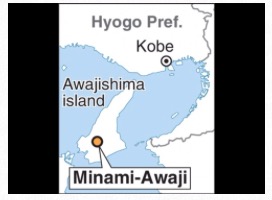

Nishisanjodai, the name of Fujiwara no Yoshimi’s residence, was also called “Hyakkatei” (One hundred flower pavilion) where Emperor Seiwa is believed to have hosted a cherry flower banquet. Yoshihiro Marukawa, a senior official of the research institute said, “It becomes clear that (Fujiwara no Yoshimi) had major power. Based on the analysis of the artifacts, it is believed to have been built in the latter half of the 9th century, which coincided with the declining period of the Yoshimi family.”

Retellings of “Chushingura” the familiar of classic tale of revenge that ranks among the most familiar of all stories in Japan, still popular today

The raid by the 47 "ronin" is enacted every year in Ako, Hyogo Prefecture, the home of Asano Takuminokami, and other locations across the nation. (Yoshiaki Arai)

The raid by the 47 “ronin” is enacted every year in Ako, Hyogo Prefecture, the home of Asano Takuminokami, and other locations across the nation. (Yoshiaki Arai)

photo

A woodblock print by Utagawa Kuniyasu (1794-1832) depicting the raid by the 47 “ronin.” (Satoshi Akahane)

Source: “Chushingura” may be 97% fiction, but it ranks highly for aesthetic sensitivity (Asahi, Dec 13, 2011)

It’s that time of year again for “Chushingura,” a fictionalized telling of a classic tale of revenge that ranks among the most familiar of all stories in Japan. Even though we know the story from start to finish, it has managed to endure and fascinate for more than 300 years.

To find out the historical basis and popular appeal of Chushingura, read this Introduction to Chushingura as well as “Chushingura: Loyalty that never goes out of style“. Read more of the article at AJW.

Other good resources include: Chushingura and the Samurai TraditionChushingura: The Treasury of Loyal Retainers (book in print) by Izumo Takeda et al.

A particular recommended resource lesson guide for studying Chushingura is the EDsitement lesson, “Hamlet meets Chushingura: Traditions of the Revenge Tragedy

The text of Kanadehon Chushingura by Takeda Izumo, Miyoshi Shoraku, and Namiki Senryu may be read online here.

You may take tours of Japanese woodblock and other art on Chushingura or watch online the trailer (in Japanese only) for Kanadehon Chushingura by the Japan Arts Council here.