
Who was Queen Himiko?
Queen Himiko was the queen of Yamatai kingdom or “country” (or state) who symbolized the unity of the Yayoi people.
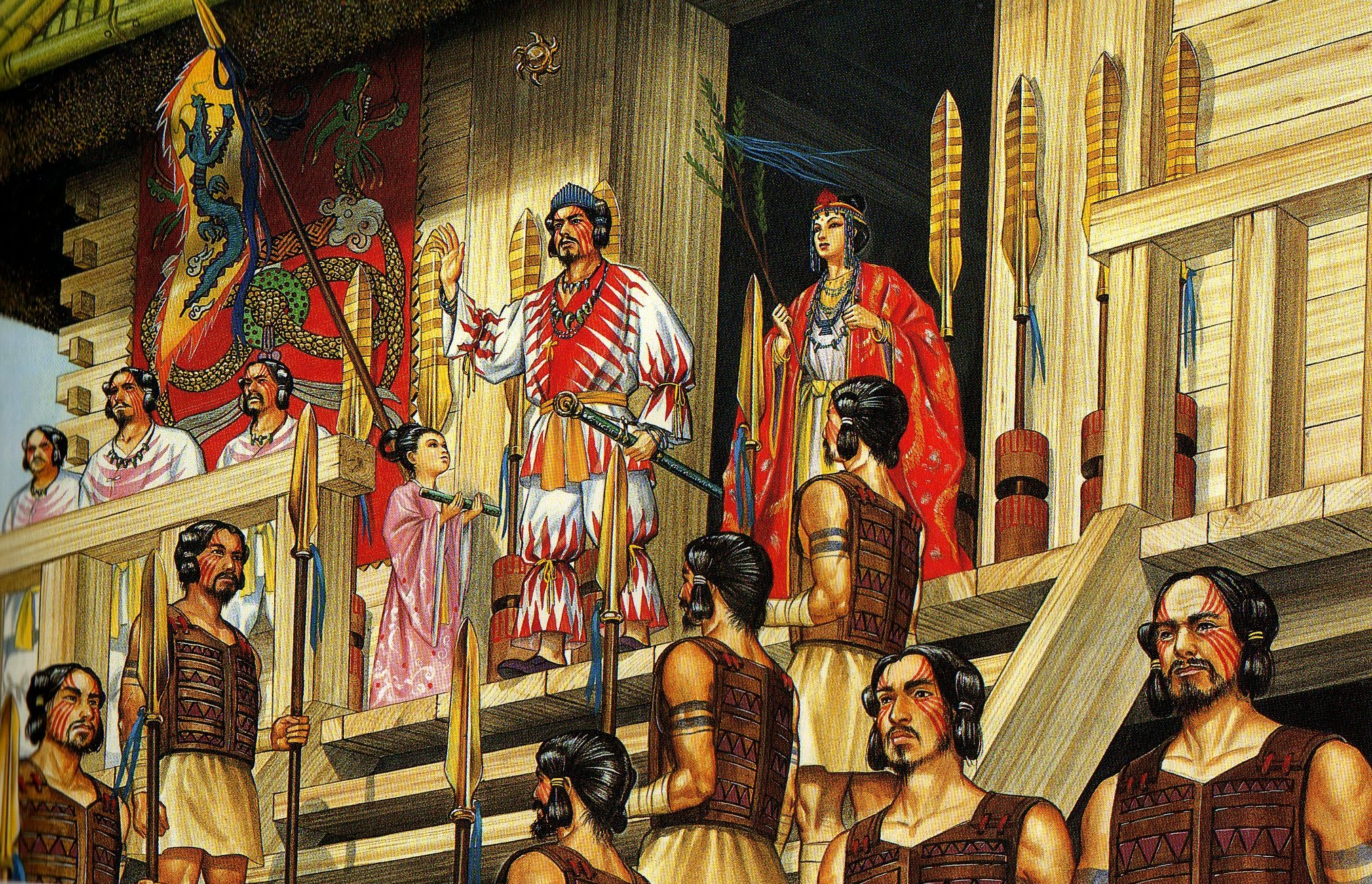
Yamatai kingdom’s Queen Himiko (Illustration copyright: Newton Graphic Science Magazine “Nihon no ruutsu”)
Earlier Chinese ca. 432 CE Hou Han Shu (Book of Later/Eastern Han) accounts had described the land of Wa (Japan) as such:
“In the middle of the Lo-lang sea there are the Wa people. They are subdivided into more than a hundred ‘countries'[called communities in some translations]. Depending on the season they come and offer tribute”.
Thirty of these countries were known to have had direct contact with China. Historians equate these “countries” with chiefdoms.
The Chinese Wei Zhi accounts in 297 A.D. asserted that Yamatai kingdom was the strongest of those countries. Yamatai country was victorious after years of warfare. Gishi no Wajinden noted decades of warfare had ensued until “the people agreed upon a woman for their ruler”, i.e. when Queen Himiko came to the throne. Towards the end of 2nd century, around 30 small chiefdoms had allied with each other to form a confederated kingdom or state known as “Yamatai country” (Yamatai koku) with Queen Himiko at the helm.
Queen Himiko was known to the Chinese because her government had sent a diplomatic mission in the year 238 A.D. to the Wei emperor, Cao Rui’s court, and the delegation was received as presenting tribute to the Chinese emperor. As such, Queen Himiko was recognized as the ruler of Wa :
“Herein we address Himiko (Pimiko is used), Queen of Wa, whom we now officially call a friend of Wei … [Your ambassadors] have arrived here with your tribute, consisting of four male slaves and six female slaves, together with two pieces of cloth with designs, each twenty feet in length. You live very far away across the sea; yet you have sent an embassy with tribute. Your loyalty and filial piety we appreciate exceedingly. We confer upon you, therefore, the title “Queen of Wa Friendly to Wei”.”
Queen Himiko may have held the ceremonial role of a shaman priestess, prophetess or perhaps, a pre-eminent shrine maiden with proxy access to the gods for the people. Gishi no Wajinden described her as a having “occupied herself with magic and sorcery, bewitching the people”. Shrouded in mystery, Queen Himiko was said to have controlled the kingdoms by sorcery and magic. She was seldom seen in public and was attended by “one thousand attendants, but only one man”.
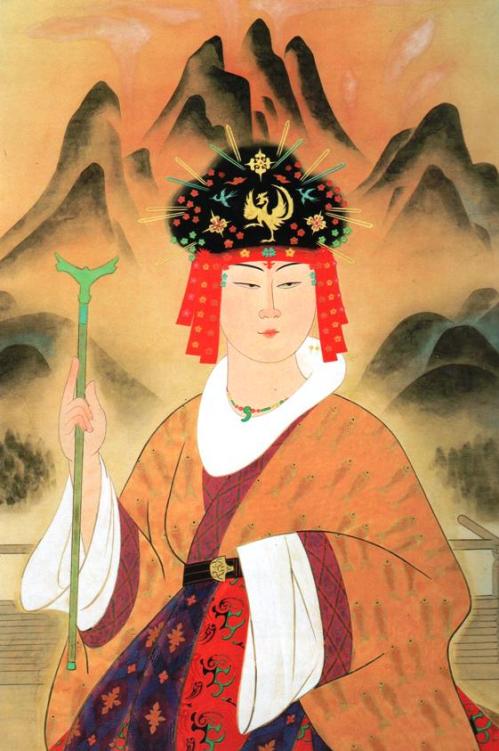
Queen of Yamataikoku Classical portrait painting by Yasuda Yukihiko Source: Wikipedia
Although Queen Himiko left the execution of the affairs of state to her younger brother, Queen Himiko very likely held actual power in addition to her ceremonial and religious role. She was guarded by a large army and the Chinese thought of her as a ruler with extraordinary power.
Yamatai kingdom prospered under Queen Himiko’s rule and was observed in the Gishi no Wajinden records to have had more than seventy thousand households, well-organized laws and taxation system and thriving trade. Her people were noted to have been mainly gentle and peace-loving.
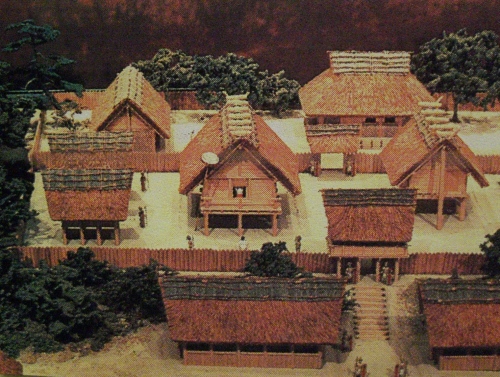
Yamatai, Himiko’s headquarters, model by Osaka Prefectural Museum of Yayoi Culture
The Wajinden records that 29 different kuni or “countries” existed and that three of these were ruled by “kings”. One of them was Ito where “there have been kings for generations, subject to the queen’s kuni [Yama’ichi] they rule”. Experts have identified Ito to be Itoshima peninsula and the Hirabaru mound site is thought to contain the grave of Ito‘s king or queen (because it contained 39 bronze mirrors and other rich burial grave goods associated with rulers of the highest order). The Wajinden also hints to us how Himiko ruled:
” high [ranking] Wa are sent to inspect [the trade of the different kuni]. A high leader was especially sent to to the region] north of the queen’s land. He inspects all the kuni there. Regularly he rules in Ito.”
Thus Ito held an important role in international relations.
During her reign, Queen Himiko sent envoys to Gi to limit the influence of a rival power, the “king” of Kunu whose country of Kuna (Kuna no Koku) lay to the south of Wa. In 239 A.D., an emperor of Gi granted the Yamatai kingdom a honorable title “Sin Gi Wa O” along with a gift of 100 bronze mirrors. By 247 A.D. Queen Himiko’s realm and that of the country of Kuna were at odds, but the outcome of that conflict is not known, only that she sought Chinese imperial support and that she died likely in the year following that.
When Queen Himiko died, her people constructed a large burial mound (about 100 meters in diameter) for her. One thousand female and male attendants were sacrificed for burial along with their queen. She had lived between A.D. 183 and 248 without having ever married.
Upon her death, the male ruler who took her place did not last long and the chiefdoms fell into disunity and fighting. “Assassination and murder followed; more than one thousand were thus slain” according to Gishi no Wajinden. When Iyo, a 13-year old girl related to Himiko was placed on the throne, peace was restored and the fighting ended.
The location of Yamatai kingdom (as well as that of the burial mound of Queen Himiko) remains a mystery and is the subject of a huge academic controversy as to whether northern Kyushu or Kinai had been the actual headquarters of Queen Himiko.
Further reading: The Yamatai Puzzle: Where were Himiko’s headquarters?
***
Sources and references:
The Chronicles of Wa | Gishiwajinden by Wes Injerd
Wa (Japan), Wikipedia
“第59回 交易の民アイヌ Ⅶ 元との戦い” (in Japanese). Asahikawa City. June 2, 2010.
Excerpts from the History of the Kingdom of Wei Columbia University‘s Primary Source Document Asia for Educators
Could the Hashihaka burial mound in Sakurai, Nara be Queen Himiko’s? (Heritage of Japan)
Dig in Nara, not Kyushu, yields palatial ruins possibly of Himiko (Japan Times, Nov 12, 2009)
The Cambridge History of Japan, Volume 1 edited by Delmer M. Brown
Himiko and Japan’s Elusive Chiefdom of Yamatai: Archaeology, History and Mythology by J. Edward Kidder, Jr.
State Formation in Japan: Emergence of a 4th-Century Ruling Elite by Gina Lee Barnes pp. 104-128. Barnes does a detailed job examining the different types of mounded/moated and various types of tombs of the 3rd- 4th centuries, the correlation with pottery types, with a focus on the excavations and artefacts from the Hirabaru mound and the Hokenoyama and Hashihaka tomb mounds in the Makimuku tomb cluster mounds. In so doing, she evinces a conclusion from the evolution of tomb forms and by deriving a general picture of social interaction patterns and the state of power relations by analyzing the trade missions and relations as well as tomb structures, material wealth and grave goods available to ruling powers of the time.
Sources of Japanese Tradition: Volume 1: From Earliest Times to 1600 by William Theodore De Bary, Yoshiko Kurata Dykstra
 Heritage of Japan
it was kool…
Women are close to divinity!
Himiko, Princess Yamatototohimomosohime (倭迹迹日百襲媛命), buried in Hashihaka tumulus, and her father Emperor Korei might have been Altaian Katun river Group called Katuragi comprising Tubulars, Kumandins, Swan Tribe, Yuezhi
http://en.wikipedia.org/wiki/Emperor_K%C5%8Drei
Korei’s progeny lived in underhill of mount Kongo. One of the famous clan of this progeny Tubura. There is a dance called Tuburosashi in Sado island, pref. Niigata、remniscent of unique Kumandin custom. http://www.kt.rim.or.jp/~sokohaka/chin-man/tuburo01.html
One of the shrines in pref. Izumo keep a legend of landing of Yuezhi worriors ashore.
Altaian Tatun tribe is named Japanese Katuragi tribe. Because consonant “n” is interchangeable with consonant “r” in Korean and Japanese. By Sinocentrism, they are mainly Beidi, having some Xirong elements in the southwest and some Dongyi elements in the east which was the Transbaikal deer herder, plitochniki or slab stone culture tribe.
Corret spelling – Katun. Sorry.
In sinocentrism term, Jimmu’s bird totem is of Nanmang. When you deem paleo-Qiangic haplogroup as Xirong, we can say all of 4 barbarians, Dongyi, Beidi, Xirong and Nanmang have gathered together to Join Jomon to form Yamato.
After 4 centuries of this Altaian progeny rule, the court was changed to Transbaikal Deer Herders progeny, which continues until now.
http://en.wikipedia.org/wiki/Fujiwara_clan
However, this haplogroup shared by Tuvans, Tofalars, Buryats, Yakuts N1c1-M178 is near extinction in Japan like the aboriginese Ainu, comprising only 0.4% of the population.http://64.40.115.138/file/lu/6/52235/NTIyMzV9K3szNTg2MTk=.jpg?download=1

http://en.wikipedia.org/wiki/Uriankhai
May be the progeny of glorius Priestess Shaman Queen Himiko are now flying above us like lines of migrant birds, following the firebird.
CARAVAN, JOURNEY IN THE SKY
AS THE SUN COMES OUT FROM THE DAY
Yayoi ended as bronze bells changed to bronze mirrors in Yamato.
Spouse of the founder of imperial house Jimmu is set forth in chronicle as was from one of the bronze bell manufacturing center in Osaka around 200 AD.
http://en.wikipedia.org/wiki/Emperor_Jimmu
So Jimmu and subsequent 4 emperors should not have known what bronze bells were about.
According to the chronicle, Jimmu was heavily wrapped in bird totem culture, quite different from Korei’s.
Without Jimmu’s baptism, there would have been no Himiko at all. There is a smaller archaic tumulus Hokenoyama, to which Himiko’s big one is directed. This may be perhaps the Jimmu’s.
While marching along a ridge from Kumano to Yamato, the chronicle says that an ibex holding a shining in 8 beams crow guided Jimmu troop.
This suggests altaians helped Jimmu in his taking power over Yamato. 8-beam crow is suggestive of a hereksur, symbolizing the sun.
Accordingly, this
http://en.wikipedia.org/wiki/Hakk%C5%8D_ichiu
should be interpreted nothing more than sun worship hereksur way of thinking.
The chronicle says this ibex with crow is the ancestor of Duck tribe, the founder of duck shrines in Yamato and Kyoto, the Kamo clan.
Yamatai was an Ainu state. The word Yamatai is word of Ainu origin. It consists of the following morphemes: ya ‘dry land’ + ma ‘a bay that deeply cuts the land’ + ta ‘to cut’ + i ‘place’ – ‘a place where land is deeply cut by a bay’. It’s a tipical Ainu toponym describing some characteristic features of a certain place. Such a place is sitiated in Kyushu in Fukuoka prefecture: http://i40.tinypic.com/2093i8p.jpg
Himiko/Pimiko is Ainu name Pi-mik-kwr [pi-mik-kur]. It’s a typical aristocratic Ainu name ends with formant ‘kwr’ – ‘a noble person’. Pi means ‘to solve problems’ and mik means ‘to cry loudly’ or ‘to bark’.
Pingback: A rejtélyes Himiko és országa – 1. rész | Shinwa-eiyuu
i want to know if she created anything
The only reason I got interested in this was cause I played the 2013 Tomb Raider game and she was one of the characters in it.
Who is the first (?) king Japan came from outside in ancient time, who also carries Aryan blood? Please reply.
Well, who were the Aryans? The identity and homeland of the legendary Aryans is contentious, but we can more or less pinpoint key early horserider-warrior culture out of Anatolia, Iran, or more recently popular are non-Aryan/Iranic origins of the Aryan culture, see here: i.e. favoring a homeland more towards E. Europe and the Pontic-Caspian steppes(D.Anthony) and Kygyrz Central Asia. I won’t go into the controversial debate but just look at the question of how far east did they get in Eurasia? There’s Underhill’s ‘Out-of-Iran’ view, and the Near Eastern origin view and there’s Anatole Klyosov’s “DNA Genealogy and Linguistics. Ancient Europe” as well as her article on R1b, because the trail to the East is latter is easier to see, we will follow this trail:
Two of them, R1a and R1b, descended from the R1 haplogroup, which is shown in Figure 1. R1a is the group, conditionally called the Aryans, which em- braces about 50% of the current population of Eastern Europe. This group has the same DNA as the legendary Aryans, who arrived to India around 3500 ybp. Currently, approximately 72% of the some upper Indian castes belong to the R1a haplogroup (Sharma et al., 2009).
“Haplogroup R1a apparently arose about 20,000 ybp (Klyosov & Rozhanskii, 2012b) in central Asia and possibly in the southern Siberia region of the Altai Mountains. Its ancient sub- clade M17 is observed in north China (Klyosov, 2009). R1a bearers migrated from central Asia across Tibet, Hindustan, the Iranian Plateau, and Anatolia between 12,000 and 10,000 ybp. Their downstream subclade, M417, crossed Asia Minor and entered the Balkans between 10,000 and 8000 ybp.”
The furthest the Aryan trail (if you equate R1a with Aryan genes) seems to make it to, in any numbers is to north China, and then according to other data, to Cambodia. And in Japan, it is only R1b1b1 in insignificant trace amounts, see Genebased.com’s map. story_fbid=1441649302748446&id=1441606772752699
According to Genebased.com data (Learning Center :: Genebase Tutorials, Figure 1 the page seems to have moved), there is only trace presence in Japan of the Aryan?Turkic-Mongol-Altaic? warring horseman culture.
We have no R1a or R1b dna from the Kofun period kurgan tumuli as yet, because the largest and most elite tombs are considered to belong to the royal family who, according to archaeologists, have largely not allowed the tombs to be excavated. Most of the DNA to come out of Japan during the period is consistently Northeast Asian-Tungusic(Baikalian/Buryat-origined) or North Chinese/Korean-Tungusic-Altaic.
This is a short summary of Anatole Klyosov’s thesis:
1) R1a and R1b are both from Alta�
2) 12.000 years ago R1a migrated and arrived in Balkans
3) Between 6.000 and 8.000 years ago R1b migrated westward from Alta� and arrived in the north of Black Sea. This R1b migration produced the cultures of Samara, Khvalynsk and Yamnaya
4) From here, 2 R1b migrations: the first one to Balkans and Italy and brings R1b-ht35 in Europe, the second one to Caucasus, Near East, North Africa and Iberia. Then R1b-ht15 spreads in occidental Europe with Bell Beaker culture.
5) R1a migrated to North Europe and produced the Corded Ware culture, then he went eastward to the Steppe between 5.000 or 4.000 years ago and produced the culture of Andronovo. Then R1a spread to Iran and India.
Anatole Klyosov thinks that R1a spoke proto IE language and R1b spoke proto turkic language. He doesn’t agree with Kurgan hypothesis. He sees that R1b migrated from east to west and that R1a migrated from west to east.
Although there is no significant R hg presence, on the mtDNA side, there is a great deal of hg C and D, which indicates perhaps the kurgan pastoral nomadic cultural diffusion and influence from the Altaic Mongolic tribes who lived close to the Turkic ones, or else who descended from the Proto-Mongoloids before they split to go west and east. I will take an open and equivocal position on these scenarios.
According to other DNA studies, in terms of affinity with North Asian or NEAS genetic component(apart from its Korean lineages), the Japanese are closest to the Khalk Mongolians (see Yoshio Tateno, 2014), other work suggest affinities to Xiongnu or Hunnu and Chandman Egyiin Gol DNA.
I should add that what is even more intriguing perhaps, is the E. Eurasian genetic component N9a, M9,10 sequences)arriving from the opposite direction, from Korea and Japan even, and detected in E. Europe, in the Koros Culture (another study dates the excavation to the later Sarmatian, 1st-4th AD period), see Derenko’s study on rare E.Eurasian haplogroups found in N. Asian populations.
A further note to the above. Examining the prevalence and types of viruses can help corroborate the data analysis from Y and mtDNA and help confirm regional contacts, affinities or origins.
JC virus analysis of Iranian population (see “Prevalence and Distribution of BK virus Subtypes in Renal Transplant Recipients Referred to Golestan Hospital in Ahvaz, Iran” http://jjmicrobiol.com/42000.pdf) shows a moderate presence of JC viruses which are common to East Asia(The rate is 85 to 97 percent in Brazil and Japan) and the Americas, but no genotyping of the virus yet so it is not possible to point to exact location. BK virus studies on the other hand, appear to show that that Iranians of the Southeast possess high incidence of subtype I of BK virus (http://www.maedica.org/articles/2012/1/2012_Vol7%2810%29_No1_pg10-13.pdf), but moderate amounts of BK virus of the subtype IV which can be linked to Mongolian populations (who have the highest frequency of this haplotype while Iranians have a moderate amount of it), and to a lesser extent, to Northeast China, Vietnam. Japanese and SE Asias are subtype I mostly) So we see some kind of link in Iranian populations back to E. Eurasia – what might you infer from this, I don’t know, but my guess is that it points some contact with lineages from the east in the ancient or medieval past, on account of either the proto-Hun or Mongol invasion (in the vein of John Man’s theories “Attila the Hun” or “Genghis Khan”)
I heard of this while playing a tomb raider game lol
I came here whilst playing ” tomb raider 2013″. Go play it and get a good view of the island nd its architecture. Its worthy.
I think Hollywood is about to release tomb raider reboot very soon.
Pingback: Tomb Raider China Publishes 3-Part Article on the Wei Mirror – The Archaeology of Tomb Raider
I love your work good job🐦😇😅
Hi i am currently searching about the himiko queen and i still need some answers to my questions so if anyone one could help me with some books to read or articles plz send me thank you so much
I believe Himiko’s grave was found in the 1950’s as they uncovered a grave with brass mirrors….
It’s so interesting. I always wanted to travel to places like these. I can sense something islandish, and ankor wats like. I even played the game tomb raider reboot. Just can’t get enough of it. I wish I could read Japanese and Chinese languages so that I could explore more about the history of Asia. If someday I get to visit Yamatai island, I would love to put a blog about it on my website
Pingback: Himiko, a guarda do trovão e o Yamatai em Tomb Raider. O maior debate da história antiga do Japão – Vida de Colecionador
Pingback: Himiko, a guarda do trovão e o Yamatai em Tomb Raider. O maior debate da história antiga do Japão – Tankyū
Pingback: Japan’s Ancient Queens: Himiko and Iyo – Sareh Lovasen
Pingback: The Yayoi Period | Story of Shiatsu
Pingback: The Rise of Yamatai | Story of Shiatsu
Pingback: Himiko